

Scrub Euphonia vs Yellow-throated Euphonia
Euphonia affinis versus Euphonia hirundinacea
Play a quiz with Scrub Euphonia and Yellow-throated Euphonia
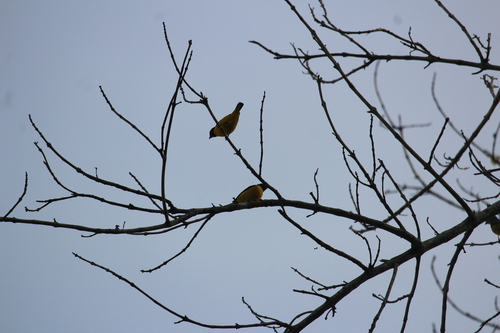 Scrub Euphonia
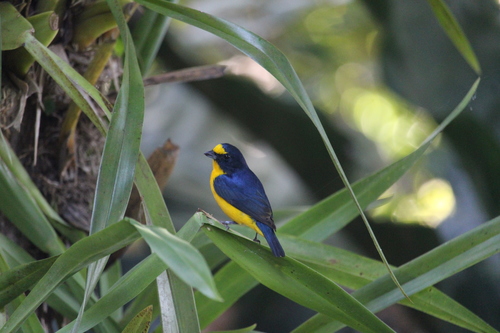 Yellow-throated Euphonia
In short
The most reliable field mark for separating Scrub Euphonia and Yellow-throated Euphonia is the color and extent of the throat and underparts in both sexes, especially the female: female Yellow-throated Euphonia shows a whitish to pale gray throat and belly, while female Scrub Euphonia is olive-yellow throughout below. Adult males are trickier, but the yellow on the forehead of Scrub Euphonia is smaller and does not reach past the eye, while in Yellow-throated Euphonia it extends to about mid-eye. In flight, both species show white in the tail, but Yellow-throated Euphonia has a more obvious white oval on the underwing. Size is also a clue: Yellow-throated is noticeably heavier and slightly longer. Immature birds are best separated by the color of the throat and belly, with Yellow-throated showing paler central underparts as soon as yellow appears.
Identification tips
- Female underparts: Female Yellow-throated Euphonia has a whitish to pale gray throat and belly, sharply contrasting with yellowish-olive flanks; female Scrub Euphonia is olive-yellow throughout below. This is the single most reliable mark for separating females and immatures.
- Male forehead patch: The yellow forehead patch on male Scrub Euphonia is small and does not reach past the eye; on Yellow-throated Euphonia it extends to about the middle of the eye. Use this mark in good light and close views.
- Male undertail coverts: Adult male Scrub Euphonia has yellow undertail coverts; Yellow-throated male has dull gray undertail coverts. This is subtle and may be hard to see unless the bird is perched and fluffed.
- Underwing pattern in flight: Yellow-throated Euphonia shows a large, white, oval-shaped area on the underwing from the inner webs of the outer tail feathers and white underwing coverts; Scrub Euphonia has white only on the inner webs of the outer two tail feathers, less extensive and less obvious in flight. This is best seen in birds flying overhead or when preening.
- Immature/juvenile males: Immature male Yellow-throated Euphonia develops a pale (whitish) throat and belly before the black mask and blue-black upperparts appear, while Scrub Euphonia immatures remain olive-yellow below. If you see a young bird with a pale throat and belly, it's Yellow-throated.
- Bill and structure: Both species have short, stubby bills, but Yellow-throated Euphonia is slightly larger and heavier overall. This is a supporting mark rather than a primary one.
- Size: Yellow-throated Euphonia is heavier (14 g vs. 10 g) and slightly longer (10–12 cm vs. 10 cm), but this is only obvious in direct comparison or with experience.
- Male upperparts: Both adult males have glossy blue-black upperparts, but this is not helpful for separation; focus on the forehead patch and undertail coverts instead.
- Female upperparts: Female Yellow-throated has a faint metallic gloss on the olive-green upperparts; Scrub Euphonia female is more uniformly olive with a gray tinge on the back. This is subtle and not always reliable.
- Vocalizations: Calls and songs are similar—high-pitched, thin, and twittering—but Yellow-throated's calls are more varied and sometimes rough or chaffy. Use voice only as a supporting clue unless you are very familiar with both species.
- Habitat: Both species overlap widely in habitat and range, so do not rely on location alone for identification.
- Tail pattern in flight: Both species show white in the outer tail feathers, but Yellow-throated's is more extensive and forms a larger white area on the underwing; Scrub Euphonia's is more limited.
- Context with other euphonias: Female Yellow-throated is unique in the region for its pale throat and belly; other local euphonias, including female Scrub, are yellow or olive-yellow below. If you see a female euphonia with a pale belly, it's Yellow-throated.
- Seasonality: No strong seasonal plumage differences are noted for either species; all key marks apply year-round.
- Pitfalls: Beware of immature Yellow-throated males, which can look like females but will show a pale throat and belly as they mature. Scrub Euphonia immatures never show this pale central underpart.
Size
Yellow-throated Euphonia is distinctly larger and heavier, averaging about 14 g versus 10 g for Scrub Euphonia. Both are short-tailed and compact, but Yellow-throated is slightly longer (10–12 cm vs. 10 cm) and has a heavier, more robust look, especially in direct comparison. This difference is subtle in the field unless both species are side by side, but can be helpful if you get a good look at proportions or see them together at a fruiting tree.
Plumage
- Females: Female Yellow-throated Euphonia is unique among local euphonias in having a whitish to pale gray throat, center of breast, and belly, with yellowish-olive flanks. Female Scrub Euphonia is olive-yellow throughout the underparts, lacking any pale or whitish area below.
- Adult males: Both have glossy blue-black upperparts and a yellow forehead, but the yellow patch on Scrub Euphonia is smaller, not reaching past the eye, while on Yellow-throated it extends to about mid-eye. Underparts are yellow in both, but Scrub Euphonia's undertail coverts are yellow, while Yellow-throated's are dull gray. Underwing coverts are white in Yellow-throated, and the underwing in flight shows a large white oval from the inner webs of the outer tail feathers; Scrub Euphonia also has white in the tail, but the underwing pattern is less extensive.
- Immatures/Juveniles: Both start out resembling females, but as Yellow-throated males mature, they develop a pale (whitish) throat and belly before the black mask and blue-black upperparts appear. Scrub Euphonia immatures remain olive-yellow below. This makes the pale throat and belly a strong mark for Yellow-throated at all ages except adult male Scrub Euphonia, which never shows it.
Behaviour
Both species are arboreal, often foraging in pairs or small groups, and can be seen at forest edges, plantations, and open woodlands. There are no strong behavioral differences noted in the sources that are reliable for field separation. Both species tend to be active and can be confiding, often feeding on mistletoe berries and other small fruits.
Habitat
Both species overlap in much of their range from Mexico through Central America, and both use a variety of habitats including forest edge, open woodland, and shaded plantations. Yellow-throated Euphonia occurs from southeastern Mexico to western Panama, while Scrub Euphonia ranges from Mexico to Costa Rica. There is considerable overlap, so habitat alone is not diagnostic, but Scrub Euphonia may be more common in drier, more open habitats, and Yellow-throated is often found in both humid and dry regions.
Voice
Both species have high-pitched, thin calls and weak, twittering songs. Scrub Euphonia gives 1–3 pure whistles ("dee-dee-dee"), sometimes followed by more notes, and a weak, twittering medley. Yellow-throated Euphonia's calls are more varied and described as short, explosive, and sometimes rough or chaffy, with phrases like "pidgel-eece" and "chi-bib-bib-bib-bib." The song of Yellow-throated is choppy and can include mimicked notes, but its repertoire is smaller than some relatives. In practice, the differences are subtle and not always reliable for field separation unless you are very familiar with both species.