

Scarlet-chested Sunbird vs White-bellied Sunbird
Chalcomitra senegalensis versus Cinnyris talatala
Play a quiz with Scarlet-chested Sunbird and White-bellied Sunbird
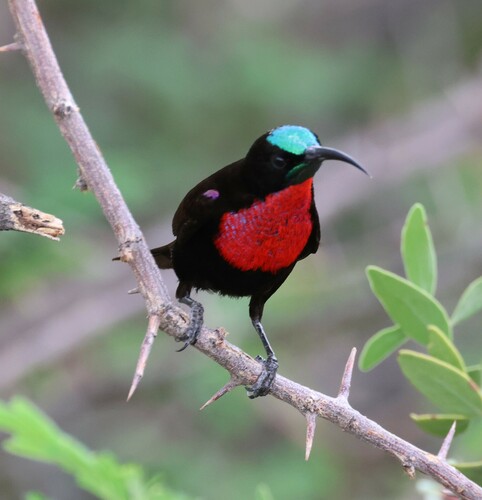 Scarlet-chested Sunbird
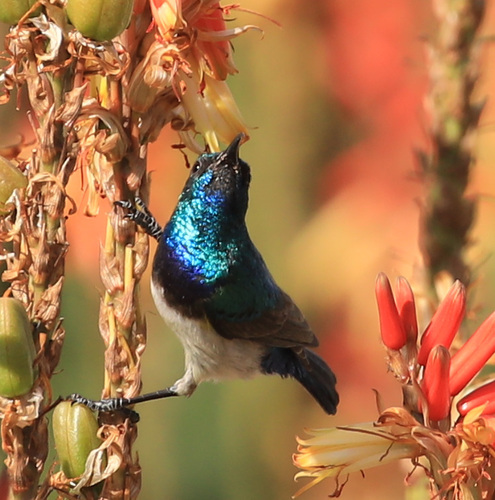 White-bellied Sunbird
In short
The most reliable field mark to separate Scarlet-chested Sunbird from White-bellied Sunbird is the male's vivid scarlet breast (Scarlet-chested) versus the white belly (White-bellied). Females are trickier, but Scarlet-chested females are uniformly dark brown below with no pale belly or supercilium, while White-bellied females show a contrasting pale or whitish belly. Both species overlap in much of southern Africa and can be found in gardens and woodland, so careful attention to underpart color and head pattern is essential. Size is not a strong separator in the field, but Scarlet-chested is generally slightly larger and heavier. Immature and non-breeding birds are best separated by underpart contrast, as neither species has distinctive juvenile wing patterns described in the sources.
Identification tips
- Male underparts: The most obvious field mark is the male's breast: Scarlet-chested Sunbird has a vivid scarlet breast, while White-bellied Sunbird has a white belly with no red.
- Male head: Scarlet-chested males show an iridescent green patch on the crown, which White-bellied lacks. Look for this in good light.
- Female underparts: Female Scarlet-chested Sunbirds are dark brown below with no pale belly, while White-bellied females have a pale or whitish belly that contrasts with darker upperparts.
- Supercilium (eyebrow): Female Scarlet-chested lacks any supercilium, while White-bellied females may show a faint pale eyebrow, helpful at close range.
- Immature birds: Juvenile and immature Scarlet-chested Sunbirds remain dark below, while White-bellied immatures show a paler belly. Use this mark if the bird lacks adult male colors.
- Upperwing pattern: No distinctive juvenile or immature wing patterns are described for either species, so do not rely on upperwing marks in flight.
- Size: Scarlet-chested is slightly larger and heavier, but this is subtle and not reliable unless birds are side by side.
- Bill and structure: No strong differences are noted in the sources; both have typical sunbird bills and proportions.
- Habitat: Both species use woodland and gardens, so context is not a reliable separator in overlapping areas.
- Behavior: Both species feed on nectar and join mixed flocks; White-bellied is noted for aerial insect hawking in late afternoon, but this is not diagnostic.
- Voice: No distinguishing vocalizations are described in the sources; do not rely on song or call for separation.
- Pitfalls: Female and immature Scarlet-chested Sunbirds are often mistaken for White-bellied due to their plain appearance, but always check for the presence or absence of a pale belly and supercilium.
- Lighting: Iridescent colors (scarlet breast, green crown) on Scarlet-chested males can be dull or invisible in poor light; confirm with underpart color if in doubt.
- Range: Both species overlap widely in southern Africa, so do not assume ID based on location alone.
- Season: No strong seasonal plumage differences are described for either species; use the same marks year-round.
Size
Scarlet-chested Sunbird is the larger of the two, measuring about 13–15 cm in length and weighing 7.5–17.2 g for males (females 6.8–15.3 g) [wikipedia]. White-bellied Sunbird is smaller and lighter, but precise measurements are not given in the notes. In the field, this size difference is subtle and not always reliable, especially when birds are not side by side. Structure and jizz may overlap, so size should only be used as a supporting clue.
Plumage
- Adult males: Scarlet-chested Sunbird males have a brilliant scarlet breast and an iridescent green crown patch. White-bellied Sunbird males have a white belly and lack the extensive scarlet, instead showing metallic green upperparts and a dark throat with a clear white belly.
- Adult females: Scarlet-chested females are dark brown overall with no pale belly or supercilium. White-bellied females have a distinctly pale or whitish belly that contrasts with darker upperparts and a faint supercilium may be present.
- Immature/juvenile birds: No distinctive upperwing or flight pattern differences are described for either species in the sources. Separation relies on underpart color: Scarlet-chested immatures remain dark below, while White-bellied immatures show a paler belly.
- In flight: No age-specific wing pattern marks (such as panels, trailing edges, or W marks) are noted for either species.
Behaviour
Both species are active nectar feeders and may join mixed-species flocks at flowering trees. White-bellied Sunbird is noted for hawking insects in the late afternoon and gleaning invertebrates from foliage. Scarlet-chested Sunbird's foraging behavior is not detailed in the notes, but both can be seen in gardens and woodland, often hovering or perching while feeding. Behavioral differences are subtle and not reliable for separation.
Habitat
Both species occur widely across southern and central Africa and are found in similar habitats: woodland, gardens, and areas with flowering plants. Scarlet-chested Sunbird is noted up to 2,400 m elevation, but there is significant overlap in range and habitat with White-bellied Sunbird. Habitat alone is not a reliable separator where both species occur.
Scarlet-chested Sunbird · White-bellied Sunbird · My Tricky Birds