

Motmot

Red-tailed Hawk vs Ferruginous Hawk

Buteo jamaicensis versus Buteo regalis

Play a quiz with Red-tailed Hawk and Ferruginous Hawk
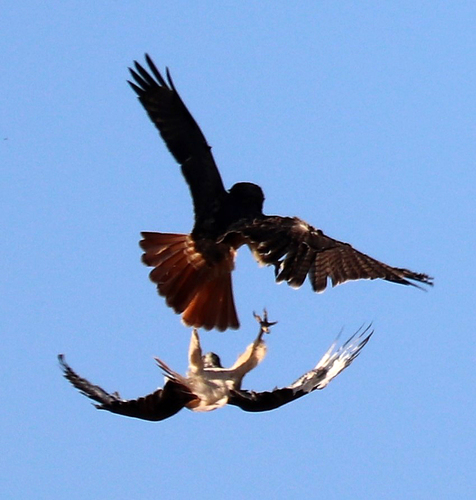
Red-tailed Hawk (Buteo jamaicensis) Red-tailed Hawk
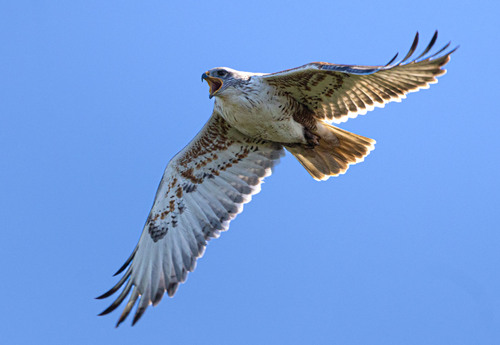
Ferruginous Hawk (Buteo regalis) Ferruginous Hawk

Media

Loading…

In short

The most reliable field mark to separate Red-tailed Hawk from Ferruginous Hawk is the tail: adult Red-tailed Hawks show a brick-red tail with a single dark band, while Ferruginous Hawks always have a pale tail with no red tones and often a whitish base. In flight, Ferruginous Hawks display prominent pale 'windows' in the primaries and a rufous patch on the upperwing, which Red-tailed Hawks lack. Juvenile Red-tailed Hawks have brown, banded tails and a dark belly band, while Ferruginous Hawks show a white underbody with a 'V' of dark feathering at the legs. Structurally, Ferruginous Hawks are longer-winged and have feathered legs to the toes, unlike the bare-legged Red-tailed. Both species can appear bulky perched, but Ferruginous is even larger and longer-winged. Habitat and range overlap in open country, but Red-tailed is much more widespread and tolerant of human-modified landscapes.

Identification tips

  1. Tail color (adult): Red-tailed Hawk adults have a brick-red tail with a single dark band; Ferruginous Hawk always has a pale tail, never red, often with a whitish base. This is the single most reliable mark for adults.
  2. Tail pattern (juvenile): Juvenile Red-tailed Hawks have brown tails with multiple (about six) dark bands; Ferruginous Hawk juveniles have pale tails with little or no banding.
  3. Underwing pattern (in flight): Ferruginous Hawk shows three pale 'windows' on the upperwing (two in the primaries, one rufous patch at the base) and a mostly pale underwing with rufous patagial smudges and dark 'comma' marks at the wrists. Red-tailed Hawk lacks these windows and instead has dark patagial bars and a more uniform underwing.
  4. Belly markings: Red-tailed Hawk typically shows a dark, horizontal belly band (especially in light morphs and juveniles); Ferruginous Hawk has a clean white underbody with a 'V' of dark feathering at the thighs.
  5. Leg feathering: Ferruginous Hawk has feathered legs all the way to the toes (like a Rough-legged Hawk); Red-tailed Hawk has bare yellow legs below the tibiotarsal joint.
  6. Head pattern: Ferruginous Hawk has a white head with a dark streak behind the eye; Red-tailed Hawk usually has a brownish head with no strong eye streak.
  7. Wing shape and length: Ferruginous Hawk is longer-winged and appears more eagle-like in flight, with wings that reach or nearly reach the tail tip when perched. Red-tailed Hawk is broader-winged and more compact.
  8. Overall size and bulk: Ferruginous Hawk is larger, especially in females, and has a proportionally larger bill and feet. Red-tailed Hawk is still robust but less massive.
  9. Leg color: Red-tailed Hawk has yellow legs and cere; Ferruginous Hawk's legs are feathered and not visibly yellow.
  10. Flight style: Ferruginous Hawk soars with wings in a slight dihedral and appears more buoyant; Red-tailed Hawk soars with broad, flat wings and a more labored flight.
  11. Habitat: Red-tailed Hawk is common in almost any open or semi-open habitat, including urban and suburban areas; Ferruginous Hawk is restricted to open grasslands and prairies, rarely near dense forest or cities.
  12. Perch choice: Red-tailed Hawks often perch on utility poles, fenceposts, and trees in a wide variety of settings; Ferruginous Hawks prefer open country perches and are less likely near human activity.
  13. Plumage variability: Red-tailed Hawk is highly variable, especially in the West, with light, dark, and intermediate morphs; Ferruginous Hawk is less variable, and even dark morphs retain pale tail and leg feathering.
  14. Iris color: Young Red-tailed Hawks have yellowish irises that darken with age; Ferruginous Hawk iris color is not a strong field mark.
  15. Confusion with Rough-legged Hawk: Ferruginous Hawk shares feathered legs with Rough-legged, but is much larger and bulkier, with a pale tail and rufous upperwing patch; Red-tailed Hawk lacks feathered legs and has a red or banded tail.

Size

Ferruginous Hawk is the larger and longer-winged of the two, with a noticeably longer wing chord (415–477 mm) and the largest, most robust feet among Buteos. Red-tailed Hawk is still a large, heavy Buteo, but is generally shorter-winged and more blocky in silhouette. Both sexes of both species overlap in size, but Ferruginous females are especially large. In the field, Ferruginous often appears more eagle-like, with a longer, broader wing and a proportionally larger head and bill.

Plumage

Juvenile and immature Red-tailed Hawks show a brown tail with multiple dark bands (about six), a pale underbelly with a dark, horizontal belly band, and variable dark spotting below. Adults have the iconic brick-red tail with a single dark band and a pale underbody with a belly band. Ferruginous Hawks, in both adult and immature plumages, have a pale tail (never red), white underparts, and a distinctive 'V' of dark feathering at the legs. In flight, Ferruginous shows three pale 'windows' on the upperwing (two in the primaries and one rufous patch at the base), and a smudgy but mostly pale underwing with rufous patagial markings and dark 'comma' marks at the wrists. Red-tailed lacks these pale wing windows and instead shows dark patagial bars and a more uniform underwing. Ferruginous has feathered legs all the way to the toes, unlike the bare yellow legs of Red-tailed. The head of Ferruginous is white with a dark eye streak, while Red-tailed usually has a brownish head. Both species are variable, but these contrasts hold across morphs.

Behaviour

Both species are broad-winged Buteos that soar frequently and hunt from perches or on the wing. Ferruginous Hawks often soar with wings in a slight dihedral and appear more eagle-like in flight due to their long wings and large size. Red-tailed Hawks soar with slightly raised wings but appear more compact and broad. Ferruginous Hawks are more likely to be seen hunting in open grassland or prairie, while Red-tailed Hawks are more adaptable and often perch along roadsides, fields, or even urban areas. Both may perch conspicuously, but Ferruginous is less tolerant of human disturbance.

Habitat

Red-tailed Hawk is extremely widespread, found in almost every North American habitat except unbroken forest and high Arctic, and is common in agricultural, urban, and suburban settings. Ferruginous Hawk is more restricted to open country, especially grasslands, prairies, and arid plains of the western interior. While their ranges overlap in the interior West, Ferruginous is much less likely in forested or heavily developed areas. If seen in a city park or along a busy highway, Red-tailed is vastly more likely.

Submit a better description

Use the same sections as the comparison. Your text is published immediately.

The most reliable field mark to separate Red-tailed Hawk from Ferruginous Hawk is the tail: adult Red-tailed Hawks show a brick-red tail with a single dark band, while Ferruginous Hawks always have a pale tail with no red tones and often a whitish base. In flight, Ferruginous Hawks display prominent pale 'windows' in the primaries and a rufous patch on the upperwing, which Red-tailed Hawks lack. Juvenile Red-tailed Hawks have brown, banded tails and a dark belly band, while Ferruginous Hawks show a white underbody with a 'V' of dark feathering at the legs. Structurally, Ferruginous Hawks are longer-winged and have feathered legs to the toes, unlike the bare-legged Red-tailed. Both species can appear bulky perched, but Ferruginous is even larger and longer-winged. Habitat and range overlap in open country, but Red-tailed is much more widespread and tolerant of human-modified landscapes.

  1. Tail color (adult): Red-tailed Hawk adults have a brick-red tail with a single dark band; Ferruginous Hawk always has a pale tail, never red, often with a whitish base. This is the single most reliable mark for adults.
  2. Tail pattern (juvenile): Juvenile Red-tailed Hawks have brown tails with multiple (about six) dark bands; Ferruginous Hawk juveniles have pale tails with little or no banding.
  3. Underwing pattern (in flight): Ferruginous Hawk shows three pale 'windows' on the upperwing (two in the primaries, one rufous patch at the base) and a mostly pale underwing with rufous patagial smudges and dark 'comma' marks at the wrists. Red-tailed Hawk lacks these windows and instead has dark patagial bars and a more uniform underwing.
  4. Belly markings: Red-tailed Hawk typically shows a dark, horizontal belly band (especially in light morphs and juveniles); Ferruginous Hawk has a clean white underbody with a 'V' of dark feathering at the thighs.
  5. Leg feathering: Ferruginous Hawk has feathered legs all the way to the toes (like a Rough-legged Hawk); Red-tailed Hawk has bare yellow legs below the tibiotarsal joint.
  6. Head pattern: Ferruginous Hawk has a white head with a dark streak behind the eye; Red-tailed Hawk usually has a brownish head with no strong eye streak.
  7. Wing shape and length: Ferruginous Hawk is longer-winged and appears more eagle-like in flight, with wings that reach or nearly reach the tail tip when perched. Red-tailed Hawk is broader-winged and more compact.
  8. Overall size and bulk: Ferruginous Hawk is larger, especially in females, and has a proportionally larger bill and feet. Red-tailed Hawk is still robust but less massive.
  9. Leg color: Red-tailed Hawk has yellow legs and cere; Ferruginous Hawk's legs are feathered and not visibly yellow.
  10. Flight style: Ferruginous Hawk soars with wings in a slight dihedral and appears more buoyant; Red-tailed Hawk soars with broad, flat wings and a more labored flight.
  11. Habitat: Red-tailed Hawk is common in almost any open or semi-open habitat, including urban and suburban areas; Ferruginous Hawk is restricted to open grasslands and prairies, rarely near dense forest or cities.
  12. Perch choice: Red-tailed Hawks often perch on utility poles, fenceposts, and trees in a wide variety of settings; Ferruginous Hawks prefer open country perches and are less likely near human activity.
  13. Plumage variability: Red-tailed Hawk is highly variable, especially in the West, with light, dark, and intermediate morphs; Ferruginous Hawk is less variable, and even dark morphs retain pale tail and leg feathering.
  14. Iris color: Young Red-tailed Hawks have yellowish irises that darken with age; Ferruginous Hawk iris color is not a strong field mark.
  15. Confusion with Rough-legged Hawk: Ferruginous Hawk shares feathered legs with Rough-legged, but is much larger and bulkier, with a pale tail and rufous upperwing patch; Red-tailed Hawk lacks feathered legs and has a red or banded tail.

Ferruginous Hawk is the larger and longer-winged of the two, with a noticeably longer wing chord (415–477 mm) and the largest, most robust feet among Buteos. Red-tailed Hawk is still a large, heavy Buteo, but is generally shorter-winged and more blocky in silhouette. Both sexes of both species overlap in size, but Ferruginous females are especially large. In the field, Ferruginous often appears more eagle-like, with a longer, broader wing and a proportionally larger head and bill.

Juvenile and immature Red-tailed Hawks show a brown tail with multiple dark bands (about six), a pale underbelly with a dark, horizontal belly band, and variable dark spotting below. Adults have the iconic brick-red tail with a single dark band and a pale underbody with a belly band. Ferruginous Hawks, in both adult and immature plumages, have a pale tail (never red), white underparts, and a distinctive 'V' of dark feathering at the legs. In flight, Ferruginous shows three pale 'windows' on the upperwing (two in the primaries and one rufous patch at the base), and a smudgy but mostly pale underwing with rufous patagial markings and dark 'comma' marks at the wrists. Red-tailed lacks these pale wing windows and instead shows dark patagial bars and a more uniform underwing. Ferruginous has feathered legs all the way to the toes, unlike the bare yellow legs of Red-tailed. The head of Ferruginous is white with a dark eye streak, while Red-tailed usually has a brownish head. Both species are variable, but these contrasts hold across morphs.

Both species are broad-winged Buteos that soar frequently and hunt from perches or on the wing. Ferruginous Hawks often soar with wings in a slight dihedral and appear more eagle-like in flight due to their long wings and large size. Red-tailed Hawks soar with slightly raised wings but appear more compact and broad. Ferruginous Hawks are more likely to be seen hunting in open grassland or prairie, while Red-tailed Hawks are more adaptable and often perch along roadsides, fields, or even urban areas. Both may perch conspicuously, but Ferruginous is less tolerant of human disturbance.

Red-tailed Hawk is extremely widespread, found in almost every North American habitat except unbroken forest and high Arctic, and is common in agricultural, urban, and suburban settings. Ferruginous Hawk is more restricted to open country, especially grasslands, prairies, and arid plains of the western interior. While their ranges overlap in the interior West, Ferruginous is much less likely in forested or heavily developed areas. If seen in a city park or along a busy highway, Red-tailed is vastly more likely.

Discard your changes?

You have unsaved edits. If you leave now, those changes will be lost.

Red-tailed Hawk · Ferruginous Hawk · My Tricky Birds