

Red-crowned Woodpecker vs Crimson-crested Woodpecker
Melanerpes rubricapillus versus Campephilus melanoleucos
Play a quiz with Red-crowned Woodpecker and Crimson-crested Woodpecker
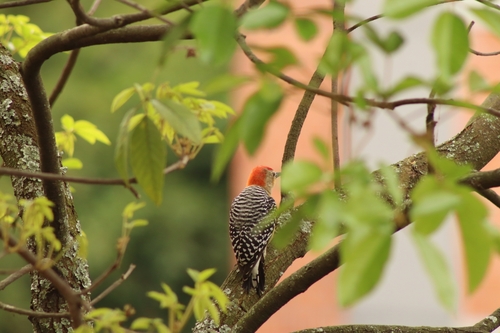 Red-crowned Woodpecker
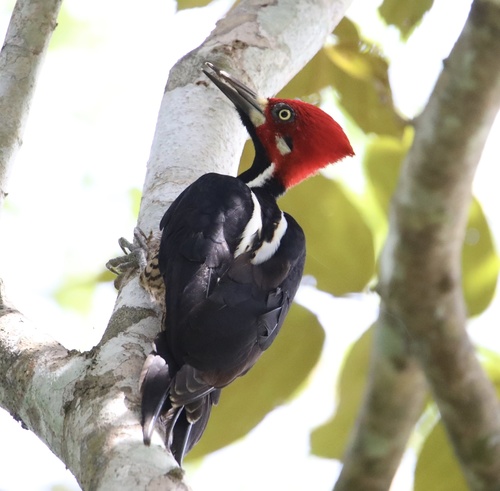 Crimson-crested Woodpecker
In short
The most reliable field mark to separate Red-crowned Woodpecker from Crimson-crested Woodpecker is overall size and structure: Crimson-crested is dramatically larger, with a heavy ivory bill and bold white neck stripes, while Red-crowned is much smaller and more compact, with a barred back and no neck stripes. In flight or perched, Crimson-crested shows a mostly black upperpart with a striking white 'V' down the back, whereas Red-crowned is barred black-and-white above. Juvenile Red-crowned are duller and browner, but still show barring, while juvenile Crimson-crested resemble adult females but have paler red on the head. Head pattern is also key: male Red-crowned has a red crown and nape, but Crimson-crested males have an all-red head with a pale patch at the bill base. These differences are visible at all ages and seasons.
Identification tips
- Size is the first check: Crimson-crested is more than twice as long and four to five times heavier than Red-crowned. If the bird looks crow-sized or larger than a flicker, it's Crimson-crested; if it's small and compact, it's Red-crowned. This works for all ages and sexes.
- Bill structure: Crimson-crested has a massive, long, ivory chisel bill (gray in some subspecies), while Red-crowned's bill is much finer, proportionally shorter, and blackish. Bill color and bulk are visible even at a distance.
- Upperpart pattern in flight or perched: Red-crowned shows bold black-and-white barring across the back and wings; Crimson-crested is mostly black above with a striking white 'V' formed by neck stripes meeting on the back. No barring on Crimson-crested's back.
- Neck stripes: Crimson-crested has bold vertical white stripes on the sides of the neck that continue onto the back, forming a 'V'. Red-crowned lacks these stripes entirely.
- Head pattern (males): Red-crowned male has a pale forehead, red crown, and orange-red nape; Crimson-crested male has an all-red head with a pale patch at the bill base. The red is much more extensive and vivid on Crimson-crested.
- Head pattern (females): Red-crowned female has a pale crown and reddish nape; Crimson-crested female has black around the eye and front of crest, with a wide white stripe from bill to ear coverts and down the neck. This white facial stripe is unique to Crimson-crested.
- Juvenile confusion: Juvenile Red-crowned are duller and browner but still show barred upperparts; juvenile Crimson-crested resemble adult females but with paler red on the head and still have the distinctive black-and-white pattern and bold neck stripes.
- Underparts: Red-crowned is buffish-gray to gray-buff below with an olive/yellowish wash and a reddish/orange-red belly patch; Crimson-crested is pale cinnamon-buff to tawny with wide black bars and pale yellowish undertail coverts. The belly patch is unique to Red-crowned.
- Tail pattern: Red-crowned's tail is black with white bars on the central and outermost feathers; Crimson-crested's tail is brownish-black, less patterned.
- Iris color: Red-crowned has a red to brown iris; Crimson-crested's iris is white to yellow. This is subtle but can help at close range.
- Leg color: Red-crowned has gray legs; Crimson-crested's legs are variable gray.
- Vocalizations: Crimson-crested gives deep, hollow, popping calls and a strong drum; Red-crowned's calls are higher-pitched and less forceful.
- Habitat context: In mature or dense forest, especially in South America, Crimson-crested is more likely. In open woodlands, edges, or urban parks, especially in Central America or Tobago, Red-crowned is more likely.
- Behavior: Crimson-crested is slow, powerful, and often forages in pairs on large trunks; Red-crowned is quick, agile, and often uses smaller branches.
- Subspecies variation: Some Crimson-crested subspecies have a gray bill and more red around the eyes, but the overall size and pattern differences remain diagnostic.
Size
Crimson-crested Woodpecker is in a completely different size class: at 33–36 cm long and 225–281 g, it is more than twice the length and four to five times the mass of Red-crowned Woodpecker (16–18.5 cm, 40–65 g) [wikidata]. Crimson-crested has a massive, long, ivory-colored chisel bill, while Red-crowned's bill is longish but much finer and blackish. Even at a distance, Crimson-crested appears large, heavy-headed, and long-necked, while Red-crowned is compact and small-billed.
Plumage
-
Juveniles: Red-crowned Woodpecker juveniles are duller and browner than adults, with paler nape/hindneck, less contrasting upperpart barring, lightly streaked underparts, and a paler, mottled belly patch. They still show the characteristic black-and-white barring above. Crimson-crested juveniles resemble adult females but have paler red on the head; both sexes lack the vivid adult red, but the overall pattern (mostly black above, white neck stripes, pale cinnamon-buff underparts with wide black bars) is already present.
-
Adults: Red-crowned males have a pale yellow/whitish forehead, bright red crown, orange-red nape/hindneck, and barred black-and-white back. Females have a gray-buff crown and less red on the nape. Both sexes have a reddish or orange-red belly patch. Crimson-crested males have an all-red head with a pale patch at the bill base; females have black around the eye and front of crest, with a wide white stripe from bill to ear coverts and down the neck. Both sexes have black upperparts with a bold white 'V' on the back, black throat and upper breast, and pale cinnamon-buff underparts with wide black bars. Their bill is ivory (gray in some subspecies), and their iris is white to yellow. Red-crowned has a red to brown iris and gray legs; Crimson-crested's legs are variable gray.
Behaviour
Crimson-crested Woodpecker often forages in pairs, favoring mid-levels of the forest, and is seen pecking, probing, and scaling bark on larger trunks and branches. It is powerful and deliberate in movement, befitting its size. Red-crowned Woodpecker is more likely to be seen on smaller branches and trunks, often in more open or edge habitats, and is more agile and active. Crimson-crested's foraging is slower and more forceful, while Red-crowned is quick and nimble.
Habitat
Both species can overlap in Panama and northern South America, but Crimson-crested is found in a wider range of forest types, including mature forest, and is absent from Costa Rica and Tobago. Red-crowned is more often found in open woodlands, edges, and even urban parks, especially in Central America and the Caribbean. If the habitat is dense, mature forest, Crimson-crested is more likely; in open or disturbed areas, Red-crowned is more likely.
Voice
Crimson-crested Woodpecker is not highly vocal but gives a hollow, popping series of notes ('tkep-tkep-tkep'), rapid chatters, and a strong, resonant drum followed by a trembling roll ('DA-drrr'). Its calls are deeper and more forceful than those of Red-crowned, which are not described in detail here but are generally higher-pitched and less resonant. In flight, Crimson-crested's wings make a heavy sound, which is not noted for Red-crowned.
Red-crowned Woodpecker · Crimson-crested Woodpecker · My Tricky Birds