

Red-bellied Macaw vs Rusty-margined Flycatcher
Orthopsittaca manilatus versus Myiozetetes cayanensis
Play a quiz with Red-bellied Macaw and Rusty-margined Flycatcher
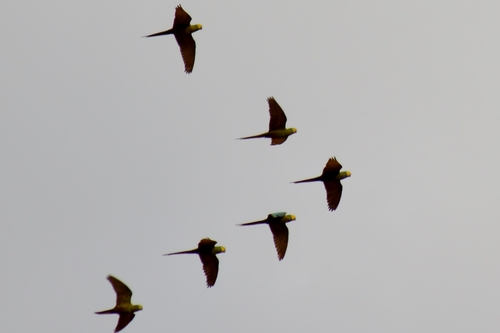 Red-bellied Macaw
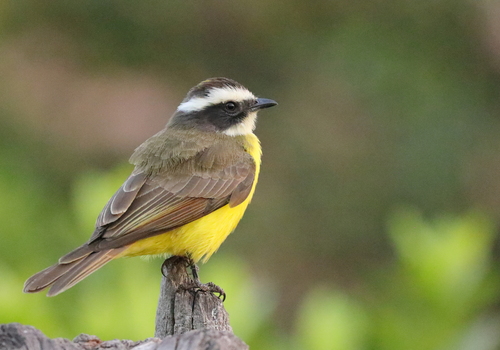 Rusty-margined Flycatcher
In short
The most reliable field mark to separate these two species is overall structure: the Red-bellied Macaw is a large, long-tailed, heavy-billed parrot with a mostly green body and a prominent maroon belly patch, while the Rusty-margined Flycatcher is a much smaller, slim-billed songbird with brown upperparts, a white supercilium, and bright yellow underparts. Juvenile Red-bellied Macaws have a unique white line on the upper beak, which is never seen in flycatchers. In flight or perched, the macaw's long, pointed tail and bare yellow facial skin are unmistakable, whereas the flycatcher shows a short tail, dark mask, and rufous-edged wings. Confusion is most likely with distant or poorly seen birds, but attention to size, structure, and the macaw's maroon belly patch will resolve nearly all field encounters.
Identification tips
- Size and structure: Red-bellied Macaw is over twice the length and many times the mass of Rusty-margined Flycatcher. Even at a distance, the macaw's long, pointed tail and bulky body are obvious. The flycatcher is small, with a short tail and slim build.
- Bill shape: Macaw has a massive, curved, dark-grey beak (juveniles with a white culmen stripe), while the flycatcher has a short, straight, stubby black bill. Bill shape is diagnostic at close range.
- Facial skin: Red-bellied Macaw shows extensive bare mustard-yellow skin on the cere and much of the face—never present in flycatchers, which have feathered faces.
- Maroon belly patch: Only the macaw has a large maroon patch on the lower belly. The flycatcher has bright yellow underparts with no maroon or red.
- Plumage color: Macaw is mostly green with a bluish forehead and greyish chin/throat; flycatcher is brown above, with a white supercilium and yellow below. No green or blue on the flycatcher.
- Supercilium: Rusty-margined Flycatcher has a strong white eyebrow (supercilium) extending well past the eye; macaw lacks any such mark.
- Wing pattern (juveniles): Juvenile macaws are duller and have a unique white stripe on the upper beak; juvenile flycatchers have more rusty-cinnamon on wing and tail edges, but never a white beak stripe.
- Tail shape: Macaw's tail is long and pointed; flycatcher's is short and square. In flight, the difference is striking.
- Bare skin vs feathered face: Only the macaw has bare facial skin; flycatcher's face is fully feathered, with a dark mask.
- Flight style: Macaws fly with strong, deep wingbeats and often call in flight; flycatchers have quick, fluttery flights, usually short sallies from a perch.
- Perching posture: Macaws perch upright, often high in palms; flycatchers perch more horizontally on exposed branches.
- Habitat: Macaws are almost always in or near palm swamps; flycatchers are found in a much wider range of open and semi-open habitats.
- Sexes: Both species are sexually monomorphic in plumage, but macaw males are slightly larger. This is rarely useful in the field.
- Juvenile macaw beak stripe: If you see a bird with a white stripe along the top of a grey beak, it is a juvenile Red-bellied Macaw—never a flycatcher.
- No rufous wing edges on macaw: Rusty or cinnamon edges on the wings and tail are a flycatcher feature, especially in juveniles and some subspecies; macaws never show these.
Size
Red-bellied Macaw is much larger, measuring about 46 cm (18 in) and weighing around 300 g (11 oz) [wikipedia], with a long, pointed tail and robust build. Rusty-margined Flycatcher is much smaller, only 16.5–18 cm (6.5–7.1 in) long and 22–29.5 g (0.78–1.0 oz) [wikipedia]. The macaw's size and bulk are immediately obvious in any direct comparison, even at a distance.
Plumage
Juvenile Red-bellied Macaws are duller than adults and have a distinctive grey beak with a white stripe along the culmen—this is unique among macaws except Spix's and never present in flycatchers. Adults of both sexes are mostly green with a bluish forehead, greyish chin/throat/upper chest, and a large maroon belly patch. The bare mustard-yellow facial skin is diagnostic. The underwings and undertail are dull olive yellow. In contrast, Rusty-margined Flycatchers (adults and juveniles) have brown to olive-brown upperparts, a white supercilium, dark sooty brown crown and face, and bright yellow underparts. Their wings are deep grayish brown with rusty or cinnamon-rufous edges (more pronounced in juveniles and some subspecies). The tail is dusky brown with olive or rufous edges. Flycatcher juveniles lack the yellow crown patch and show more extensive rusty-cinnamon on wing and tail edges. No flycatcher shows a maroon belly, bare facial skin, or green body.
Behaviour
Red-bellied Macaws are strong, direct fliers, often seen in pairs or small flocks, and are usually associated with palm groves. They perch upright, often in the open, and use their heavy bill to manipulate food and climb. Rusty-margined Flycatchers are active, sallying flycatchers; they perch more horizontally, often on exposed branches, and make short flights to catch insects. Their movements are quick and agile, unlike the heavier, more deliberate macaw.
Habitat
Red-bellied Macaw is tightly linked to Moriche palm (Mauritia flexuosa) swamps and sandy savannahs with palm groves, rarely found away from these habitats [wikipedia]. Rusty-margined Flycatcher is much more adaptable, found in a wide range of open and semi-open habitats across South America, including forest edges, second growth, gardens, and urban areas. If seen away from palm swamps, a Red-bellied Macaw is unlikely.
Red-bellied Macaw · Rusty-margined Flycatcher · My Tricky Birds