

Pomarine Skua vs Brown Skua
Stercorarius pomarinus versus Stercorarius antarcticus
Play a quiz with Pomarine Skua and Brown Skua
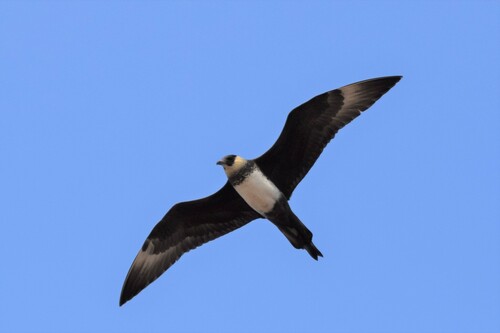 Pomarine Skua
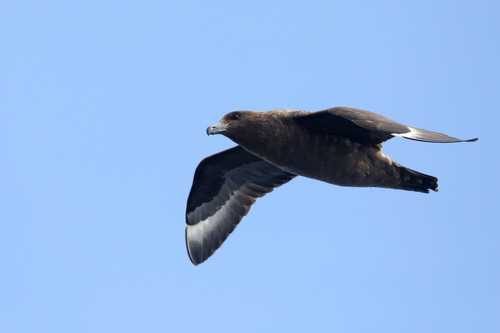 Brown Skua
In short
The most reliable field mark to separate Pomarine Skua from Brown Skua is overall size and structure: Brown Skua is much heavier, bulkier, and broader-winged, while Pomarine Skua is smaller and more slender, with a distinctive tail shape in breeding adults. In flight, Pomarine Skuas (especially adults) show a diagnostic double white flash on the underwing and, in breeding plumage, long, spoon-shaped central tail feathers. Brown Skuas are uniformly dark brown and lack any white wing flash, appearing much more massive and gull-like. Juvenile Pomarine Skuas are notoriously tricky to separate from other skuas, but Brown Skua is always much larger and lacks the Pomarine's white underwing pattern. Structure and bulk, along with the presence or absence of the white wing flash, are your best field clues.
Identification tips
- Size and bulk: Brown Skua is much heavier and bulkier than Pomarine Skua. If the bird appears as massive as a large gull (Great Black-backed or Glaucous), it is almost certainly a Brown Skua.
- White wing flash: Pomarine Skua of all ages and morphs shows a white 'double flash' on the underwing (most obvious in adults), which Brown Skua never shows. This is a key mark in flight.
- Tail shape in adults: Breeding adult Pomarine Skuas have two long, twisted, spoon-shaped central tail feathers. Brown Skua never shows tail streamers; its tail is always short and rounded.
- Overall coloration: Brown Skua is always uniformly dark brown, with no pale underparts or head. Pomarine Skua can be light, dark, or intermediate, but light morphs show white underparts and yellowish-white head/neck with a black cap.
- Bill and head: Pomarine Skua has a less massive bill and head compared to the thick, heavy bill and blocky head of Brown Skua. This is most apparent at close range or in perched birds.
- Flight style: Pomarine Skua is less agile than smaller jaegers but still more streamlined and less lumbering than Brown Skua, which appears heavy and gull-like in flight.
- Juvenile confusion: Juvenile Pomarine Skuas are very similar to other jaegers, but Brown Skua juveniles are always much larger and lack any white wing flash. If you see a large, dark skua with no pale in the wing, suspect Brown Skua.
- Underwing pattern: Always look for the white double flash in Pomarine Skua. Brown Skua's underwing is plain dark brown.
- Plumage morphs: Pomarine Skua can be light, dark, or intermediate, but always with the wing flash. Brown Skua is always dark.
- Habitat context: In the subantarctic or Antarctic, Brown Skua is expected; Pomarine Skua is unlikely. In tropical or temperate offshore waters, Pomarine Skua is more likely.
- Perched birds: Brown Skua appears much more massive and heavy-chested when perched; Pomarine Skua is slimmer and less imposing.
- Association with gulls: Brown Skuas may be seen interacting with large gulls or penguin colonies in the south; Pomarine Skuas are more pelagic and less likely to be seen in such contexts.
- Head pattern: Light-morph Pomarine Skuas have a contrasting pale head and neck with a black cap, unlike the uniform brown of Brown Skua.
- Vocalizations: If heard, Pomarine Skua gives harsh chattering calls and 'which-yew' notes, but this is rarely diagnostic at sea.
- Season: Breeding plumage marks (tail streamers, pale head) are only present in Pomarine Skua during the breeding season; outside this, rely on size, structure, and wing flash.
Size
Brown Skua is dramatically heavier and bulkier than Pomarine Skua. Pomarine Skua averages around 694 g [wikidata], while Brown Skua can weigh from 1.2 to 2.18 kg, often more than double or even triple the mass of Pomarine Skua [wikipedia]. In length, Pomarine Skua is 46–67 cm (including tail streamers), while Brown Skua is 52–64 cm, but the Brown Skua's greater wingspan (126–160 cm vs. Pomarine's 110–138 cm) and much heavier build are obvious in the field. Brown Skuas rival the largest gulls in mass, while Pomarine Skuas are only slightly larger than a Common Gull.
Plumage
- Juvenile/immature birds: Pomarine Skua juveniles are very difficult to separate from other skuas by plumage alone, but they do show a white 'flash' on the underwing (a double flash in adults) that Brown Skua lacks. Brown Skua juveniles and adults are uniformly dark brown without any white wing flash.
- Adult breeding Pomarine Skua: Shows a brown back, white underparts, dark primaries with a white 'double flash' on the underwing, yellowish-white head and neck with a black cap (light morph), or is all dark brown (dark morph). All morphs have the white wing flash. Breeding adults have two long, twisted, spoon-shaped central tail feathers, which are unique and diagnostic.
- Adult Brown Skua: Uniformly dark brown overall, with no white wing flash or pale underparts. No tail streamers. Much more massive and broad-winged.
- Intermediate morphs: Pomarine Skua can show intermediate morphs with paler underparts and neck, but always retains the white wing flash, which Brown Skua never shows.
Behaviour
Pomarine Skua has a more measured, less agile flight than smaller jaegers, but is still sleeker and more aerial than the massive Brown Skua. Brown Skuas are powerful, heavy fliers, often appearing lumbering and gull-like, especially when compared side-by-side with Pomarine Skua. Brown Skuas may also display bold, inquisitive behavior around humans in the subantarctic, which is not typical of Pomarine Skua.
Habitat
Pomarine Skua is a migrant, wintering at sea in tropical oceans and breeding in the high Arctic. Brown Skua breeds in subantarctic and Antarctic zones and moves northward when not breeding, but is rarely found in tropical waters. Overlap is limited; Pomarine Skua is more likely encountered on oceanic migration or offshore, while Brown Skua is tied to colder southern waters and islands.
Voice
Pomarine Skua gives harsh chattering calls and a distinctive 'which-yew' sound. Brown Skua vocalizations are not described in the sources, so voice is not a reliable separator based on current information.