

Pigeon Guillemot vs Common Guillemot
Cepphus columba versus Uria aalge
Play a quiz with Pigeon Guillemot and Common Guillemot
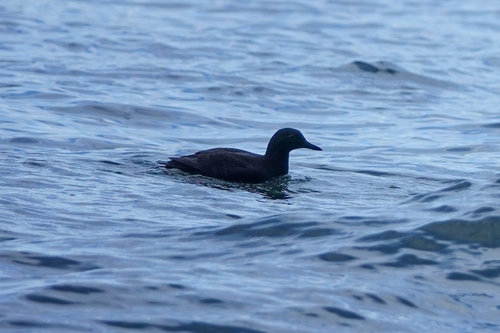 Pigeon Guillemot
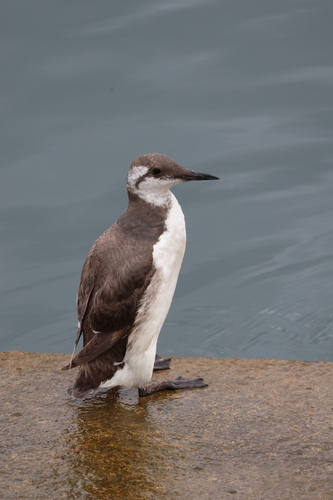 Common Guillemot
In short
The most reliable field mark between Pigeon Guillemot and Common Guillemot is the wing pattern: Pigeon Guillemot (of all ages) shows a bold white wing patch broken by a dark wedge, while Common Guillemot has entirely dark wings with no white patch. In flight, this contrast is unmistakable. On the water or perched, Pigeon Guillemot is smaller, stockier, and sits more upright, with bright red legs and feet, while Common Guillemot is larger, sleeker, and has dark legs. Seasonal plumage differences can cause confusion, but the wing pattern and leg color remain strong clues year-round. Juveniles and immatures are best separated by wing pattern and overall structure.
Identification tips
- White wing patch (all ages): Pigeon Guillemot always shows a white wing patch, broken by a dark wedge, visible in flight and often at rest. Common Guillemot's wings are entirely dark, with no white patch at any age or season.
- Juvenile/immature contrast: Even juvenile Pigeon Guillemots have a reduced but still visible white wing patch; Common Guillemot juveniles lack any white in the wing.
- Leg color: Pigeon Guillemot has bright red legs and feet (grey-brown in juveniles), obvious when perched or swimming. Common Guillemot's legs are dark grey.
- Bill structure: Pigeon Guillemot has a long, thin, black bill; Common Guillemot's bill is also thin and pointed but proportionally longer relative to head size, and always dark.
- Body shape and posture: Pigeon Guillemot is compact and sits upright, often on its tarsi. Common Guillemot is larger, more elongated, and sits lower to the ground or water.
- Breeding plumage: Pigeon Guillemot is dark brown with a black sheen, while Common Guillemot is black (or dark brown in some southern populations) above and white below, with a sharp color boundary.
- Non-breeding plumage: Pigeon Guillemot becomes mottled above but keeps the white wing patch; Common Guillemot's face turns white with a dark eye spur, but wings remain dark.
- Head pattern: In non-breeding, Common Guillemot may show a white face with a dark line behind the eye (the 'bridled' morph), but never a white eye-ring. Pigeon Guillemot has a thin, unbroken white eye-ring in all plumages.
- Flight style: Pigeon Guillemot has shorter, rounder wings and a rapid wingbeat, reflecting its diving specialization. Common Guillemot's wings are longer and more pointed, and it appears less agile in flight.
- Habitat context: Pigeon Guillemot is usually seen close to rocky shores, singly or in pairs. Common Guillemot is more likely in large groups, especially offshore or at cliff colonies.
- Size in context: If seen together, Common Guillemot is much larger and heavier, but beware of distance effects when alone.
- Feet color in flight: Pigeon Guillemot's red feet may be visible trailing behind in flight, a good clue at close range.
- Vocalizations: If heard, Common Guillemot's growling calls are distinctive at colonies, but voice is rarely helpful at sea.
- Seasonal timing: Both species change plumage seasonally, but wing pattern and leg color remain reliable throughout the year.
- Common pitfalls: Beware of distant or silhouetted birds where size and color are hard to judge—rely on the wing pattern and leg color whenever possible.
Size
Pigeon Guillemot is distinctly smaller and lighter: 30–37 cm in length and 450–550 g in weight [wikipedia]. Common Guillemot is larger and heavier: 38–46 cm long, weighing 775–1250 g, often twice the mass of Pigeon Guillemot [wikipedia]. This size gap is visible when seen together, but may be subtle at a distance or alone. Pigeon Guillemot also appears more compact and short-necked, while Common Guillemot is longer-bodied and more elongated.
Plumage
- Juvenile/First-winter: Pigeon Guillemot juveniles resemble winter adults but have brown-tipped underparts (giving a barred look), more brown on the upperparts, and a smaller white wing patch. Their wing patch, though reduced, is still present and diagnostic. Common Guillemot juveniles look like winter adults, with no white wing patch at all; their wings are uniformly dark.
- Adult breeding: Pigeon Guillemot is dark brown with a black sheen and a prominent white wing patch broken by a dark wedge. Common Guillemot is black (or dark brown in southern birds) above and white below, with entirely dark wings and no white patch. Both have dark heads, but Common Guillemot's is more sharply demarcated from the white underparts.
- Adult non-breeding: Pigeon Guillemot develops mottled grey and black upperparts and white underparts, but the white wing patch remains. Common Guillemot's face turns white with a dark line behind the eye, but wings remain uniformly dark. Pigeon Guillemot's legs and feet are always red (grey-brown in juveniles), while Common Guillemot's are dark grey.
Behaviour
Pigeon Guillemot often sits upright on rocks or the water, sometimes resting on its tarsi, and walks well on land. It is a strong swimmer and diver, using both wings and feet for propulsion. It takes off with difficulty in calm conditions but is fast in flight once airborne. Common Guillemot is less upright, more elongated in posture, and typically breeds in dense cliff colonies. It spends more time at sea and is less likely to be seen walking or standing upright on land. Both species dive for food, but Pigeon Guillemot is more frequently seen close to shore and in smaller groups.
Habitat
Pigeon Guillemot is mostly found along rocky coasts, islands, and nearshore waters of the North Pacific. It is often seen singly or in pairs, close to shore, and nests in crevices or under rocks. Common Guillemot breeds in large, dense colonies on steep sea cliffs in both the North Atlantic and North Pacific, and spends most of its life far offshore. Away from colonies, Common Guillemot is usually seen in large rafts on the open sea, rarely close to shore except during breeding.
Voice
Common Guillemot is highly vocal at colonies, with a loud growling "murrrr" and chicks giving a high-pitched whistle. Pigeon Guillemot's voice is not described in the provided notes, so is not a reliable separator here.