

Persian Wheatear vs Nile Valley Sunbird
Oenanthe chrysopygia versus Hedydipna metallica
Play a quiz with Persian Wheatear and Nile Valley Sunbird
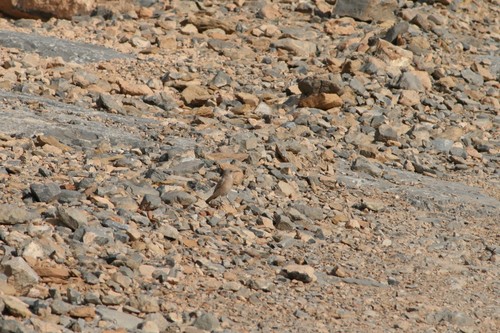 Persian Wheatear
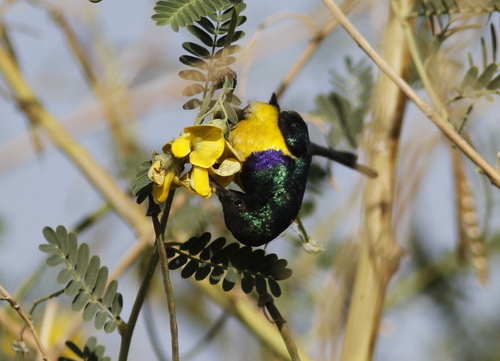 Nile Valley Sunbird
In short
The most reliable field mark to separate Persian Wheatear from Nile Valley Sunbird is overall structure and tail pattern: Persian Wheatear is a robust, upright, thrush-like bird with a rufous rump and a black T-shaped tail pattern, while Nile Valley Sunbird is much smaller, slender, and delicate with a long, downcurved bill and, in breeding males, elongated tail streamers. In nonbreeding plumage, the sunbird is plain grey above and yellowish below, lacking any rufous or black tail pattern. If you see a small bird with a long, curved bill and no rufous rump or black tail, it's a sunbird; a larger, upright bird with a rufous rump and black T-tail is a wheatear. Immature and female wheatears can be drab, but their structure and tail pattern remain distinctive. Habitat and behavior also help: wheatears forage on the ground in rocky, open areas, while sunbirds are more likely in scrub or gardens, often hovering or feeding from flowers.
Identification tips
- Tail pattern (all ages): Persian Wheatear always shows a rufous rump and black T-shaped tail pattern, visible both perched and in flight. Nile Valley Sunbird never shows this pattern; its tail is plain, and in breeding males, it is elongated with streamers but not rufous or T-marked.
- Bill shape: Sunbird has a long, slender, and distinctly downcurved bill, adapted for nectar feeding. Wheatear's bill is short, straight, and thrush-like, suited for insectivory. This is a quick and reliable check, especially at close range.
- Size and structure: Wheatear is much larger, upright, and robust, with a sparrow-like jizz. Sunbird is tiny, slender, and delicate, with a more horizontal posture and rapid movements.
- Breeding male sunbird (seasonal): By February, male Nile Valley Sunbird is unmistakable with metallic green upperparts, brilliant yellow belly, and long tail streamers. No wheatear ever shows metallic colors or such a long tail.
- Nonbreeding/plumage confusion: In winter, both sunbird sexes are plain grey above and yellowish below, but still show the long, curved bill and lack any rufous or black tail pattern. Wheatear remains drab but is larger and always has the tail pattern.
- Supercilium: Wheatear may show a faint pale stripe over the eye (supercilium), especially in fresh plumage. Sunbird lacks any such facial marking.
- Ear-coverts: Wheatear may have a rufous tinge to the ear-coverts; sunbird does not.
- Underwing: Wheatear has silvery-white underwing-coverts, sometimes glimpsed in flight. Sunbird's underwing is not described as distinctive.
- Perching and foraging behavior: Wheatear perches upright on rocks or the ground, often sallying out for insects. Sunbird is more likely to be seen hovering at flowers or moving quickly through foliage.
- Habitat context: If the bird is in a rocky, barren, or mountainous area, favor wheatear. In gardens, acacia scrub, or near flowering plants, favor sunbird.
- Flight style: Wheatear's flight is direct and strong, often between rocks or perches. Sunbird's flight is more fluttery, with frequent hovering.
- Sex differences: Only breeding male sunbird is metallic green with streamers; females and nonbreeding birds are dull, but still show the structural differences.
- Vocalizations: Wheatear gives repeated whistles and clicking calls; sunbird (not detailed here) typically has high, thin calls. Use with caution unless familiar with both.
- Pitfall: Female and immature wheatears can seem plain and sunbird-like, but always check for the rufous rump and black T-tail, which sunbirds never show.
- Seasonal context: If seen in February–April and showing metallic green and streamers, it's a male sunbird. Wheatear never shows these features, regardless of season.
Size
Persian Wheatear is significantly larger and bulkier, measuring about 14.5 cm in length with a wingspan of 26–27 cm and weighing 20–27 g [wikipedia]. Nile Valley Sunbird is much smaller, only 9–10 cm long, and is notably lighter and more delicate in build. The sunbird's tail can appear longer in breeding males due to tail streamers, but the body remains much smaller and slimmer overall. In the field, the size difference is striking: the wheatear is sparrow-sized and upright, while the sunbird is tiny, almost warbler-like, and more active.
Plumage
- Juvenile/immature/first-winter Persian Wheatear: No specific juvenile upperwing pattern is described, but all ages show a rufous rump and black T-shaped tail pattern, which is consistent and diagnostic. Plumage is drab grey-brown above and greyish-white below, with a faint pale supercilium and sometimes a rufous tinge to the ear-coverts. Sexes are similar, but males have a small black area between eye and bill.
- Adult Persian Wheatear: Maintains the same tail pattern and overall drab coloration. No seasonal change as dramatic as the sunbird.
- Nile Valley Sunbird (nonbreeding, both sexes): Tiny, plain pale grey above and washed-out yellow below, with no strong markings, rufous, or black in the tail. Bill is long and downcurved.
- Breeding male Nile Valley Sunbird (by February): Transforms into a glossy green above, brilliant sulfur-yellow below, and acquires long tail streamers. No rufous rump or black T-tail. Females remain dull.
- Key contrast: Only the wheatear shows a rufous rump and black T-tail at all ages; only the sunbird has a metallic green breeding male and long, curved bill.
Behaviour
Persian Wheatear is a ground-foraging, upright bird, often seen on rocks or bare ground, making short flights to catch insects or dropping to the ground to feed. It perches conspicuously and is rarely seen feeding from flowers. Nile Valley Sunbird is much more active and agile, often hovering at flowers to feed on nectar, sometimes sallying for insects, and rarely perching upright on the ground. Males may display by hovering and showing off their tail streamers. The foraging style and posture are immediately different: wheatears are terrestrial and upright, sunbirds are aerial and often hover.
Habitat
Persian Wheatear breeds in mountainous, rocky, and barren areas with little vegetation, often at high elevations (1,200–4,000 m), and winters in rocky hills, steppe, and semi-desert. It is rarely found in lush, vegetated areas. Nile Valley Sunbird is found in a wider range of habitats, including scrub, gardens, and areas with flowering plants, often at lower elevations and in more vegetated or riparian settings. If the bird is in a rocky, open, barren landscape, wheatear is more likely; in gardens, acacia scrub, or with flowering shrubs, sunbird is more probable.
Voice
Persian Wheatear has a simple, repeated whistle for its song, and calls include clicking, rasping, and whistling notes. Nile Valley Sunbird's vocalizations are not described in detail here, but sunbirds typically have high, thin, rapid calls and sometimes a weak, warbling song. In practice, the wheatear's calls are more thrush-like and less high-pitched than the sunbird's, but vocalizations are not the most reliable separation tool unless the song is heard clearly.