

Pallas's Sandgrouse vs Black-bellied Sandgrouse
Syrrhaptes paradoxus versus Pterocles orientalis
Play a quiz with Pallas's Sandgrouse and Black-bellied Sandgrouse
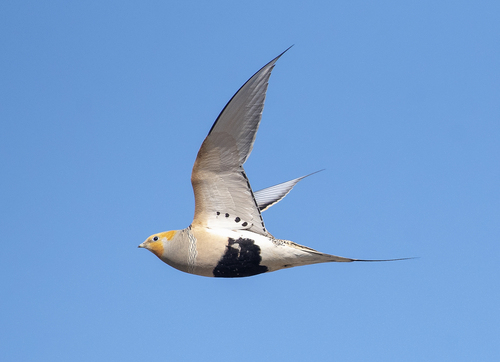 Pallas's Sandgrouse
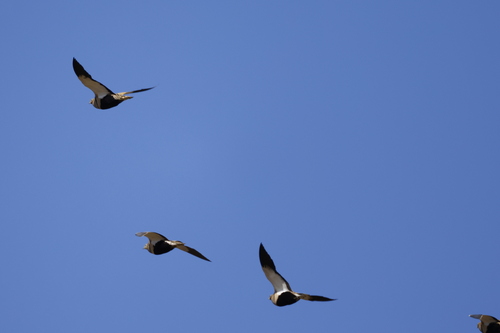 Black-bellied Sandgrouse
In short
The most reliable separation in the field is the underwing color in flight: Pallas's Sandgrouse shows pale underwings, while Black-bellied Sandgrouse has striking white underwings. Both species have a black belly patch, but Pallas's Sandgrouse is overall buffier and more barred above, with a more compact, paw-footed look. Males of both have a grey head and breast, but only Pallas's male has an orange face and a grey breast band. Females are trickier, but Pallas's is more barred above and lacks the breast band. Structure, flight jizz, and subtle differences in upperpart pattern can help, especially at a distance or in mixed flocks.
Identification tips
- Underwing color in flight (all ages): Pallas's Sandgrouse shows pale (not white) underwings; Black-bellied Sandgrouse has bright white underwings. This is the single most reliable field mark, especially in flocks or at a distance.
- Black belly patch: Both species have a black belly, but Pallas's is set against buff underparts, while Black-bellied's is against whiter underparts. Look for the contrast in flight or when birds are drinking.
- Male head and breast: Pallas's male has a grey head and breast, orange face, and a grey breast band. Black-bellied male also has a grey head and breast, but with a chestnut throat patch and a thin black border on the lower breast. The orange face and breast band are unique to Pallas's.
- Female upperparts: Pallas's female is more barred above and lacks a breast band; Black-bellied female is browner and more finely marked, but has the same black belly and breast band as the male. If you see a barred, band-less female, it's Pallas's.
- Upperpart color: Pallas's is overall buff with barring; Black-bellied is golden-brown with darker markings. In strong light, Pallas's can look paler and more uniform.
- Feet and legs: Pallas's has feathered legs and toes, with fused front toes and a paw-like appearance. This is only visible at very close range or in photos, but is unique among sandgrouse.
- Size: Black-bellied is generally heavier and slightly longer, but overlap is substantial. Use only if birds are side by side.
- Flight style: Both are fast and direct, but Pallas's is noted for especially long, high-speed flights. Not usually diagnostic in the field.
- Habitat: If in true steppe with little or no vegetation, Pallas's is more likely. If in semi-arid plains with some vegetation, especially in southern Europe or North Africa, Black-bellied is more likely.
- Range: Pallas's is central Asian, sometimes irrupting west; Black-bellied is southern European, North African, and Middle Eastern. Out-of-range records should be checked carefully.
- Voice: Only Black-bellied's call is described ('chowrrr rrrr-rrrr'), but not a primary separator based on these notes.
- Context at water: Both species gather at waterholes at dawn/dusk, often in large flocks. Mixed flocks are rare but possible during irruptions; check underwings and belly patches carefully.
- Juvenile/immature plumage: No specific juvenile flight marks are described for either species in these notes; focus on underwing and belly pattern for all ages.
- Seasonal variation: No strong seasonal plumage changes are noted; sex and age differences are more important.
- Common pitfalls: Females of both species are dull and can be confused; always check underwing color in flight and look for the presence or absence of a breast band and barring above.
Size
Both species are medium to large sandgrouse with similar overall shape: small, pigeon-like head and neck, and a compact, sturdy body. Black-bellied Sandgrouse is likely the largest sandgrouse species, with a length of 33–39 cm and a body mass around 405.5 g [wikidata], while Pallas's Sandgrouse is 30–41 cm long (no mass given). In practice, size overlap is considerable and not a reliable field mark unless birds are side by side.
Plumage
- In flight (all ages): The underwing is the key: Pallas's Sandgrouse has pale underwings, while Black-bellied Sandgrouse shows bright white underwings. Both have a black belly patch, but Pallas's is set against buff underparts, and Black-bellied's is against whiter underparts.
- Adult males: Both have a grey head and breast, but Pallas's male has an orange face and a distinct grey breast band, while Black-bellied's male has a chestnut throat patch and a thin black border on the lower breast. Pallas's upperparts are buff and barred; Black-bellied's are golden-brown with darker markings.
- Adult females: Both are duller and more finely marked than males. Pallas's female lacks the breast band and has more barring above; Black-bellied's female is browner above, with breast and underparts similar to the male, and the same black belly patch.
- Feet: Only Pallas's has feathered legs and toes, with fused front toes and a paw-like appearance (visible only at close range or in photos).
Behaviour
Both species are gregarious and often seen in flocks, especially at watering holes at dawn and dusk. Pallas's Sandgrouse is known for very long, fast flights (up to 64 km/h and 121 km round trips), and males carry water in their breast feathers for chicks. Black-bellied Sandgrouse also flies fast and directly, but only the male brings water for the young. Both species nest in ground scrapes and lay cryptically marked eggs. Flight style is similar: long, pointed wings and rapid, direct flight.
Habitat
Both favor dry, open plains or steppes, but Black-bellied Sandgrouse avoids areas completely lacking vegetation, while Pallas's is more of a true steppe specialist. Pallas's breeds across central Asia, with irruptions westward in some years; Black-bellied is resident or migratory in southern Europe, North Africa, and parts of the Middle East. Overlap is rare except as vagrants.
Voice
Only Black-bellied Sandgrouse's call is described: a soft 'chowrrr rrrr-rrrr.' No vocal description is given for Pallas's Sandgrouse in these notes, so voice is not a reliable separator based on this information.
Pallas's Sandgrouse · Black-bellied Sandgrouse · My Tricky Birds