

Paint-billed Crake vs Azure Gallinule
Mustelirallus erythrops versus Porphyrio flavirostris
Play a quiz with Paint-billed Crake and Azure Gallinule
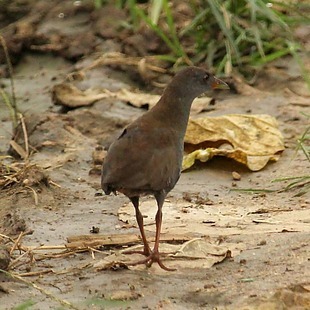 Paint-billed Crake
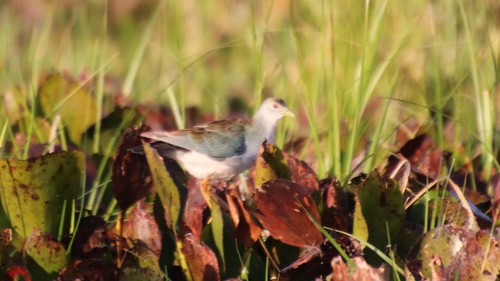 Azure Gallinule
In short
The most reliable field mark to separate Paint-billed Crake from Azure Gallinule is the bill and leg color: Paint-billed Crake has a distinctive red and yellow bill with bright red legs, while Azure Gallinule shows a pale greenish-yellow bill and shield with yellow legs. In flight or at rest, Azure Gallinule is notably larger and bulkier, with a blue-toned upperwing and pale blue-gray face and breast, contrasting with the crake's browner, more cryptic plumage and bold black-and-white barring on the underparts. Immature Azure Gallinules can be confusing, but their yellowish-orange legs and buffy face/breast help. Both species can occur in similar marshy habitats, but the crake is much more secretive and rarely seen in the open.
Identification tips
- Bill color: Paint-billed Crake has a striking red and yellow bill; Azure Gallinule's bill and shield are pale greenish-yellow. This is often visible even at a distance or in poor light.
- Leg color: Paint-billed Crake's legs are bright red, while Azure Gallinule's are yellow (adults) or yellowish-orange (immature). If you see red legs, it's the crake.
- Size and structure: Azure Gallinule is noticeably larger, longer-legged, and bulkier than Paint-billed Crake. The crake appears more compact and rail-like, with a shorter tail and neck.
- Upperwing and face color: Azure Gallinule shows blue to greenish-blue upperwing coverts and a pale blue-gray face and breast (adults); Paint-billed Crake lacks any blue or azure tones, instead showing brown upperparts and gray face/breast.
- Underpart pattern: Paint-billed Crake has bold black-and-white barring on the flanks, belly, and vent (all ages); Azure Gallinule has plain white underparts with no barring (all ages).
- Juvenile/immature confusion: Immature Azure Gallinule has a buffy face, neck, and breast, with a green shield and yellowish-orange legs—never shows the crake's barring or red tones. If you see a buffy, plain-faced bird with yellowish legs, suspect immature gallinule.
- Tail and uppertail coverts: Azure Gallinule's tail and uppertail coverts are brownish-olive to black, blending with the back; Paint-billed Crake's tail is brown, matching the upperparts, and not contrasting.
- Behavior: Paint-billed Crake is extremely furtive, rarely in the open; Azure Gallinule is more often seen walking on floating vegetation or in open marsh.
- Habitat context: If the bird is in a drier pasture, bushy edge, or rice field, Paint-billed Crake is more likely. If on floating aquatic plants or open marsh, Azure Gallinule is favored.
- Flight style: Paint-billed Crake flushes low and quickly drops into cover; Azure Gallinule may fly further and is less strictly tied to dense cover.
- Sexes: Both species are sexually monomorphic—do not rely on sex for identification.
- Seasonal movements: Azure Gallinule may be absent from some areas outside the wet season, while Paint-billed Crake's presence is less predictable due to its secretive nature.
- Geographic overlap: Both can occur together in much of northern and central South America, so range alone is not diagnostic.
- No blue or green in crake: Any blue or azure tones on the wing or face rule out Paint-billed Crake.
- No barring in gallinule: Any black-and-white barring on the underparts rules out Azure Gallinule.
Size
Azure Gallinule is significantly larger and heavier: adults are 23–26 cm long and weigh 92–111 g (males) or 92–107 g (females) [wikipedia], while Paint-billed Crake is 18–20 cm and 40–70 g [wikipedia]. The gallinule is the smallest Porphyrio but still bulkier and longer-legged than the crake, which is a compact, short-tailed rail. In the field, the gallinule's longer legs and neck, as well as its more upright posture, are usually apparent.
Plumage
- Juvenile/Immature Azure Gallinule: Upperparts are browner than adults, with a buffy face, neck, and breast; green frontal shield; yellowish-orange legs. No bold barring below.
- Adult Azure Gallinule: Pale greenish-yellow bill and shield, yellow legs, pale brownish-olive crown/back, blue to greenish-blue upperwing coverts, gray-blue flight feathers, pale blue-gray face/sides of neck/breast, white belly, brownish-olive to black tail.
- Paint-billed Crake (all ages): Red and yellow bill, bright red legs, brown crown/nape/back, white throat, gray face/throat/breast, bold black-and-white barring on flanks/belly/vent. No blue tones or pale blue-gray face. Sexes alike.
- Key contrast: Paint-billed Crake always shows strong underpart barring and lacks any blue or greenish tones; Azure Gallinule (even immature) never shows such barring and has blue/azure tones on wing and face.
Behaviour
Paint-billed Crake is extremely furtive, rarely seen in the open, and typically skulks through dense grass, reeds, or thickets, often only glimpsed as it darts across a gap. Azure Gallinule is more likely to be seen walking on floating vegetation or clambering about in emergent marsh plants, sometimes in the open. The gallinule's longer toes and legs allow it to move more confidently atop aquatic vegetation. Paint-billed Crake is more likely to flush low and drop quickly back into cover, while Azure Gallinule may fly further and is less strictly tied to dense cover.
Habitat
Both species occur in marshes, reedbeds, and wet grasslands, but Paint-billed Crake is more often found in drier or mixed wet-dry pastures, rice fields, and sometimes bushy or wooded edges, especially in South America. Azure Gallinule is more strictly associated with aquatic vegetation in marshes, lakes, and flooded fields, often where there are floating plants. The crake's secretive habits mean it is less likely to be seen in open water or on floating plants compared to the gallinule.