

Ornate Sunbird vs Black-throated Sunbird
Cinnyris ornatus versus Aethopyga saturata
Play a quiz with Ornate Sunbird and Black-throated Sunbird
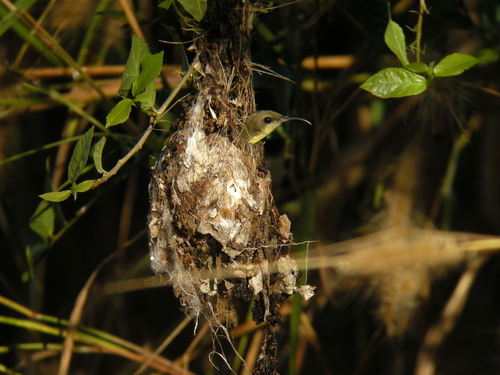 Ornate Sunbird
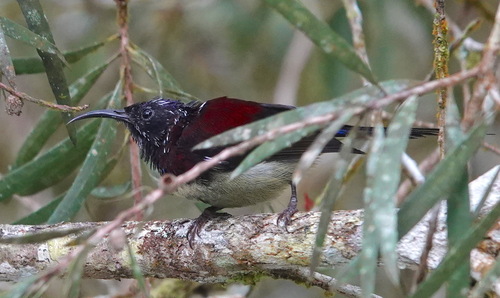 Black-throated Sunbird
In short
The most reliable field mark to separate Ornate Sunbird from Black-throated Sunbird is the male's throat and breast: Ornate Sunbird males show a blue-black iridescent throat and breast with yellow underparts, while Black-throated Sunbird males have a distinctive black throat but lack the bright yellow belly. Females are trickier, but Ornate Sunbird females have a yellow supercilium and greenish-olive upperparts, while Black-throated Sunbird females are generally darker and lack the strong yellow eyebrow. Size and structure are not strongly diagnostic in the field, but Black-throated Sunbird is slightly lighter. Both species overlap in Southeast Asia, so careful attention to plumage is essential, especially in mixed flocks or forest edge habitats.
Identification tips
- Male throat and breast color: Male Ornate Sunbird has a blue-black iridescent throat and breast, while Black-throated Sunbird male has a plain black throat without the iridescent blue-black sheen. This is the most reliable field mark for adult males.
- Male underparts: Ornate Sunbird males have bright yellow underparts, contrasting sharply with the dark throat. Black-throated Sunbird males are generally darker below and lack the strong yellow belly.
- Male forehead gloss: Ornate Sunbird males may show a purple-black gloss on the forehead, which is absent in Black-throated Sunbird.
- Tail tip: Ornate Sunbird males have a black tail with a white tip, which can be visible in good views. Black-throated Sunbird lacks this strong white tip.
- Female supercilium: Female Ornate Sunbird has a yellow supercilium (eyebrow), which is lacking in Black-throated Sunbird females. This is a key mark for separating females and immatures.
- Female upperparts: Ornate Sunbird females are greenish-olive above, while Black-throated Sunbird females are generally darker and less olive.
- Female underparts: Ornate Sunbird females have yellow underparts, while Black-throated Sunbird females are duller and less yellow.
- Wing pattern: No distinctive upperwing or flight pattern marks are described for either species, so do not rely on wing panels or trailing edges.
- Size: Ornate Sunbird is slightly heavier, but this is not a reliable field mark in the field.
- Habitat: In areas where both occur, Black-throated Sunbird may be more common in higher elevation or denser forest, while Ornate Sunbird is more widespread in lowland and edge habitats. However, there is considerable overlap.
- Geographic range: If you are in the Indian subcontinent (India, Nepal, Bhutan, Bangladesh), you are almost certainly seeing Black-throated Sunbird. In Java, Borneo, or the Lesser Sundas, only Ornate Sunbird occurs.
- Behavior: Both species behave similarly, so do not rely on feeding or flight style for separation.
- Sexual dimorphism: Both species are sexually dimorphic, so always consider sex when identifying. Males are easier to separate than females.
- Pitfalls: Females and immatures are the most likely to be confused. Focus on the presence or absence of the yellow supercilium and the tone of the underparts.
- Mixed flocks: In mixed-species flocks, check each sunbird carefully, as both can occur together in some regions.
Size
Ornate Sunbird is slightly heavier (male 6.7–11.9 g, female 6–10 g) than Black-throated Sunbird (about 5.3 g) [wikipedia][wikidata]. However, this difference is subtle and not easily judged in the field. Both are small, active sunbirds, and size alone is not a reliable separator unless seen side by side.
Plumage
- Adult males: Ornate Sunbird males show olive upperparts, black remiges with green edging, a black tail with a white tip, and a blue-black iridescent throat and breast. The underparts are bright yellow. The forehead has a purple-black gloss. In contrast, Black-throated Sunbird males have a black throat (as the name suggests), but lack the bright yellow belly and iridescent blue-black breast of Ornate. Their upperparts and underparts are generally darker and less contrasting.
- Adult females: Female Ornate Sunbirds are greenish-olive above, with a yellow supercilium and yellow underparts. Female Black-throated Sunbirds are generally darker, lack the yellow supercilium, and have less yellow below.
- Immature/juvenile plumage: No specific juvenile or first-winter wing pattern is described for either species in the sources. Thus, separation relies on overall coloration and supercilium in females and immatures.
- Wing pattern in flight: No distinctive upperwing or flight pattern marks are described for either species, so this is not a useful field mark.
- Tail: Ornate Sunbird males have a black tail with a white tip; this may be visible in good views and is less pronounced in Black-throated Sunbird.
Behaviour
Both species are active, nectar-feeding sunbirds, often seen flitting among flowers. No strong behavioral differences are noted in the sources. Both can be found singly, in pairs, or in mixed-species flocks, especially at forest edges or in gardens.
Habitat
Ornate Sunbird is endemic to Mainland Southeast Asia, Sumatra, Java, Borneo, and the Lesser Sunda Islands, and is often found in a range of habitats from lowland forests to gardens [wikipedia]. Black-throated Sunbird has a broader range, including the Indian subcontinent and much of Southeast Asia, and is found in both lowland and montane moist forests. In areas of overlap (e.g., Thailand, Malaysia), both species may be present, but Black-throated Sunbird is more likely at higher elevations or in denser forest.