

Oriental Cuckoo vs Grey Nightjar
Cuculus optatus versus Caprimulgus jotaka
Play a quiz with Oriental Cuckoo and Grey Nightjar
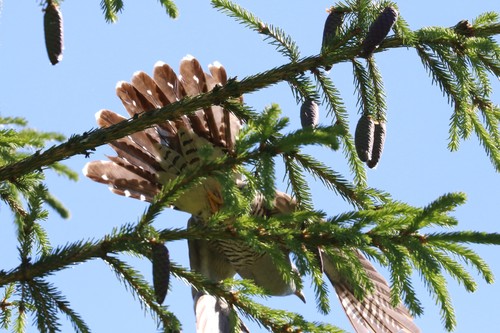 Oriental Cuckoo
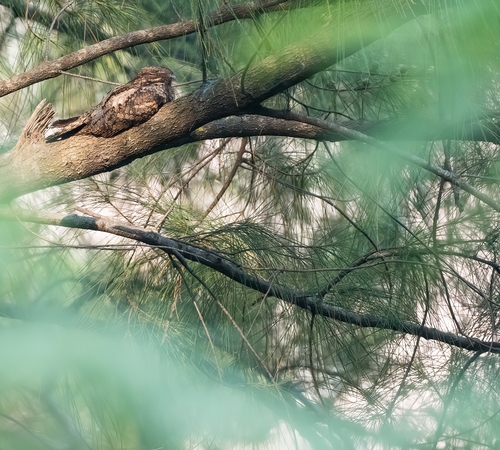 Grey Nightjar
In short
The most reliable field mark to separate Oriental Cuckoo from Grey Nightjar is overall structure and posture: the cuckoo is a slim, long-winged, hawk-like bird with a clear barring pattern on the underparts, while the nightjar is a broad-headed, short-legged, cryptically patterned bird with a distinctive white throat patch and intricate vermiculated plumage. In flight, Oriental Cuckoo shows a steady, direct flight with pointed wings, whereas Grey Nightjar has a floppy, buoyant flight with rounded wings and white patches on the primaries and tail (in males). Juvenile and female nightjars lack the prominent white patches but still show a more mottled, camouflaged appearance than any cuckoo. If seen perched, the nightjar's parallel alignment to the branch and cryptic coloration are distinctive. Vocalizations and habitat context can also help, but structure and plumage are usually decisive.
Identification tips
- Head and bill shape: Oriental Cuckoo has a small head, slender bill, and a hawk-like profile; Grey Nightjar has a large, broad head, tiny bill, and large eyes—especially obvious in profile or close views.
- Perched posture: Cuckoo perches upright or slightly angled, often exposed on branches; nightjar perches lengthwise along a branch, hugging it closely for camouflage, usually nearly invisible unless flushed.
- Flight style: Cuckoo flies with direct, steady wingbeats and pointed wings; nightjar has slow, floppy, buoyant flight with rounded wings, often gliding or making erratic turns.
- Wing pattern in flight: Male nightjars have prominent white patches on the primaries and tail; females and juveniles lack these but still show mottled, vermiculated upperwings. Cuckoo never shows white patches on the wings or tail, and upperwing is plain grey.
- Underparts: Cuckoo shows creamy-white underparts with strong, regular dark barring; nightjar has pale brownish-yellow underparts with dense, irregular dark horizontal stripes, never barred like the cuckoo.
- Throat patch: Nightjar has a conspicuous white throat patch (smaller and browner in females); cuckoo lacks any white throat patch, instead showing a plain grey or brownish breast.
- Upperparts: Cuckoo is plain grey (male/grey morph) or rufous with dark bands (rufous morph); nightjar is intricately patterned with vermiculations, streaks, and bars for camouflage.
- Rump and tail: Rufous morph cuckoo has strong dark bands on the rump; nightjar's tail is barred with black and brown, with white subterminal patches in males.
- Eye color and bare parts: Cuckoo has a yellow eye-ring and orange-yellow legs and feet; nightjar's bare parts are less conspicuous, with large dark eyes.
- Activity period: Cuckoo is diurnal, active by day; nightjar is nocturnal, most active at dusk and night.
- Habitat context: Cuckoo is more strictly forest-dwelling; nightjar is often in open woodlands, forest edges, or grassy slopes, especially at dusk or night.
- Vocalization: Cuckoo gives low, paired 'poo-poo' notes by day; nightjar (not described here) typically gives churring or repetitive calls at night.
- Sex and age differences: Female and juvenile nightjars lack the white wing and tail patches but retain the cryptic, mottled pattern; rufous morph cuckoos can be confused with nightjars in poor light, but always lack the intricate vermiculations and have a more uniform, banded appearance.
- Confusion risk: In poor light or at dusk, a flushed nightjar may be mistaken for a cuckoo, but note the erratic, buoyant flight and cryptic plumage. A perched cuckoo is never as well-camouflaged or aligned to the branch as a nightjar.
- When in doubt: Focus on head shape, throat patch, and underpart pattern—these are reliable even in brief or distant views.
Size
Oriental Cuckoo is slightly larger and heavier (body mass ~94.5g [wikidata]), with a length of 30–32 cm and wingspan of 51–57 cm [wikipedia]. Grey Nightjar is a medium-sized nightjar, but no precise mass is given here; structurally, it is shorter-legged and broader-headed, with a proportionally longer tail and shorter wings compared to the cuckoo. The cuckoo appears more slender and falcon-like, while the nightjar is chunkier and more compact.
Plumage
-
Juvenile/immature flight: No specific age-related upperwing pattern is described for Oriental Cuckoo, but all ages show grey upperparts and clear, dark barring on the creamy underparts. Juvenile Grey Nightjar resembles adults but lacks the white patches on the wings and tail (females and immatures), and is overall more mottled and vermiculated above, with a smaller or browner throat patch.
-
Adult plumage: Oriental Cuckoo males are grey above with a creamy, heavily barred belly and a buff, lightly marked vent. Females and juveniles can be grey or rufous morphs; rufous morphs are reddish above with strong dark bands, including on the rump (unlike Common Cuckoo). Grey Nightjar adults are intricately patterned with grayish-white, brown, and black vermiculations above, a prominent white throat patch (smaller and browner in females), and prominent white patches on the wings and tail in males. Underparts are pale brownish-yellow with dense dark brown horizontal stripes, never barred like the cuckoo. The nightjar's cryptic pattern is designed for camouflage, while the cuckoo's pattern is more sharply defined and less mottled.
Behaviour
Oriental Cuckoo is secretive and often forages in trees, bushes, or on the ground, usually alone and difficult to see. Its flight is direct and purposeful, with strong, steady wingbeats. Grey Nightjar is nocturnal, forages for insects on the wing at dusk and night, and rests during the day on branches or ground, aligning its body parallel to the branch for camouflage. Its flight is buoyant, with slow, floppy wingbeats, gliding, and erratic turns when chasing insects. The nightjar is much more likely to be seen at night, while the cuckoo is active by day.
Habitat
Oriental Cuckoo prefers forests—coniferous, deciduous, or mixed—across northern Eurasia and east Asia, often arriving later than Common Cuckoo in breeding areas. Grey Nightjar breeds in similar regions but is more often found in open woodlands, forest edges, and sometimes grassy slopes, especially for daytime roosting. Nightjar is more likely in open or semi-open habitats, especially at dusk or night, while the cuckoo is more strictly forest-dwelling and diurnal.
Voice
Oriental Cuckoo males give a series of low, paired 'poo-poo' notes, both notes equally stressed, sometimes introduced by a longer phrase or grating notes; females give a deep bubbling trill. Grey Nightjar's call is not described here, but nightjars typically have churring or repetitive calls at dusk or night, quite unlike the cuckoo's hooting. If you hear a low, even two-note phrase by day, it's likely cuckoo; if you hear churring or repetitive calls at night, it's likely nightjar.