

Olive-sided Flycatcher vs Western Wood-Pewee
Contopus cooperi versus Contopus sordidulus
Play a quiz with Olive-sided Flycatcher and Western Wood-Pewee
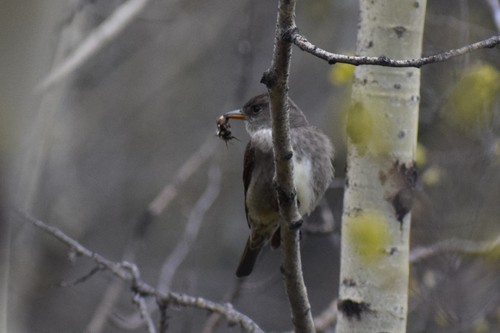 Olive-sided Flycatcher
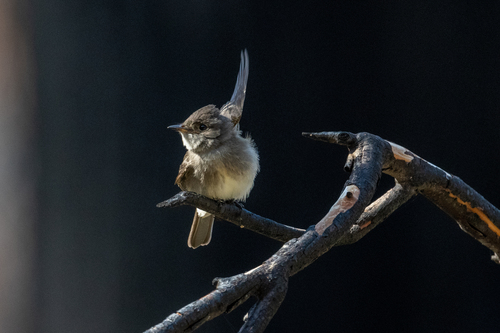 Western Wood-Pewee
In short
The most reliable field mark for separating Olive-sided Flycatcher from Western Wood-Pewee is the bold, dark 'vest' of dusky gray on the sides of the breast, framing a contrastingly white central throat and belly—unique to Olive-sided and visible on all ages. Western Wood-Pewee lacks this vest and instead shows a much more uniform, lightly washed olive-gray breast and underparts. Olive-sided Flycatcher is also noticeably larger and bulkier, with a stouter bill and longer wings, often perching very upright atop exposed snags. Both species are drab flycatchers with similar upperpart tones, but careful attention to breast pattern, size, and posture will separate them in most field situations.
Identification tips
- Look for the 'vest': Olive-sided Flycatcher always shows a bold, dark gray vest on the sides of the breast, sharply framing a white central throat and belly. Western Wood-Pewee lacks this vest and is more uniformly pale below with only a faint olive wash on the breast.
- Size and bulk: Olive-sided is much larger and heavier—about twice the mass of Western Wood-Pewee. If you see both together, the size difference is striking, but even singly, Olive-sided looks robust and long-winged.
- Perching posture: Olive-sided perches very upright, often on the highest, most exposed dead branches or snags. Western Wood-Pewee is upright but less extreme, and usually chooses lower or less prominent perches.
- Bill structure: Olive-sided has a relatively long, stout bill; Western Wood-Pewee's bill is thinner and shows yellow at the base of the lower mandible, but this can be hard to see at a distance.
- Wing bars: Both species have two pale wing bars, but these are not strong enough to separate them.
- Upperpart color: Both are gray-olive above, but Olive-sided can look browner or more olive in fresh plumage and good light. This is subtle and unreliable in poor light.
- Underpart color: Western Wood-Pewee is more evenly pale below, with only a slight olive wash on the breast—never the sharply defined vest of Olive-sided.
- Sex and age: Both sexes and all ages are similar within each species; there is no seasonal or sex-based difference to use.
- Habitat context: If you are in a high, open coniferous forest with prominent snags, especially near water, Olive-sided is more likely. In lower, more closed or riparian woods, Western Wood-Pewee is more typical.
- Behavior in flight: Olive-sided's flight is more powerful and direct, matching its larger size and longer wings. Western Wood-Pewee appears lighter and more fluttery.
- Voice (with caution): If you hear a loud, buzzy 'peeer' or a song of descending 'tsees' ending in 'peeer,' you are likely hearing Western Wood-Pewee. Olive-sided's vocalizations are not described here, so do not rely on this unless you know both species' songs well.
- Pitfalls: In poor light or at a distance, the breast vest can be hard to see; always try for a clear, frontal view. Size can be misleading if the bird is alone or distant, so use multiple marks.
- Not diagnostic: Wing pattern in juveniles and immatures is not described as distinctive for either species, so do not rely on this for separation.
- When in doubt: Prioritize the breast pattern and overall size/structure over subtle color differences or wing bars.
- Summary tip: If the bird looks vested and bulky, perched high and upright, it's Olive-sided; if it looks slender, evenly pale below, and less prominent in posture, it's Western Wood-Pewee.
Size
Olive-sided Flycatcher is significantly larger and heavier than Western Wood-Pewee—about twice the weight ([wikipedia]). Olive-sided averages 28–35 g ([avonet]), while Western Wood-Pewee is just 11–14 g ([wikipedia]). In length, Olive-sided is larger than a sparrow but smaller than a robin, while Western Wood-Pewee is 14–16 cm (5.5–6.3 in) long. Olive-sided also has proportionally longer wings and a stouter bill, giving it a more robust, upright look compared to the slender, more delicate Western Wood-Pewee.
Plumage
-
Juvenile/immature flight and wing pattern: No specific juvenile or immature upperwing pattern differences are described for these two species in the sources; both are drab above and lack strong wing patterning. Focus instead on breast and underpart contrasts.
-
Adult plumage: Olive-sided Flycatcher shows a distinctive 'vested' look: the sides of the breast are dark gray, sharply contrasting with a white central throat and belly. The olive tones on the back and wings are subtle and best seen in good light. Western Wood-Pewee is more evenly gray-olive above and below, with only a faint olive wash on the breast and no sharply defined vest. Both have two pale wing bars, but these are not strongly contrasting or diagnostic between the two.
-
Bill color: Western Wood-Pewee has a dark bill with yellow at the base of the lower mandible; Olive-sided's bill is relatively long and stout, but color is less distinctive in the field.
-
Sex/season: Both species are sexually monomorphic; no seasonal plumage variation is noted that would affect identification.
Behaviour
Olive-sided Flycatcher typically perches very upright, often at the very top of tall dead snags or exposed branches, scanning for flying insects. Its posture is more vertical and alert compared to Western Wood-Pewee, which also perches upright but tends to choose lower, less exposed perches and appears more delicate and less bulky. Both species sally out to catch insects in flight, but Olive-sided's larger size and longer wings make its flight appear more powerful and direct.
Habitat
Olive-sided Flycatcher prefers open areas or edges of boreal and coniferous forests, often near water and at higher elevations, and is strongly associated with tall, prominent trees or snags ([wikipedia]). Western Wood-Pewee is also found in open woodlands but is more typical of a wider range of wooded habitats, including riparian areas, and is not as tightly linked to tall snags or forest edges. Both can overlap in western North America, but Olive-sided is more likely in higher, more open, or recently burned coniferous forests.
Voice
No direct comparison of calls is provided in the notes. Western Wood-Pewee has a distinctive, buzzy 'peeer' call and a song of three rapid descending 'tsees' ending with a descending 'peeer' ([wikipedia]). Olive-sided Flycatcher's vocalizations are not described here, so rely on visual marks for separation.
Olive-sided Flycatcher · Western Wood-Pewee · My Tricky Birds