

Okinawa Rail vs Slaty-legged Crake
Gallirallus okinawae versus Rallina eurizonoides
Play a quiz with Okinawa Rail and Slaty-legged Crake
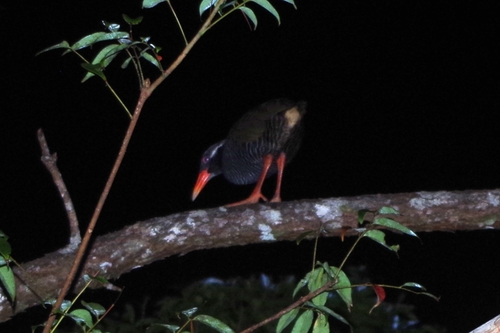 Okinawa Rail
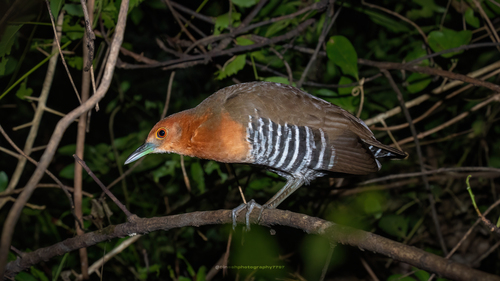 Slaty-legged Crake
In short
The most reliable field mark to separate Okinawa Rail from Slaty-legged Crake is the combination of bright red bill and legs (Okinawa Rail) versus yellowish bill and green legs (Slaty-legged Crake), visible even in poor light. Juvenile plumage also differs: young Okinawa Rails are paler and mottled below, while juvenile Slaty-legged Crakes are dark brown overall but retain belly barring and a white throat. Okinawa Rail is nearly flightless with very short wings and tail, and is restricted to Okinawa Island, while Slaty-legged Crake is more widespread and a better flyer. Both have barred underparts, but the Okinawa Rail's black-and-white barring is on a black background, while the Slaty-legged Crake shows chestnut tones and a white throat.
Identification tips
- Bill color: Okinawa Rail has a large, bright red bill with a whitish tip (adult), while Slaty-legged Crake has a yellowish bill. This is visible at all ages except juvenile Okinawa Rail, which has a brownish bill.
- Leg color: Adult Okinawa Rail has bright red legs; Slaty-legged Crake has green legs. Juvenile Okinawa Rail has yellow-ochre legs and feet, while Slaty-legged Crake young have greenish legs.
- Facial pattern: Okinawa Rail shows a black face with a white spot in front of the eye and a white line behind the eye, extending to the neck; Slaty-legged Crake lacks these facial stripes and instead has a white throat.
- Underparts barring: Both species have black-and-white barring below, but Okinawa Rail's barring is on a black background and is narrow, while Slaty-legged Crake's barring is bold and on a chestnut or brown background, with a white throat and chestnut breast.
- Upperparts: Okinawa Rail is olive-brown above; Slaty-legged Crake is brown above with a chestnut head and breast.
- Juvenile plumage: Juvenile Okinawa Rail is paler and mottled below, with less distinct facial marks and yellow-ochre legs; juvenile Slaty-legged Crake is dark brown above and below but still shows belly barring and a white throat.
- Tail and wings: Okinawa Rail has very short wings and tail and is nearly flightless, often appearing stubby and heavy-bodied. Slaty-legged Crake has a short tail but is a capable flyer and appears more slender.
- Body shape: Okinawa Rail is bulkier and more robust, especially in the legs and bill; Slaty-legged Crake is more laterally compressed for moving through dense vegetation.
- Behavior: Okinawa Rail is usually seen running on the ground or roosting in trees, rarely flying. Slaty-legged Crake is secretive, often hiding in bushes, and can fly when flushed.
- Habitat: Okinawa Rail is only found in the forests of northern Okinawa Island; Slaty-legged Crake is widespread in wooded wetlands across South and Southeast Asia.
- Size: Okinawa Rail is larger (30 cm, 435 g) and heavier than Slaty-legged Crake (25 cm, lighter build).
- Iris color: Adult Okinawa Rail has a red iris and eye-ring; Slaty-legged Crake does not show this feature.
- Context: If seen outside Okinawa, it is almost certainly not Okinawa Rail. If in dense subtropical forest on Okinawa, Slaty-legged Crake is extremely unlikely.
- Vocalization: Okinawa Rail is noisy at dawn and dusk, often calling in groups; Slaty-legged Crake is secretive and less often heard.
- Pitfalls: Both species have barred underparts, but check for facial stripes, bill and leg color, and overall bulk to avoid confusion, especially in juveniles.
Size
Okinawa Rail is larger and heavier, measuring about 30 cm in length with a wingspan of 48–50 cm and a weight around 435 g [wikipedia]. Slaty-legged Crake is smaller, about 25 cm long, with a more slender, laterally compressed body for moving through dense undergrowth [wikipedia]. The Okinawa Rail appears bulkier and more robust, especially in the legs and bill.
Plumage
-
Juvenile/immature: Juvenile Okinawa Rail is paler than the adult, with white mottling below instead of the adult's narrow white bars, and the facial white marks are less distinct. Bill and iris are brownish, legs and feet yellow-ochre. Juvenile Slaty-legged Crake is dark brown above and below, but retains the strong black-and-white belly barring and a white throat, lacking the facial stripes of Okinawa Rail.
-
Adult: Okinawa Rail has olive-brown upperparts, black underparts with narrow white bars, a black face with a white spot in front of the eye and a white line behind the eye, and dark brown undertail with pale bars. The bill and legs are bright red. Slaty-legged Crake has a brown back, chestnut head and breast, strong black-and-white barring on flanks, belly, and undertail, a white throat, yellowish bill, and green legs. Sexes are similar in both species.
Behaviour
Okinawa Rail is almost flightless, running rapidly but rarely flying, and spends most of its time on the ground, though it roosts in trees. It is usually seen in dense cover but may come into the open to bathe. Slaty-legged Crake is secretive and prefers to hide in bushes when disturbed, but is capable of flight and moves through undergrowth with ease due to its flattened body. Both forage on the ground, but Slaty-legged Crake may also clamber through bushes.
Habitat
Okinawa Rail is endemic to Okinawa Island, Japan, and restricted to subtropical moist forests and adjacent habitats. It is not found outside this small range. Slaty-legged Crake is widespread across South and Southeast Asia, breeding in swamps and wet, wooded areas from India to Indonesia and the Philippines. The two species do not overlap in range except as rare vagrants, and habitat context is a strong clue: Okinawa Rail is only found in the forests of northern Okinawa.
Voice
Okinawa Rail is noisy, with a variety of loud calls, especially at dawn and dusk, often calling in pairs or groups. Slaty-legged Crake is described as secretive; no distinctive vocalizations are specified in the notes, so voice is not a reliable separator with the information provided.