

Northern Tropical Pewee vs Yellow-bellied Flycatcher
Contopus bogotensis versus Empidonax flaviventris
Play a quiz with Northern Tropical Pewee and Yellow-bellied Flycatcher
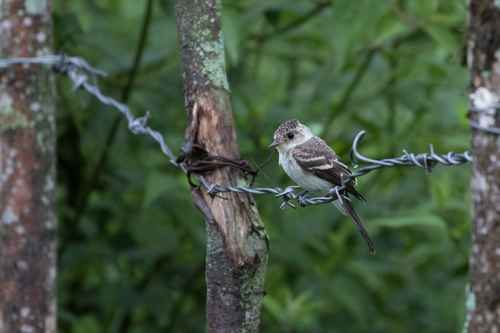 Northern Tropical Pewee
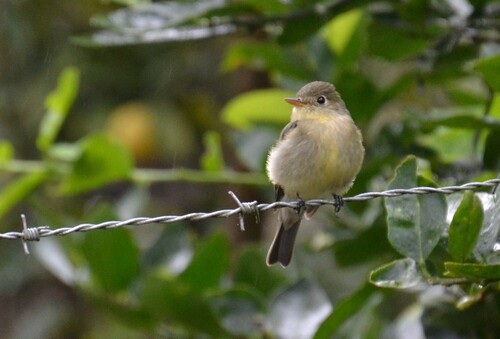 Yellow-bellied Flycatcher
In short
The most reliable field mark to separate Northern Tropical Pewee and Yellow-bellied Flycatcher is the color and pattern of the underparts and wing bars, especially in juveniles: juvenile pewees show browner upperparts and broad cinnamon-buff tips to wing coverts, while Yellow-bellied Flycatchers of all ages have strong yellowish underparts and bold, contrasting wing bars. Adults can be separated by the pewee’s sooty olive-gray upperparts and thin wing bars versus the flycatcher's greenish back, yellow belly, and much more prominent wing bars. Bill color also helps: the pewee has a yellowish or orangey mandible, while the flycatcher’s lower mandible is orange-pink. Both species perch upright and sally for insects, but the pewee often returns to the same perch and shivers its tail, while the flycatcher may hover over foliage. Size is similar, but the pewee can appear slightly slimmer and longer-tailed.
Identification tips
- Juvenile wing coverts: Juvenile Northern Tropical Pewee shows broad pale cinnamon-buff tips to wing coverts, giving a warm, buffy look to the wing bars. Yellow-bellied Flycatcher juveniles (and adults) have bold white or yellowish wing bars, but not the broad cinnamon-buff of the pewee.
- Upperparts color: Pewee is sooty olive-gray above (adults) or browner (juveniles), while flycatcher is always greenish above.
- Underparts color: Pewee has white to yellowish white underparts with only a faint gray tinge on the upper breast; flycatcher is distinctly yellow below, especially on the throat and belly.
- Wing bars: Pewee’s wing bars are thin and grayish white to brownish gray, often subtle; flycatcher’s are bold, white or yellowish, and strongly contrast with the blackish wings.
- Eye-ring: Both have a white or pale eye-ring, but the pewee’s is thin and the flycatcher’s is often more prominent, never with a teardrop projection (which is diagnostic for Western Flycatcher, not these two).
- Bill color: Pewee has a black upper mandible and yellowish/orangey lower mandible (dusky orange in juveniles); flycatcher’s lower mandible is orange-pink, upper is dark.
- Tail length: Pewee’s tail is slightly longer and olive-gray; flycatcher’s is relatively short and not as distinct in color.
- Crest: Pewee has a slight crest on the crown, giving a subtly peaked appearance; flycatcher’s crown is flatter.
- Face pattern: Pewee’s face is grayish olive with white to grayish white lores; flycatcher’s face is greenish with a brighter yellow throat.
- Perching behavior: Pewee often returns to the same perch and shivers its tail after sallying; flycatcher may hover over foliage and does not show the same tail-shivering habit.
- Habitat context: In tropical forest edge or mid-level perches, pewee is more likely; in boreal or northern mixed forest, especially during migration, flycatcher is more likely.
- Feeding behavior: Pewee is strictly insectivorous and rarely joins mixed flocks; flycatcher may eat berries or seeds and is more flexible in foraging.
- Vocalization: If heard, the flycatcher’s rough, descending "tse-berk" may help, but pewee’s voice is not described here.
- Sex and season: Both species are sexually monomorphic in plumage; seasonal variation is subtle, but juvenile pewee’s buffy wing coverts are a strong mark in late summer and fall.
- Pitfall: Beware of lighting: the pewee’s subtle olive and gray tones can look greener in deep shade, and the flycatcher’s yellow belly can be subdued in poor light. Always check multiple marks.
Size
Both species are similar in length (Northern Tropical Pewee: 12–14 cm; Yellow-bellied Flycatcher: 13–15 cm), and their weights overlap (Pewee: 8–14 g; Flycatcher: 8.5–17 g), but the flycatcher averages slightly heavier (mean 11.3 g). In the field, size is not a strong separator, but the pewee may look a bit more slender and long-tailed, while the flycatcher appears more compact with a shorter tail.
Plumage
- Juveniles: Juvenile Northern Tropical Pewees have browner upperparts than adults, with broad buff to cinnamon-buff edges on upperpart feathers and wide pale cinnamon-buff tips to wing coverts; their chin is brown. Juvenile Yellow-bellied Flycatchers are not described in detail, but all ages show greenish upperparts and strong yellow underparts, with bold white or yellowish wing bars.
- Adults: The pewee is sooty olive-gray above with a dark crown and thin grayish white to brownish gray wing bars. Its underparts are white to yellowish white, with only a gray tinge on the upper breast. The flycatcher is greenish above, with a brighter yellow belly and throat, and the wing bars are much more prominent and contrasting against blackish wings. The pewee’s face is grayish olive with a thin white eye-ring, while the flycatcher’s eye-ring is white or yellow, never teardrop-shaped.
- Bill: The pewee has a black maxilla and yellowish/orangey mandible (juveniles: dusky orange), while the flycatcher’s upper mandible is dark and lower mandible is orange-pink.
- Tail: The pewee’s tail is olive-gray and slightly longer; the flycatcher’s tail is relatively short.
Behaviour
Both species sally for insects from perches, but the pewee typically sits more upright on exposed or semi-exposed perches at forest edge or mid-level, often returning to the same perch and shivering its tail after each sally. The flycatcher also perches low or mid-level, but is more likely to hover over foliage and may take berries or seeds in addition to insects. The pewee rarely joins mixed-species flocks, while the flycatcher’s flocking behavior is not specified.
Habitat
Northern Tropical Pewee is found from southeastern Mexico to northern South America, favoring forest edges and mid-level perches. Yellow-bellied Flycatcher breeds in boreal or mixed forests and is more likely to be found in North America during migration or breeding. In overlapping ranges, context and habitat can help: pewee is more likely in tropical/subtropical forest edge, flycatcher in northern or migratory woodland settings.
Voice
The Yellow-bellied Flycatcher gives a rough, descending "tse-berk" song, which can be confused with the Least Flycatcher but is not described for the pewee. The pewee’s vocalizations are not detailed in the sources, so voice is not a reliable separator here.
Northern Tropical Pewee · Yellow-bellied Flycatcher · My Tricky Birds