

New Zealand Fantail vs Welcome Swallow
Rhipidura fuliginosa versus Hirundo neoxena
Play a quiz with New Zealand Fantail and Welcome Swallow
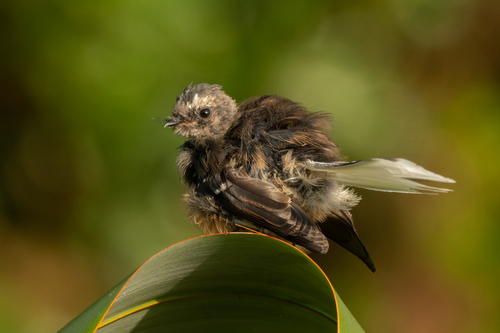 New Zealand Fantail
 Welcome Swallow
In short
The most reliable field mark to separate New Zealand Fantail from Welcome Swallow is the tail: fantails display a broad, fan-shaped tail (often fanned and showing strong contrast between white outer and dark central feathers), while swallows have a long, deeply forked tail with white spots. In flight, the fantail's erratic, flitting movements and frequent tail-fanning are distinctive, contrasting with the swallow's smooth, swift, gliding flight and long, pointed wings. Juvenile swallows lack the long tail streamers of adults, but still show a forked tail, while juvenile fantails resemble adults but are browner and less well-marked. Both species are small and agile, but the fantail is lighter and more compact. Calls differ: fantails have a metallic, chattering call, while swallows give soft twitters and warbles.
Identification tips
- Tail shape is the single best field mark: Fantails have a broad, rounded, fan-shaped tail, often fanned and showing strong contrast between white outer and dark central feathers (except in the rare black morph). Swallows have a long, deeply forked tail with pointed streamers and a row of white spots; even juveniles show a forked tail, though the streamers are shorter.
- Flight style: Fantails are erratic, flitting, and often hover or sally from perches, frequently fanning their tails. Swallows fly smoothly and swiftly, with long glides and rapid, direct flight, rarely fanning their tails.
- Upperparts color: Fantails are grey or brown above (never metallic), while swallows are metallic blue-black above.
- Underparts color: Fantails are yellowish or orange below with a dark chest band and white throat; swallows are light grey below with a rusty (rufous) forehead, throat, and upper breast, lacking any chest band.
- Facial markings: Fantails have a white throat and white markings over the eye; swallows have a rusty (rufous) forehead and throat, with no white supercilium.
- Tail markings: Fantail's tail is boldly patterned with white outer feathers (except in black morphs); swallow's tail has a row of white spots on the feathers, visible when tail is spread.
- Juvenile differences: Juvenile swallows have buffy white (not rufous) forehead and throat, and shorter tail streamers, but still show a forked tail. Juvenile fantails are browner than adults, with less distinct markings, but retain the fan-shaped tail.
- Perching behavior: Fantails perch frequently, often flicking and fanning their tails; swallows rarely perch for long, and when they do, their long, forked tail is obvious.
- Foraging behavior: Fantails sally from perches and often follow people to catch disturbed insects; swallows forage exclusively on the wing, often over water or open ground.
- Habitat preference: Fantails are more common in wooded or shrubby habitats; swallows prefer open areas, farmland, and water bodies.
- Voice: Fantail's call is a metallic, chattering 'cheek', while swallow's call is a soft twitter or warble, quieter and less distinctive.
- Size and structure: Swallows are heavier and more elongated, with long wings and tail; fantails are lighter, more compact, and round-bodied.
- Rare morphs: The black morph fantail is all dark except for a white spot behind the eye, but still shows the fan-shaped tail and erratic behavior; swallows are never all dark.
- Seasonal context: Both species are present year-round in much of New Zealand, but swallows are more likely to be seen in open habitats and over water, especially in flocks outside the breeding season.
- Common pitfalls: Juvenile swallows lacking long tail streamers may be mistaken for fantails, but always check for the forked (not fanned) tail and absence of chest band or yellowish underparts.
Size
Welcome Swallow is about twice as heavy as New Zealand Fantail (15.0 g vs 7.2 g [wikidata]), but both are similarly small in overall length (fantail: 16 cm, swallow: 15 cm [wikipedia]). The fantail's length is exaggerated by its broad, fanned tail, while the swallow's length includes its long, forked tail streamers (longer in males). In hand, swallows are noticeably more robust and heavier-bodied, but this is subtle in the field. The fantail appears more compact and rounded, while the swallow is sleeker and more elongated.
Plumage
Juvenile welcome swallows are buffy white on the forehead and throat, with shorter tail streamers than adults, but still show a forked tail. Juvenile fantails are similar to adults but browner overall and have less distinct body markings; their tail is still broad and fan-shaped. Adult New Zealand Fantails are mid to dark grey or grey-brown above, yellowish or orange below, with a dark chest band, white throat, and striking white outer tail feathers (or, in the rare black morph, all dark except a white spot behind the eye). Welcome Swallows are metallic blue-black above, light grey below, and have a rusty (rufous) forehead, throat, and upper breast, with a long, deeply forked tail marked by a row of white spots. The swallow's underparts are never yellowish or orange as in the fantail, and the fantail never shows the swallow's metallic blue-black upperparts or rufous face.
Behaviour
New Zealand Fantails are almost never still, constantly flitting from perch to perch, often fanning and flicking their tails, and frequently foraging close to people or on the ground. Their flight is erratic and fluttery, with abrupt changes of direction. Welcome Swallows, by contrast, are graceful, agile fliers, usually seen flying fast and low in open areas, often in wide circles or figure-eights. They rarely perch for long, and their flight is smooth, with long glides and swift, darting movements. Swallows often drink on the wing and may be seen swooping over water, which fantails do not do.
Habitat
Both species can be found throughout New Zealand, including gardens, parks, and forest edges. Fantails are more often seen in wooded or shrubby areas, including suburban gardens, where they forage among trees and bushes. Welcome Swallows prefer open country, farmland, lakeshores, and urban areas, and are especially common near water. While there is overlap, swallows are more likely in open, treeless habitats and over water, while fantails are more tied to vegetation.
Voice
New Zealand Fantail gives a metallic 'cheek' call, often repeated in a chattering series. The call is sharp and carries well. Welcome Swallow produces a mixture of soft twittering and warbling notes, with a sharp whistle in alarm, but their calls are generally quieter and less far-carrying than the fantail's. In the field, the fantail's call is more likely to draw attention.