

Narcissus Flycatcher vs Mugimaki Flycatcher
Ficedula narcissina versus Ficedula mugimaki
Play a quiz with Narcissus Flycatcher and Mugimaki Flycatcher
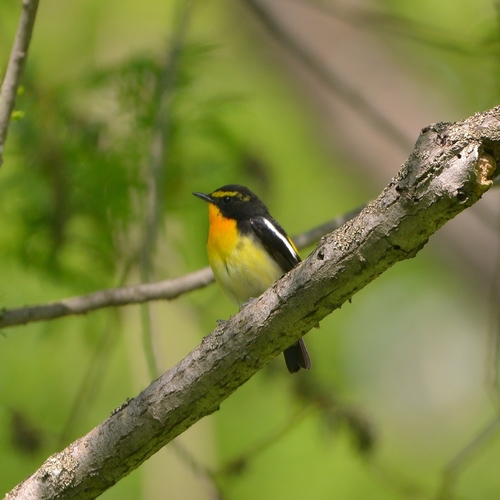 Narcissus Flycatcher
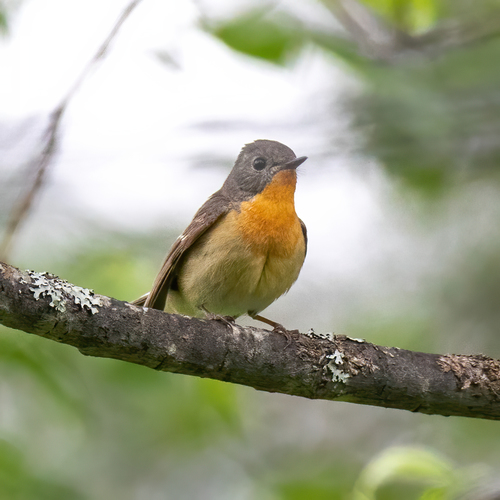 Mugimaki Flycatcher
In short
The most reliable field mark between Narcissus Flycatcher and Mugimaki Flycatcher is the combination of head and wing pattern in adult males: Narcissus males show a bold orange-yellow eyebrow and throat with a black crown and a prominent white wing patch, while Mugimaki males have a shorter white supercilium, orange-red throat and breast, and a white wing patch but also white at the base of the outer tail feathers. Females and immatures of both species are much duller and more similar, but Mugimaki females and young males often show faint or absent supercilium and lack the strong wing patch of adult Narcissus. Juvenile and first-winter birds are particularly tricky, but subtle differences in wing and tail pattern, as well as supercilium and underpart color, can help. Both species are highly migratory and overlap in much of East Asia, so context alone is not reliable.
Identification tips
- Adult male head pattern: Narcissus has a bold orange-yellow eyebrow (supercilium) and black crown; Mugimaki has a shorter, less obvious white supercilium and blackish crown. This is a key field mark in spring and early summer.
- Adult male throat and breast: Narcissus shows a bright orange throat with paler chest and underparts; Mugimaki has a more orange-red throat and breast with a sharp contrast to the white belly and undertail.
- Adult male wing patch: Both have a white wing patch, but Narcissus's is typically larger and more sharply defined. Mugimaki also has white edges to the tertials.
- Tail pattern (adult male and young male Mugimaki): Mugimaki shows white at the base of the outer tail feathers, visible in flight or when tail is flicked. Narcissus lacks this white in the tail.
- Rump color (adult male Narcissus): Narcissus has a distinctive orange-yellow rump, which is absent in Mugimaki.
- Female and immature supercilium: Narcissus females have a two-toned eyering and generally lack a supercilium; Mugimaki females and young males may show a faint or absent supercilium, but when present, it is shorter and paler than in male Narcissus.
- Female and immature wing pattern: Narcissus females have rusty-colored wings without obvious wingbars; Mugimaki females and young males have one or two pale wingbars, not a bold patch.
- Underparts (female/immature): Narcissus females are buff-brown below, while Mugimaki females are pale orange-brown on the breast and throat, with a whiter belly.
- Eyering (female Narcissus): The two-toned eyering of Narcissus female is a subtle but helpful mark when seen well.
- Behavioral cues: Mugimaki is especially prone to flicking wings and tail, but this is not exclusive.
- Plumage variability: Non-breeding and first-year males of both species can show intermediate features; in these cases, look for tail pattern and wingbars/patches.
- Song and call: If singing, Narcissus gives melodious whistles; Mugimaki has a rattling call. Use with caution unless heard well.
- Habitat and context: Both can occur together in migration; do not rely on habitat alone.
- Size: Narcissus is slightly heavier, but not noticeably so in the field.
- Pitfalls: Beware of confusing dull first-year males of both species, which can show a mix of features. Focus on tail pattern, wing markings, and head pattern for best results.
Size
Narcissus Flycatcher is slightly heavier (12.0g) than Mugimaki Flycatcher (10.8g), but this difference is not likely to be noticeable in the field. Both are small, active flycatchers with similar overall proportions. Length is not diagnostic between them.
Plumage
- Juvenile/First-winter/Immature birds: Both species are drab, but Mugimaki young males can show a more obvious supercilium and some white in the tail, while Narcissus females and immatures are generally buff-brown with rusty wings and a two-toned eyering. Mugimaki females and young males lack the strong white wing patch of adult Narcissus and instead have one or two pale wingbars.
- Adult males (breeding): Narcissus male is striking with a black crown and mantle, orange-yellow eyebrow, bright orange throat, paler chest, orange-yellow rump, and a bold white wing patch. Mugimaki male has blackish upperparts, a short white supercilium, orange-red throat and breast, white belly and undertail, a white wing patch, and white at the base of the outer tail feathers.
- Adult females: Narcissus female is buff-brown with rusty wings and a two-toned eyering, lacking strong wing or tail markings. Mugimaki female is grey-brown above, pale orange-brown below, with faint or absent supercilium, one or two pale wingbars, and no white in the tail.
Behaviour
Both species are active, often flicking wings and tail. Mugimaki Flycatcher is noted for frequent wing and tail flicking, especially when foraging in the canopy. Both species are typically seen alone or in small groups, sallying for insects. Behavior is not a strong separator, but Mugimaki may appear slightly more restless and is more likely to be seen in parks and gardens during migration.
Habitat
Both species breed in temperate forests and woodlands and migrate through similar habitats in East Asia. Mugimaki Flycatcher is especially associated with higher elevation forests but also frequents parks and gardens on migration. Narcissus Flycatcher prefers deciduous woodlands. Habitat overlap is extensive, so this is not a reliable separator.
Voice
Narcissus Flycatcher males sing repeated melodious whistles during the breeding season. Mugimaki Flycatcher has a rattling call. Song is useful if heard well, but both species are often silent on migration and calls can be hard to distinguish in the field.
Narcissus Flycatcher · Mugimaki Flycatcher · My Tricky Birds