

Mottle-cheeked Tyrannulet vs Pearly-vented Tody-Tyrant
Phylloscartes ventralis versus Hemitriccus margaritaceiventer
Play a quiz with Mottle-cheeked Tyrannulet and Pearly-vented Tody-Tyrant
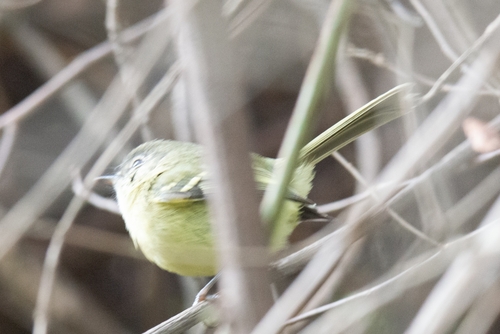 Mottle-cheeked Tyrannulet
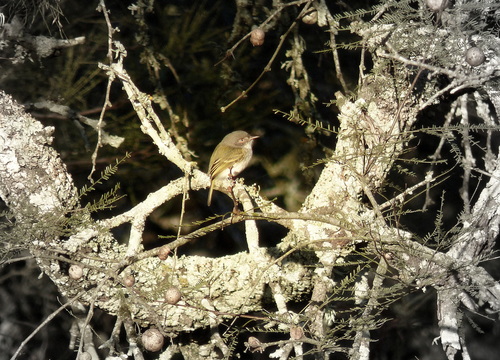 Pearly-vented Tody-Tyrant
In short
The most reliable field mark between Mottle-cheeked Tyrannulet and Pearly-vented Tody-Tyrant is the facial pattern: Mottle-cheeked Tyrannulet shows distinctive mottled cheeks with a broken whitish eye-ring and a strong dusky 'moustache', while Pearly-vented Tody-Tyrant has a plainer grayish-brown face with a whitish eye-ring and lores, but lacks the mottling and strong facial contrast. Both species have two wing bars and similar size, but the tyrannulet is slightly longer and slimmer, with a more olive-toned upperpart and yellowish underparts, compared to the tody-tyrant’s grayish-brown tones and white underparts. In perched or flight views, focus on the facial pattern and the tone of the underparts for the most reliable separation.
Identification tips
- Facial pattern is key: Mottle-cheeked Tyrannulet shows a short whitish supercilium, broken whitish eye-ring, strong dusky eye-stripe, a wide crescent below the eye, a dusky 'moustache', and distinctive mottled cheeks. Pearly-vented Tody-Tyrant has a plain grayish-brown face with a whitish eye-ring and lores, but lacks the mottling and strong facial contrasts. This is the most reliable separator in all ages and seasons.
- Upperparts color: Tyrannulet is dark olive above with bright olive-yellow on the outer webs of the flight feathers and tail base, giving a greenish cast. Tody-tyrant is grayish-brown to brownish olive above, with a gray crown and no greenish or yellowish tones on the wings or tail.
- Underparts: Mottle-cheeked Tyrannulet has olive-grayish to yellowish underparts, sometimes with faint olive markings, and paler yellow belly/undertail coverts. Pearly-vented Tody-Tyrant is white below with faint grayish streaking and may have a slight yellow tinge on the flanks in some subspecies, but is never as yellow as the tyrannulet.
- Wing bars: Both species show two pale wing bars, so this is not a safe separator. However, the tyrannulet’s wing bars may appear more yellow, while the tody-tyrant’s are buff-whitish to yellow.
- Bill color and shape: Mottle-cheeked Tyrannulet has a long, flat, pointed black bill with a pinkish to yellowish base to the mandible. Pearly-vented Tody-Tyrant has a reddish brown to blackish maxilla and a pinkish brown to pinkish mandible; bill is generally shorter and stubbier.
- Iris color: Tyrannulet has a dark brown iris; tody-tyrant has a pale iris. This can be useful at close range.
- Leg color: Tyrannulet has slate to bluish gray legs and feet; tody-tyrant’s are pink to pale grayish pink. This is subtle but can help in good light.
- Structure and jizz: Tyrannulet is slightly longer and slimmer, often perching horizontally and sometimes cocking its tail. Tody-tyrant is more compact and may appear shorter-tailed.
- Habitat context: In humid, mid-story/canopy forest, expect tyrannulet; in dry scrub, woodland edge, or shrubby pasture, expect tody-tyrant.
- Behavior: Tyrannulet often forages higher and joins mixed-species flocks; tody-tyrant is more often low in dense vegetation.
- Tail pattern: Both have dusky tails, but tyrannulet shows olive-yellow outer webs at the base, sometimes visible in good light or flight.
- Subspecies variation: Some tody-tyrant subspecies show more yellow or streaking, but none approach the facial contrast of tyrannulet.
- Sex and age: Both species have similar plumage across sexes and ages; no distinct juvenile/immature wing patterns are described.
- Flight views: In flight, focus on the facial pattern and any yellow tones in the wings/tail for tyrannulet; tody-tyrant remains plain-faced and grayish-brown.
- Pitfalls: Do not rely on wing bars or general size alone; always check the face and underparts color for a confident ID.
Size
Both species are very small flycatchers, but Mottle-cheeked Tyrannulet averages slightly larger at about 12 cm in length and 8 g in mass [wikidata], while Pearly-vented Tody-Tyrant is about 10–11 cm and 7–10 g [wikipedia]. The difference is subtle and not always obvious in the field, but the tyrannulet may appear a bit longer and more slender, while the tody-tyrant is more compact. Size alone is not a safe separator unless seen side-by-side.
Plumage
-
Juvenile/immature wing pattern: No age-specific upperwing patterns are described for either species; both have two pale wing bars formed by tips of the wing coverts, visible in all plumages.
-
Adult plumage: Mottle-cheeked Tyrannulet is olive above with bright olive-yellow outer webs at the base of the flight feathers and tail, and has a distinctive facial pattern: short whitish supercilium, broken whitish eye-ring, dusky eye-stripe, wide crescent below the eye, dusky 'moustache', and mottled cheeks. Underparts are olive-grayish to yellowish, sometimes with faint olive markings, and the belly/undertail coverts can be paler yellow. Pearly-vented Tody-Tyrant is grayish-brown to brownish olive above, with a gray crown, whitish lores and eye-ring, and a generally plainer face. Its wings are dusky with buff-whitish to yellow edges and two wing bars. Underparts are white with faint grayish streaking, and the tail is dusky. Subspecies variation exists in both, but the main differences hold across their ranges: tyrannulet is more olive/yellow and strongly marked on the face, tody-tyrant is grayer/browner and plainer-faced.
Behaviour
Mottle-cheeked Tyrannulet is typically seen foraging actively in the mid-story to canopy, sometimes lower, often singly or in pairs, and sometimes joins mixed-species flocks. It perches horizontally and may cock its tail slightly. Its foraging involves short sallies and hover-gleaning, with wings making a whirring sound. Pearly-vented Tody-Tyrant is more often found in shrubby, dry habitats, foraging in the undergrowth or at forest edges, and is generally more associated with low, dense vegetation. Both species are active and may be seen making short flights, but the tyrannulet is more likely to be higher in the forest strata.
Habitat
Mottle-cheeked Tyrannulet is found in humid and semi-humid forests, often in the mid-story or canopy, across southern and eastern South America (Argentina, Bolivia, Brazil, Paraguay, Peru, Uruguay). Pearly-vented Tody-Tyrant is much more of a dry-country specialist, found in arid scrub, shrubby pastures, woodland edges, and second-growth scrub throughout most of South America except Chile, Ecuador, French Guiana, and Suriname. If you find the bird in dense, humid forest canopy, Mottle-cheeked Tyrannulet is more likely; in dry, shrubby, or edge habitats, Pearly-vented Tody-Tyrant is favored.
Mottle-cheeked Tyrannulet · Pearly-vented Tody-Tyrant · My Tricky Birds