

Mottle-cheeked Tyrannulet vs Bay-ringed Tyrannulet
Phylloscartes ventralis versus Phylloscartes sylviolus
Play a quiz with Mottle-cheeked Tyrannulet and Bay-ringed Tyrannulet
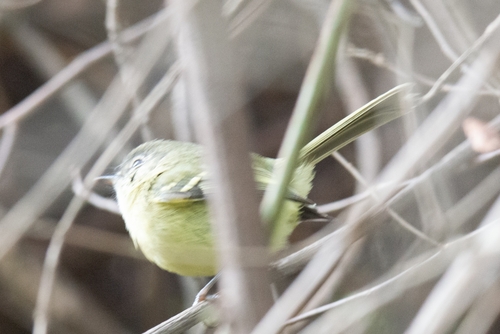 Mottle-cheeked Tyrannulet
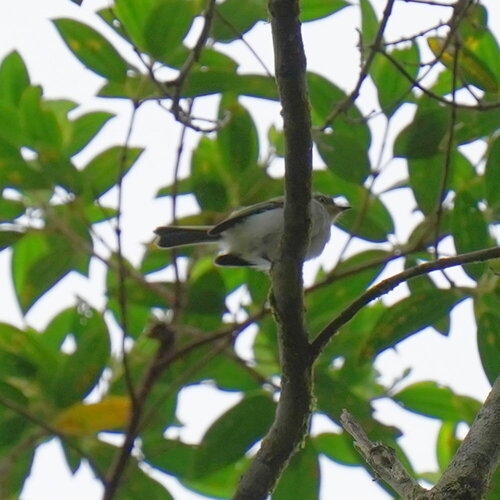 Bay-ringed Tyrannulet
In short
The most reliable field mark to separate Mottle-cheeked Tyrannulet from Bay-ringed Tyrannulet is the facial pattern: Mottle-cheeked shows a distinctive mottled cheek with a broken whitish eye-ring and dusky 'moustache', while Bay-ringed has a bold rufous-chestnut lore and eye-ring that stand out against its otherwise olive face. Both species are small, active Phylloscartes tyrannulets with similar size and structure, but their head and underpart coloration are key. In the field, pay close attention to the color and pattern around the eye, lores, and cheeks, as well as the iris color. Wing and tail patterns are subtle but can help when combined with facial marks. Both species often join mixed flocks and forage in the canopy, so context is not always helpful for separation.
Identification tips
- Facial pattern is key: Mottle-cheeked Tyrannulet has a mottled cheek with a broken whitish eye-ring, dusky 'moustache', and a crescent below the eye; Bay-ringed Tyrannulet has a bold rufous-chestnut lore and a wide matching eye-ring, with no mottling.
- Iris color: Mottle-cheeked has a dark brown iris, while Bay-ringed has a bright white iris. This is often visible in good light and is a strong field mark.
- Supercilium and eye-ring: Mottle-cheeked shows a short, thin whitish supercilium and an indistinct, broken eye-ring; Bay-ringed lacks a supercilium but has a wide, continuous rufous-chestnut eye-ring.
- Lore color: The rufous-chestnut lores of Bay-ringed are unique and contrast with the olive upper face, while Mottle-cheeked has dusky lores blending into the facial mottling.
- Cheek and moustache: Only Mottle-cheeked shows the distinctive mottled cheek and dusky 'moustache' mark; Bay-ringed's face is clean except for the rufous eye-ring.
- Crown and upperparts: Both are olive, but Mottle-cheeked is darker and less bright than Bay-ringed's bright olive crown and back.
- Wing pattern: Both have dusky wings with yellowish or pale yellow wing bars, but Mottle-cheeked may show two wing bars (from yellow-tipped coverts), while Bay-ringed typically shows a single bar.
- Tail edges: Mottle-cheeked has bright olive-yellow outer webs at the base of tail feathers; Bay-ringed has olive edges but not as bright or extensive.
- Underparts: Mottle-cheeked is more olive-gray to yellowish with faint olive markings; Bay-ringed is mostly whitish with a greenish dusky tinge on the sides and yellow undertail coverts.
- Chin and throat: Mottle-cheeked has a whitish chin and upper throat; Bay-ringed has a yellow chin and paler yellow throat.
- Bill and legs: Both have a pointed black bill and bluish gray to slate legs—these are not useful for separation.
- Foraging behavior: Both species forage similarly, so behavior is not reliable for separation.
- Habitat and range: Where both occur, habitat is not diagnostic, but Mottle-cheeked is more widespread outside the core Atlantic Forest region.
- Age/sex variation: Both sexes and all ages look similar within each species; no juvenile or immature-specific wing or tail marks are described for either.
- Lighting and angle: In poor light, iris color and subtle facial marks may be hard to see, so prioritize the boldness and color of the lore/eye-ring and overall face pattern.
Size
Both species are essentially identical in size, with an average body mass of about 8 grams and a length of approximately 12 cm. There are no meaningful differences in structure or proportions that can be reliably used in the field to separate them. Bill shape and tail length are also similar, so do not rely on size or jizz alone for identification.
Plumage
No age-specific upperwing or flight marks are described for either species, so focus on adult plumage. Mottle-cheeked Tyrannulet has a short, thin whitish supercilium, a broken whitish eye-ring, dusky line through the eye, and a distinctive mottled cheek with a dusky 'moustache' and a crescent below the eye. Its crown and upperparts are dark olive, with dusky wings featuring bright olive-yellow outer webs at the base of the flight feathers and two yellowish wing bars. Underparts are variable but generally olive-gray to yellowish, sometimes with faint olive markings. The iris is dark brown.
Bay-ringed Tyrannulet, in contrast, shows a strong rufous-chestnut coloration at the lores that extends into a wide, matching eye-ring, setting off a bolder facial pattern. The upper face is olive, lower face pale yellow, and the crown/upperparts are bright olive. The wings are dusky with olive edges and a single pale yellow wing bar. The tail is dusky with olive edges. Underparts are mostly whitish with a greenish dusky tinge on the sides of the breast/flanks and yellow undertail coverts. The iris is bright white, a striking contrast to Mottle-cheeked. Both have a pointed black bill and bluish gray to slate legs.
Behaviour
Both species forage actively in the mid-story to canopy, often joining mixed-species flocks, and use similar feeding strategies—short sallies and hover-gleaning from leaves and twigs. Both perch horizontally, sometimes with the tail cocked up. There is no significant behavioral difference to separate them in the field.
Habitat
Their ranges overlap in Argentina, Brazil, and Paraguay, and both are found in forested habitats. Mottle-cheeked Tyrannulet is more widespread, occurring also in Bolivia, Peru, and Uruguay, while Bay-ringed is more restricted. Both species forage mainly in the canopy or mid-story, so habitat and foraging height are not reliable for separation where their ranges overlap.
Mottle-cheeked Tyrannulet · Bay-ringed Tyrannulet · My Tricky Birds