

Malaysian Eared-Nightjar vs Great Eared-Nightjar
Lyncornis temminckii versus Lyncornis macrotis
Play a quiz with Malaysian Eared-Nightjar and Great Eared-Nightjar
 Malaysian Eared-Nightjar
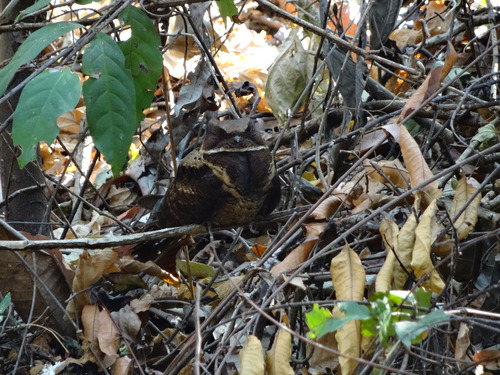 Great Eared-Nightjar
In short
The most reliable field mark to separate Malaysian Eared-Nightjar from Great Eared-Nightjar is size: Great Eared-Nightjar is much larger and heavier, with a longer body and tail. Both species have long ear-tufts, cryptic brown plumage, and white throat markings, but the Great Eared-Nightjar lacks any white on the wings or tail, while Malaysian Eared-Nightjar shows white speckling on the wings and more buff on the underparts. Juveniles of Malaysian Eared-Nightjar are more cinnamon and orange-brown above, with less speckling and buff below, which helps distinguish them from the generally greyer and more heavily barred Great Eared-Nightjar. Structure and overall bulk in the field are often the quickest clues, especially when perched birds are partially hidden.
Identification tips
- Size is the most immediate clue: Great Eared-Nightjar is much larger and heavier than Malaysian Eared-Nightjar. If you see a nightjar that appears especially long-bodied and bulky, favor Great Eared-Nightjar.
- Ear-tufts: Both species have prominent ear-tufts, but these are not always visible. When visible, both can show long tufts, but Great Eared-Nightjar's are often more recumbent, while Malaysian Eared-Nightjar's may stand more upright when alert.
- White on wings: Malaysian Eared-Nightjar shows white speckling on the wings, visible in good light or in flight. Great Eared-Nightjar lacks any white on the wings or tail—this is a key separation point for all ages.
- Throat markings: Both have white on the throat, but Malaysian Eared-Nightjar may show a patch or spot, while Great Eared-Nightjar has a more complete white throat band.
- Underpart color: Malaysian Eared-Nightjar is buffier below, with more white dotting and a 'buffish' appearance, especially on the belly and undertail. Great Eared-Nightjar is more uniformly grey-brown and heavily barred below.
- Upperpart color: Malaysian Eared-Nightjar adults have a mix of greyish-brown and cinnamon-brown on the crown and nape, with a dark brown mantle and rump. Great Eared-Nightjar is more uniformly grey-brown and streaked.
- Juvenile/immature plumage: Young Malaysian Eared-Nightjars are more cinnamon and orange-brown above, with less speckling and buff below. This contrasts with the generally greyer, more barred look of Great Eared-Nightjar of any age.
- Tail pattern: Great Eared-Nightjar has a long, barred tail with no white. Malaysian Eared-Nightjar's tail is also long but may show more buff and white dotting near the undertail.
- Flight jizz: In flight, Great Eared-Nightjar appears more powerful and heavyset, with long, pointed wings and a long tail. Malaysian Eared-Nightjar is sprier and more agile.
- Bill and gape: Both have wide, short bills typical of nightjars, but Great Eared-Nightjar's gape is especially wide (opens to ~120°), though this is rarely diagnostic in the field.
- Crown feathers: Malaysian Eared-Nightjar sometimes shows upright crown feathers behind the eyes, which can be mistaken for ear-tufts; check for the true ear-tufts at the rear crown.
- Camouflage: Both species are extremely well-camouflaged when roosting. Look for subtle differences in color and pattern if you have a good view.
- Context: If seen in southwest India, only Great Eared-Nightjar is possible. In Southeast Asia, both occur, so size and plumage are critical.
- Sex and season: No strong sexual or seasonal differences are described for either species, so use structural and plumage marks year-round.
- When in doubt: If the bird is very large, lacks any white on the wings or tail, and is heavily barred and grey-brown, it is almost certainly Great Eared-Nightjar. If it is smaller, buffier below, and shows white speckling on the wings, favor Malaysian Eared-Nightjar.
Size
Great Eared-Nightjar is the largest nightjar in its family, measuring 31–41 cm in length and weighing 131–151 g (males/females). Malaysian Eared-Nightjar is smaller at 25–28 cm in length (weight not specified, but distinctly lighter). In the field, Great Eared-Nightjar appears noticeably bulkier, longer-bodied, and longer-tailed, with proportionally longer wings. Malaysian Eared-Nightjar is medium-sized for its genus, larger than most nightjars but clearly smaller and less massive than Great Eared-Nightjar.
Plumage
- Juveniles/immatures: Malaysian Eared-Nightjar immatures are more cinnamon and orange-brown above, with less heavy speckling and reduced buff on the underparts compared to adults. Great Eared-Nightjar juveniles are not specifically described, but adults and immatures share the same general grey-brown, mottled, and heavily barred plumage.
- Adults: Malaysian Eared-Nightjar adults have cryptic brown, black, and grey plumage with white speckles on the wings and a white throat patch or spot. The underparts are buffy with white dotting, especially on the belly, flanks, and undertail. Great Eared-Nightjar adults are more uniformly grey-brown and heavily barred, with a white throat band but no white on the wings or tail. Both have long ear-tufts, but these are often more recumbent in Great Eared-Nightjar. The crown and nape of Malaysian Eared-Nightjar are more cinnamon-brown, and the mantle and rump are dark brown, aiding camouflage.
Behaviour
Both species are nocturnal and cryptically roost on the ground or low branches during the day, relying on camouflage. In flight, both show long wings and tails, but Great Eared-Nightjar appears more powerful and heavyset, while Malaysian Eared-Nightjar is described as spry and agile. Ear-tufts may be raised when alert, but often lie flat when the bird is at rest. Both species are difficult to spot when roosting due to their plumage.
Habitat
Both species occur in Southeast Asia, with Great Eared-Nightjar also found in southwest India. There is significant overlap in their ranges in Southeast Asia. Habitat preferences are not detailed in the notes, but both are typical of forested or wooded areas where they can roost and hunt at night.
Malaysian Eared-Nightjar · Great Eared-Nightjar · My Tricky Birds