

Malayan Night Heron vs Javan Pond Heron
Gorsachius melanolophus versus Ardeola speciosa
Play a quiz with Malayan Night Heron and Javan Pond Heron
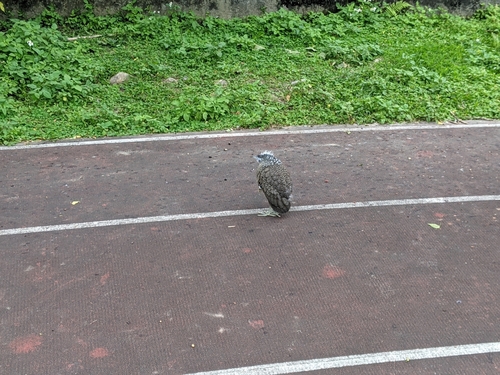 Malayan Night Heron
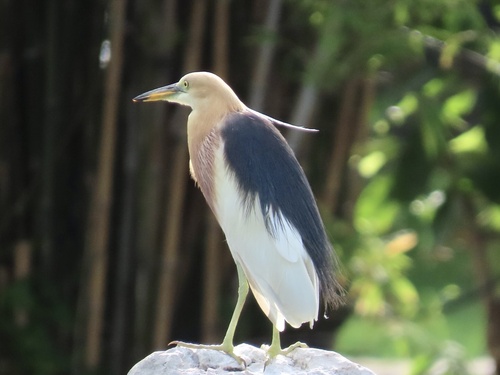 Javan Pond Heron
In short
The most reliable field mark to separate Malayan Night Heron from Javan Pond Heron is the wing and body coloration, especially in non-breeding and immature birds. Malayan Night Heron juveniles are greyish to rufous with heavy spotting and vermiculation, while Javan Pond Heron in non-breeding or immature plumage is brown and flecked with white, closely resembling other pond herons. In adults, Malayan Night Heron shows a rufous neck and breast with streaks, chestnut upperparts, and a black crown, while Javan Pond Heron in breeding plumage is orange, slaty, and white with strikingly white wings. Structural differences are subtle but Malayan Night Heron is stockier with a shorter bill. Habitat and behavior can help: Malayan Night Heron is usually solitary and terrestrial, often in wooded or urban parks, while Javan Pond Heron is more likely in open wetlands.
Identification tips
- Juvenile/immature plumage: Malayan Night Heron juveniles are heavily spotted and vermiculated, with a greyish to rufous tone; Javan Pond Heron juveniles are brown and flecked with white, lacking strong spotting. This is the most reliable mark for immatures, especially in flight or at a distance.
- Adult breeding plumage: Malayan Night Heron shows a rufous neck and breast with dark streaks, chestnut and vermiculated upperparts, black crown, and blackish flight feathers. Javan Pond Heron in breeding plumage is orange, slaty, and white with bright white wings—wings are especially diagnostic in flight.
- Adult non-breeding plumage: Malayan Night Heron retains its rufous and streaked appearance, while Javan Pond Heron becomes brown and flecked with white, resembling other pond herons and lacking the rufous/vermiculated look.
- Flight views: Malayan Night Heron shows blackish flight feathers and a stocky, short-necked profile. Javan Pond Heron shows white wings in breeding plumage and a more typical pond heron shape.
- Bill color: Malayan Night Heron has a black bill; Javan Pond Heron has a yellow bill with a black tip (especially obvious in breeding plumage).
- Leg color: Malayan Night Heron has greenish legs; Javan Pond Heron has yellow legs.
- Crown and face: Malayan Night Heron has a black crown and white chin; Javan Pond Heron lacks a black crown.
- Eye color: Both have yellow eyes, so this is not useful for separation.
- Structure: Malayan Night Heron is stockier and shorter-billed; Javan Pond Heron is more slender and longer-billed, but this is subtle and best used in combination with plumage.
- Behavior: Malayan Night Heron is usually solitary and terrestrial, often away from water; Javan Pond Heron is more likely to be seen in groups and in wetlands.
- Habitat: Malayan Night Heron in wooded parks, gardens, or urban areas; Javan Pond Heron in open wetlands, rice paddies, or marshes.
- Voice: If you hear a deep 'oo' or hoarse croak, suspect Malayan Night Heron. Javan Pond Heron is usually silent.
- Season: Javan Pond Heron is migratory and shows its brightest colors in the breeding season (June–September); Malayan Night Heron does not have such a dramatic seasonal change.
- Sexual differences: Malayan Night Heron males may show deeper blue lores and a longer crest during breeding, but this is subtle and rarely useful in the field.
- Pitfalls: Non-breeding Javan Pond Heron is extremely similar to other pond herons and can be confused with them, but never shows the strong rufous, streaked, and vermiculated pattern of Malayan Night Heron at any age.
Size
Malayan Night Heron is slightly larger and heavier (body mass ~415g, length 48 cm, wingspan 86 cm) than Javan Pond Heron (length ~45 cm; mass not specified but generally lighter than Malayan Night Heron). Malayan Night Heron is also stockier with a shorter beak, while Javan Pond Heron is more slender and typical of pond herons. However, size alone is not a reliable field mark unless both species are seen side by side.
Plumage
-
Juvenile/immature birds: Malayan Night Heron juveniles are greyish to rufous, heavily spotted and vermiculated overall, with a distinctive streaked rufous neck and breast. Javan Pond Heron juveniles and non-breeding birds are brown and flecked with white, lacking the heavy spotting and vermiculation of Malayan Night Heron, and are virtually indistinguishable from other pond herons (Chinese, Indian) in this plumage.
-
Adult breeding plumage: Malayan Night Heron adults have a rufous neck and breast with dark streaks, chestnut and vermiculated upperparts, blackish flight feathers, a black crown, white chin, and yellow eyes. Javan Pond Heron adults in breeding plumage have orange, slaty, and white body coloration with bright white wings, a yellow bill with a black tip, yellow eyes, and yellow legs.
-
Adult non-breeding plumage: Malayan Night Heron remains rufous and streaked, while Javan Pond Heron becomes brown and flecked with white, closely resembling other pond herons and lacking the strong rufous and vermiculated pattern of Malayan Night Heron.
-
Flight feathers: Malayan Night Heron has blackish flight feathers, while Javan Pond Heron has white wings (especially obvious in flight in breeding plumage).
Behaviour
Malayan Night Heron is solitary, often foraging alone in open areas, parks, or wooded environments, and is more terrestrial, sometimes seen feeding on earthworms and frogs in urban settings. It roosts in trees but is rarely seen in groups. Javan Pond Heron is more typical of pond herons, often found in shallow wetlands, sometimes in loose groups, and is more likely to be seen wading in water for insects, fish, and crabs. Malayan Night Heron is less likely to be seen in open, wet habitats frequented by Javan Pond Heron.
Habitat
Malayan Night Heron prefers wooded areas, urban parks, and sometimes feeds in open grassy areas, often away from open water. It is usually solitary and can be found nesting near buildings in urban areas. Javan Pond Heron is strongly associated with shallow fresh and salt-water wetlands, rice paddies, and marshes, and is rarely found far from water. Habitat is a useful clue: a heron in a wooded park or away from water is more likely Malayan Night Heron, while one in a wetland is likely Javan Pond Heron.
Voice
Malayan Night Heron's territorial call is a deep 'oo' note, with additional hoarse croaks and 'arh, arh, arh' sounds. No distinctive vocalization is described for Javan Pond Heron in these notes, so voice is only useful if Malayan Night Heron's deep calls are heard.