

Little Bittern vs White-backed Night Heron
Botaurus minutus versus Calherodius leuconotus
Play a quiz with Little Bittern and White-backed Night Heron
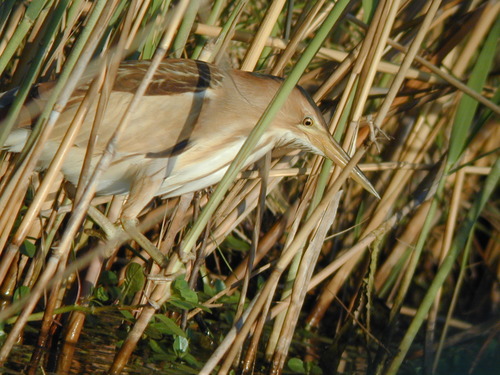 Little Bittern
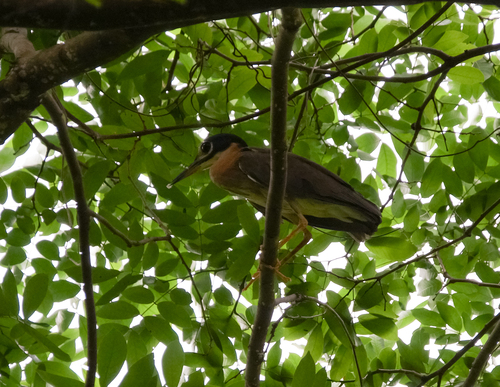 White-backed Night Heron
In short
The most reliable field mark for separating Little Bittern and White-backed Night Heron, especially in immature birds, is the upperwing pattern: juvenile White-backed Night Herons show distinct white spots on the upperwing coverts, while juvenile Little Bitterns are more uniformly rufous and streaked, lacking these spots. Adult Little Bitterns are much smaller, with a compact, delicate build and a pale forewing panel, while White-backed Night Herons are noticeably larger, with a striking white triangular patch on the back and a rufous neck and breast. Both species can show streaked underparts in immature plumages, but overall size, wing markings, and the presence or absence of a white scapular patch are key. Habitat and range are also helpful: Little Bitterns are European-African migrants, while White-backed Night Herons are resident in sub-Saharan Africa.
Identification tips
- Juvenile upperwing pattern: Look for white spots on the upperwing coverts—present in juvenile White-backed Night Heron, absent in Little Bittern of any age. This is the most reliable mark for immatures in flight or perched.
- Size and structure: Little Bittern is much smaller and more delicate, with a proportionally longer, thinner neck and bill. White-backed Night Heron is robust, heavyset, and noticeably larger.
- Forewing panel (adults): Adult Little Bitterns show a pale pinkish-buff oval panel on the inner wing coverts, contrasting with black wings. This is absent in White-backed Night Heron.
- White scapular patch: Adult White-backed Night Herons have a large, triangular white patch on the back (scapulars), visible when perched and sometimes in flight. Little Bitterns never show this feature.
- Head and eye: White-backed Night Heron has a black head with a short crest and large red eyes with white rings, while Little Bittern males have a black crown but lack the crest and red eye.
- Neck and breast color: White-backed Night Heron adults have a rufous (reddish-brown) neck and breast, contrasting with the pale buff underparts of Little Bitterns.
- Underwing color: Little Bitterns show completely whitish underwings in flight; White-backed Night Heron underwing color is not described as distinctive.
- Streaking: Both species can show streaked underparts in juveniles, but only White-backed Night Heron has white spots on the upperwing coverts.
- Bill shape: Both have long, sharp bills, but Little Bittern's is proportionally finer and longer relative to head size.
- Leg color: White-backed Night Heron has yellow legs; Little Bittern leg color is not specified but is not a primary field mark.
- Flight jizz: Little Bitterns fly with rapid, deep wingbeats and appear compact; White-backed Night Herons are bulkier and slower in flight.
- Habitat and range: If seen in Europe outside of migration, it's almost certainly Little Bittern. In sub-Saharan Africa, especially in wooded wetlands, White-backed Night Heron is more likely.
- Season: Little Bitterns are only present in Europe from mid-April to September; outside this window, White-backed Night Heron is more likely in Africa.
- Sex differences: Female Little Bitterns are duller and more streaked than males, but still lack the white scapular patch of White-backed Night Heron.
- Confusion risk: Immature birds are most often confused—focus on upperwing pattern (white spots vs. uniform rufous/streaked) and overall size.
Size
Little Bittern is significantly smaller, with a body mass of about 147 g and a length of 33–38 cm. In contrast, White-backed Night Heron is a medium-sized heron, 50–55 cm long, making it much bulkier and longer in the field. The Little Bittern is the smallest breeding heron in Europe, appearing almost dainty next to the robust, heavyset White-backed Night Heron.
Plumage
-
Juvenile/immature birds: Juvenile White-backed Night Herons are best recognized by their streaked breast and distinctive white spots on the upperwing coverts, a feature not present in Little Bittern. Juvenile Little Bitterns are more rufous overall and heavily streaked on both upperparts and underparts, including the wing coverts, but lack discrete white spots.
-
Adult males: Little Bittern males have a black crown, nape, back, and wings with a faint green sheen, and a contrasting pinkish-buff oval panel on the inner wing coverts. Their underparts are pale buff, and the underwing is whitish. White-backed Night Heron adults have a black head with a short crest, large red eyes with white rings, a rufous neck and breast, white throat, and a prominent white triangular patch on the back (scapulars). The belly is whitish-brown.
-
Adult females: Female Little Bitterns are duller, with brownish-black upperparts and more streaked, less clean underparts. Their wing panel is less obvious. Female White-backed Night Herons are not specifically described as differing from males, but the key marks (white scapular patch, rufous neck) remain.
-
In flight: Little Bitterns show pale forewing panels and whitish underwings, while White-backed Night Herons may show the white scapular patch and, in immatures, white spots on the upperwing.
Behaviour
Both species are secretive and often skulk in dense wetland vegetation, but Little Bitterns, due to their small size, can appear more agile and are often seen clambering through reeds or making short, low flights. White-backed Night Herons, being larger and heavier, move more deliberately and are often more crepuscular or nocturnal, sometimes roosting during the day. In flight, Little Bitterns appear compact and quick, while White-backed Night Herons look bulkier and slower.
Habitat
Little Bitterns breed in European wetlands and migrate to Africa for the winter, arriving in Europe from mid-April and departing by September. They prefer dense reedbeds and marshes. White-backed Night Herons are residents of sub-Saharan Africa, found in wooded wetlands, rivers, and lakes, often in more forested or shaded habitats than Little Bitterns. Range alone can be diagnostic outside migration periods.