

Javan Pond Heron vs Great White Egret
Ardeola speciosa versus Ardea alba
Play a quiz with Javan Pond Heron and Great White Egret
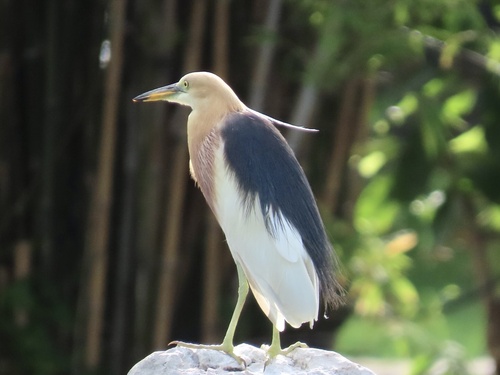 Javan Pond Heron
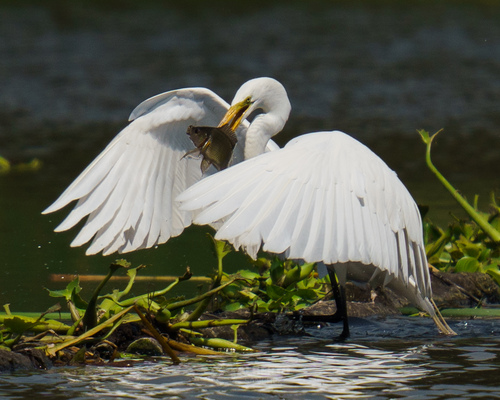 Great White Egret
In short
The most reliable field mark between Javan Pond Heron and Great White Egret is overall size and structure: Great White Egret is much larger, with a long neck and legs, while Javan Pond Heron is compact and short-necked. In flight, both show white wings, but the egret is strikingly big and all white, while the pond heron is much smaller and only shows all-white wings (body and head are colored in breeding season). Nonbreeding Javan Pond Herons are especially tricky, as their brown-streaked body can resemble other pond herons, but never matches the pure white of the egret. Bill and leg color also help: Javan Pond Heron has a yellow bill with a black tip and yellow legs, while Great White Egret has a yellow bill and black legs. Juvenile and nonbreeding pond herons are the biggest pitfall, as their duller colors can cause confusion.
Identification tips
- Size is the clearest separator: Great White Egret is nearly twice the length of Javan Pond Heron and much bulkier. If you see a large, stately white heron, it's almost certainly a Great Egret.
- Neck and leg length: Great Egret has a long, slender neck (often held in an S-shape in flight) and long black legs. Javan Pond Heron is short-necked and short-legged by comparison, with yellow legs.
- Bill color: Javan Pond Heron has a yellow bill with a black tip; Great Egret's bill is all yellow (may darken slightly in breeding season, but never has a black tip).
- Leg color: Javan Pond Heron shows yellow legs, while Great Egret has black legs and feet (lower legs may become lighter in breeding season, but never yellow).
- Plumage in flight: Both show white wings, but Great Egret is all white, while Javan Pond Heron (especially in breeding) shows colored (orange/slaty) or brown-streaked body and head contrasting with white wings.
- Breeding plumage: Javan Pond Heron develops bright orange and slaty colors on the body and head, but wings remain white. Great Egret remains all white but grows long ornamental plumes on the back.
- Nonbreeding/juvenile confusion: Nonbreeding Javan Pond Heron is brown and streaked, but wings are always white in flight. Great Egret is always pure white, regardless of age or season.
- Jizz and posture: Great Egret stands tall and upright, often in open water. Javan Pond Heron is hunched, often crouched at water's edge or among reeds.
- Flight style: Great Egret flies with slow, deep wingbeats and a retracted neck; Javan Pond Heron is quicker, more direct, and looks compact in flight.
- Habitat context: If the bird is in a large, open wetland or visible from a distance, it's more likely a Great Egret. If skulking at the edge or among vegetation, consider Javan Pond Heron.
- Head and body color in breeding season: Only Javan Pond Heron shows orange/slaty tones on the head and body; Great Egret never does.
- No all-white small pond herons: If you see a small heron with all-white body, head, and wings, it's not a Javan Pond Heron (unless it's a rare leucistic individual).
- Voice is not helpful: Both are mostly silent; Great Egret may give croaks at colonies, but this is rarely diagnostic in the field.
- Pitfall: Nonbreeding Javan Pond Heron can look very dull and brownish, but never matches the pure white of the egret except for the wings in flight.
- When in doubt, check multiple marks: Use size, neck/leg length, and bill/leg color together, especially when plumage is ambiguous (e.g., nonbreeding pond heron).
Size
Great White Egret is dramatically larger: adults measure 80–104 cm in length with a wingspan of 131–170 cm and average about 1,000 g in mass [wikipedia][avonet]. Javan Pond Heron is much smaller, about 45 cm long [wikipedia]. The egret stands nearly twice as tall and is much bulkier, with a longer neck and legs. In the field, the egret's size is obvious when both are seen together, but even singly, the egret's long-legged, long-necked, stately jizz is distinctive compared to the squat, short-necked pond heron.
Plumage
- Juvenile/Nonbreeding: Javan Pond Heron in nonbreeding or immature plumage is brown and streaky with white flecks, but always shows pure white wings in flight. The body and head remain brownish, never all-white. Great White Egret, both adult and juvenile, is pure white all over, including wings, body, and head, in all seasons and ages [wikipedia].
- Breeding Adult: Javan Pond Heron develops rich orange, slaty, and white tones on the body and head, but wings remain white. Great White Egret develops ornamental plumes on the back but remains all white.
- In flight: Both show white wings, but the egret is all white, while the pond heron may show colored body and head (breeding) or brownish tones (nonbreeding) contrasting with white wings. The egret's wings are much broader and longer proportionally.
Behaviour
Great White Egret moves with slow, deliberate steps, neck extended when walking and retracted in flight. Its flight is slow and graceful, with long legs trailing well beyond the tail and a long neck tucked in an S-shape. Javan Pond Heron is more compact, often crouched or hunched, with a shorter neck and legs. In flight, the pond heron appears stubby and quick, with rapid wingbeats compared to the egret's languid, deep wingbeats. The egret often stands in open water or marsh, while the pond heron is more likely to skulk at the water's edge or among vegetation.
Habitat
Both species occur in wetlands, but Great White Egret is found in a wider range of open habitats, including large lakes, marshes, estuaries, and even coastal areas across multiple continents. Javan Pond Heron is restricted to Southeast Asia and prefers shallow fresh and saltwater wetlands, often with more cover. Where ranges overlap, the egret is more likely to be seen in open water or conspicuous locations, while the pond heron keeps to edges and vegetated margins.
Voice
Great White Egret is generally silent but may give a low, hoarse croak or loud 'cuk cuk cuk' at colonies or when disturbed. Javan Pond Heron is not described as vocal in the sources, so voice is not a reliable separator in the field.