

Humboldt Penguin vs Magellanic Penguin
Spheniscus humboldti versus Spheniscus magellanicus
Play a quiz with Humboldt Penguin and Magellanic Penguin
 Humboldt Penguin
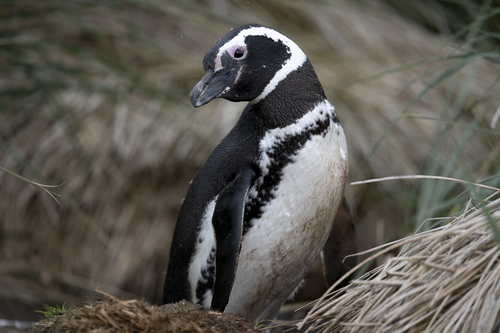 Magellanic Penguin
In short
The most reliable field mark between Humboldt and Magellanic Penguins is the number and shape of the black breast bands on adults: Magellanic Penguins show two distinct black bands across the upper chest and belly (the lower one forming an inverted horseshoe), while Humboldt Penguins have a single, broad black breast-band that extends down the flanks. Juvenile birds of both species lack these breast bands, making them much harder to separate visually. Structurally, both are similar medium-sized penguins, but Humboldt tends to be slightly heavier on average. In the field, careful attention to the pattern and extent of the breast bands on adults is the best separation tool, while location and context can help when plumage is ambiguous.
Identification tips
- Adult breast band pattern is the key field mark: Magellanic Penguins always show two black bands between the head and breast, with the lower band forming an inverted horseshoe across the belly. Humboldt Penguins have only a single, broad black breast-band that extends down the flanks. This is diagnostic for adults.
- Juvenile confusion: Juveniles of both species lack the black breast bands, making them very difficult to separate visually. Humboldt juveniles have dark heads and plain underparts; Magellanic juveniles have grey-blue backs and paler chests, but this is subtle and unreliable in the field.
- Head and facial pattern: Both species have a black head with a white border running from behind the eye, around the ear-coverts and chin, joining at the throat. This is not useful for separation.
- Bill structure: Males of both species have longer, heavier bills than females, but bill shape is not a reliable species-level field mark.
- Size: Humboldt Penguins are on average slightly heavier, but size overlaps greatly and is not a practical field mark.
- Feet in young birds: Young Magellanic Penguins have blotched feet that become all black by about ten years of age. This is not described for Humboldt, but is subtle and not likely to be useful in the field.
- Habitat and range: If seen on the Pacific coast of Peru or northern Chile, it is almost certainly a Humboldt Penguin. If in southern Argentina, the Falklands, or along the Atlantic coast, it is Magellanic. In southern Chile, both may occur, so plumage must be checked.
- Behavior: No behavioral differences are reliably diagnostic in the field.
- Voice: Both have similar calls with no field-diagnostic differences described.
- Sexing: Both species are monomorphic in plumage; males are larger, but this is not helpful for species ID.
- In flight: Both species are rarely seen flying, and there are no described differences in wing pattern or flight silhouette.
- Molting and season: No seasonal plumage differences are described that aid separation.
- Context: Magellanic is much more numerous overall, but local abundance depends on location.
- When in doubt with juveniles: If breast bands are absent and range is ambiguous, identification may not be possible without close examination or context.
- Summary tip: For adults, always check the number and shape of the black breast bands; for juveniles, rely on range and context, as plumage is not reliably separable.
Size
Both species are medium-sized Spheniscus penguins and overlap considerably in size. Magellanic Penguins are typically 61–76 cm tall and weigh 2.7–6.5 kg, with an average adult mass of about 4.1 kg [wikidata]. Humboldt Penguins are 56–70 cm long and average 4.05 kg (females) to 4.7 kg (males) [wikipedia]. Thus, Humboldt is on average slightly heavier, but size alone is not a reliable field mark due to overlap and sexual dimorphism in both species.
Plumage
Adult Magellanic Penguins are distinguished by two black bands between the head and breast: the upper band is narrow and collar-like, while the lower band forms an inverted horseshoe across the belly. Humboldt Penguins have only a single, broad black breast-band that curves down the flanks to the thighs. Both species have black heads with a white border running from behind the eye around the ear-coverts and chin, joining at the throat. Juvenile birds of both species lack the breast bands: Humboldt juveniles have dark heads and plain underparts, while Magellanic juveniles have grey-blue backs and paler chests. Therefore, adults are separable by breast band pattern, but juveniles are very similar and difficult to distinguish visually.
Behaviour
Both species are similar in behavior, being colonial nesters and foraging for small fish and marine prey. There are no strong behavioral differences in the field that reliably separate them. Both use rigid wings for underwater swimming and have similar social and territorial displays.
Habitat
Geography is often the best clue: Humboldt Penguins are found along the Pacific coast of Peru and Chile, while Magellanic Penguins breed further south in coastal Patagonia (Argentina, Chile, Falkland Islands) and migrate north along the Atlantic coast, sometimes reaching Brazil and Uruguay. Overlap is possible in southern Chile, but in most of their range, location is a strong hint. Magellanic Penguins are much more numerous overall.
Voice
Both species have a range of calls used for territory, mate attraction, and warning, with similar functions and types (yells, throbs, brays, etc.). There are no field-diagnostic differences in vocalizations described in the sources.