

Hudsonian Godwit vs Black-throated Grey Warbler
Limosa haemastica versus Setophaga nigrescens
Play a quiz with Hudsonian Godwit and Black-throated Grey Warbler
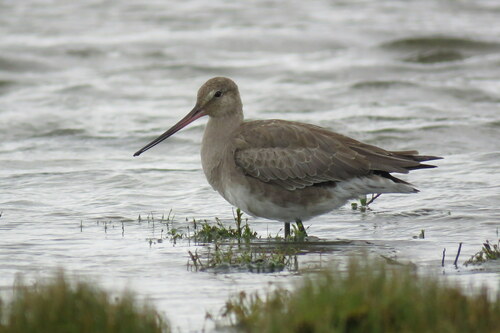 Hudsonian Godwit
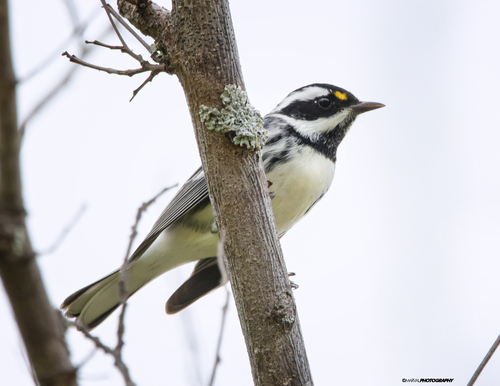 Black-throated Grey Warbler
In short
Hudsonian Godwit and Black-throated Grey Warbler are extremely unlikely to be confused in the field due to their vast size difference and contrasting structure, but confusion can arise in distant, brief, or poor-light views, especially of immatures in flight. The godwit is a large, upright shorebird with long legs and a long, slightly upturned pink-based bill, showing a striking white rump and black tail in flight, while the warbler is a tiny, active songbird with a short, thin bill and bold black, gray, and white facial pattern. Juvenile and non-breeding godwits still show the white rump and black tail in flight, a key mark at all ages, whereas the warbler never shows such a pattern. If you see a bird with black underwings and a white rump flashing in flight, it's the godwit. Perched, focus on bill shape, leg length, and overall size.
Identification tips
- White rump and black tail in flight (all ages): Only Hudsonian Godwit shows a bold white rump and black tail in flight. If you see this pattern, especially over mudflats or marshes, it's a godwit, not a warbler.
- Black underwing linings (godwit): In flight, godwits show black underwing linings, a feature never seen in the warbler.
- Size and shape: Godwit is massive compared to the tiny warbler. If the bird is anywhere near the size of a pigeon or larger, it's a godwit. Warblers are sparrow-sized and delicate.
- Bill shape: Godwit has a long, slightly upturned, pink-based bill with a dark tip, used for probing mud. Warbler has a short, thin, pointed bill for gleaning insects.
- Leg length: Godwit has very long, bluish-gray legs, often visible even in flight. Warbler has short legs, never appearing long-legged.
- Perched posture: Godwit stands upright, often in open, wet areas. Warbler perches horizontally or flits through foliage, rarely in the open.
- Facial pattern: Warbler (especially males) has a bold black-and-white facial pattern with a small yellow spot in front of the eye. Godwit has a plain face with no such markings.
- Underparts: Godwit in breeding plumage has chestnut underparts; warbler is always white below with black flank streaks, never chestnut.
- Sex/age confusion: Female warblers have a white throat and duller head but still show the facial pattern; godwit sexes are similar except for subtle breeding differences.
- Habitat context: Godwit is in open, wet areas; warbler is in trees or shrubs, often away from water.
- Behavior: Godwit walks or wades; warbler flits, hovers, and gleans.
- Flight style: Godwit flies with strong, direct wingbeats; warbler's flight is weak, fluttery, and rarely sustained over open ground.
- Vocalizations: Warbler gives sharp 'tup' calls and buzzy songs; godwit is mostly silent, especially away from breeding grounds.
- Seasonal context: Godwit is a long-distance migrant, often seen in migration at staging sites; warbler is present in forests during breeding and migration.
- Misleading views: Distant, backlit, or brief views may obscure size and structure, but the white rump/black tail in flight and habitat should resolve nearly all confusion.
Size
Hudsonian Godwit is a very large shorebird, weighing around 255.5 g [wikidata], with long legs and a body length much greater than the Black-throated Grey Warbler, which is a small passerine at about 13 cm (5.1 in) in length and weighing only 8.4 g [wikipedia]. The godwit stands tall, often up to a person's knee, while the warbler is sparrow-sized and delicate. There is no overlap in size: any bird remotely approaching the godwit's bulk cannot be a warbler.
Plumage
- Juvenile/Immature/Flying Birds: Hudsonian Godwit of all ages shows a bold white rump and black tail in flight, with black underwings (black wing linings) [wikipedia]. This pattern is never shown by Black-throated Grey Warbler, which has plain gray upperparts and white underparts with black flank streaks, and no white rump or black tail.
- Adults (perched): Godwit adults have mottled brown upperparts, chestnut underparts in breeding plumage, long bluish-gray legs, and a long pink-based bill. Warblers have gray upperparts, white underparts with black streaks, and a distinctive facial pattern: males have a black throat and crown, females have a white throat and duller head.
- Sex/Age Variation: Godwit sexes are similar except in breeding plumage, where females are slightly heavier. Warbler males are boldly marked, females are paler with a white throat. No godwit plumage ever resembles the warbler's facial pattern.
Behaviour
Hudsonian Godwit is typically seen wading or walking in open mudflats, marshes, or shorelines, often probing with its long bill. In flight, it is strong and direct, with rapid wingbeats and obvious white rump. Black-throated Grey Warbler is highly active, gleaning insects from foliage, often flitting and hovering in trees or shrubs. It rarely if ever walks on the ground and never wades. The godwit stands upright and moves deliberately; the warbler is restless and quick.
Habitat
Godwits are found in open wet habitats: mudflats, marshes, shorelines, and sometimes flooded fields, especially during migration. They are never in dense trees or shrubs. Black-throated Grey Warbler is found in woodlands, especially open coniferous or mixed forests, oak woodlands, and sometimes in chaparral or scrub, almost always in or near trees and away from open water or mudflats. If the bird is in a forest canopy or shrub, it's a warbler; if it's on a mudflat or wading, it's a godwit.
Voice
Hudsonian Godwit is generally quiet, but may give sharp, high-pitched calls, especially in flight or alarm, but these are not described in detail here. Black-throated Grey Warbler gives a sharp 'tup' or 'thick' call, and the male sings a buzzy, doubled song with a high note near the end. Warbler calls are more frequent and easily heard in wooded habitats, while godwit calls are rare and not a reliable field mark in most situations.
Hudsonian Godwit · Black-throated Grey Warbler · My Tricky Birds