
Hen Harrier vs Eurasian Goshawk
Circus cyaneus versus Astur gentilis
Play a quiz with Hen Harrier and Eurasian Goshawk
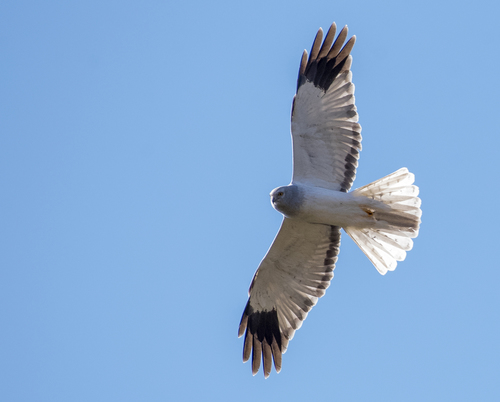 Hen Harrier
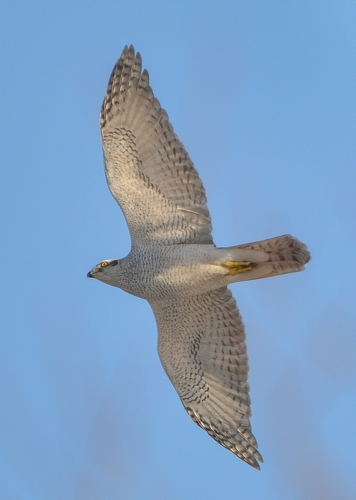 Eurasian Goshawk
In short
The most reliable field mark between Hen Harrier and Eurasian Goshawk is the presence of a distinct white rump patch on all ages of Hen Harrier, especially visible in flight, which is never shown by Goshawk. Juvenile Hen Harriers (the 'ringtails') are brown above with a white rump and buffy, less-barred underparts, while juvenile Goshawks are brown above but lack the white rump and show strong dark streaking or barring below. Structurally, Hen Harrier is slimmer, longer-winged, and longer-tailed, with a buoyant, low, gliding flight style, whereas Goshawk is much bulkier, with shorter, broader wings and a more powerful, deep-flapping flight. In perched views, Goshawk appears more robust with a prominent pale supercilium (eyebrow), which is absent in Hen Harrier. Habitat can also help: Hen Harrier is almost always seen hunting low over open country, while Goshawk prefers wooded areas and is rarely seen in open habitats.
Identification tips
- White rump patch: All ages and sexes of Hen Harrier show a clear white rump in flight, especially obvious from behind or above. Goshawk never shows a white rump; its back and rump are concolorous.
- Wing shape and flight style: Hen Harrier has long, narrow wings held in a shallow V when gliding, giving a buoyant, floating flight low over open ground. Goshawk has shorter, broader wings and a heavier, deliberate flight with deep wingbeats, usually higher and more direct.
- Tail shape: Hen Harrier's tail is long and slim, often appearing slightly rounded or wedge-shaped. Goshawk's tail is also long but broader and more squared-off, with bold dark barring.
- Juvenile underparts: Juvenile Hen Harrier ('ringtail') has buffy underparts with faint barring, while juvenile Goshawk is heavily streaked or barred below, often with a darker, cinnamon tone.
- Adult male plumage: Adult male Hen Harrier is pale grey above, white below, with black wingtips and a white rump—never matched by Goshawk.
- Adult female/juvenile confusion: Both female Hen Harrier and juvenile Goshawk are brown above, but only Hen Harrier shows the white rump. Goshawk is bulkier, with a prominent white supercilium and heavier streaking below.
- Supercilium (eyebrow): Goshawk of all ages shows a bold white supercilium, especially in adults. Hen Harrier lacks this feature.
- Size and bulk: Goshawk is much larger and heavier than Hen Harrier, especially in females. If you get a good size comparison (with crows or buzzards), use it cautiously.
- Legs and feet: Goshawk has robust, thick legs and toes, often visible when perched; Hen Harrier's legs are slimmer.
- Perched posture: Goshawk perches upright, looking powerful and deep-chested, often in trees. Hen Harrier perches lower, more slender, and usually on posts or the ground in open country.
- Habitat: Hen Harrier is almost always in open country; Goshawk is a woodland bird. Context can help, but beware of migration.
- Vocalizations: If you hear a whistled or chattering call from a harrier gliding over fields, it's likely Hen Harrier. Goshawk is usually silent away from the nest.
- Behavior: Hen Harrier hunts by quartering low over open ground; Goshawk hunts by surprise attacks in woodland or rapid dashes from cover.
- Moult gaps: Not usually a field mark, but female Goshawk in late spring may show wing gaps due to moulting, rarely seen in Hen Harrier.
- Pitfalls: Juvenile Goshawk can look brown and streaky like a 'ringtail' harrier, but always lacks the white rump and shows a heavier, more powerful build with a strong supercilium.
Size
Eurasian Goshawk is significantly larger and heavier than Hen Harrier. Average body mass is about 926 g for Goshawk and 436.5 g for Hen Harrier, with female Goshawks especially massive compared to even the largest female Hen Harrier. In the field, Goshawk appears much bulkier and more powerful, with a deep chest and thick legs, while Hen Harrier is slim, long-winged, and graceful. Hen Harrier's wingspan is similar or slightly shorter, but the overall impression is of a lighter, more buoyant bird. If seen together, Goshawk dwarfs Hen Harrier.
Plumage
- Juvenile/immature birds: Juvenile Hen Harriers ('ringtails') are brown above with a striking white rump patch and buffy underparts with faint barring; their secondaries are dark brown and the belly is less distinctly barred. Juvenile Goshawks are also brown above but lack the white rump, and their underparts are heavily streaked or barred with dark cinnamon-brown, never buffy. Both show barred tails, but Goshawk's tail barring is broader and more contrasting.
- Adults: Adult male Hen Harrier is pale grey above, white below, with black wingtips and a white rump. Adult female is brown above, buff below with brown barring, and always shows the white rump. Adult Goshawk is blue-grey or brownish-grey above, white or grey below with fine dark barring, and always has a bold white supercilium (eyebrow); no white rump. Goshawk's plumage is more variable, but never shows the harrier's white rump or the male's clean grey-and-white look.
- In flight: Hen Harrier's wings are longer and narrower, with a more obvious 'V' shape and a white rump visible from above and behind. Goshawk's wings are shorter, broader, and more rounded, with a longer, more squared-off tail and no white rump.
Behaviour
Hen Harrier hunts by flying low over open ground with wings held in a shallow V, gliding and quartering fields and moors. Its flight is buoyant, light, and often accompanied by vocalizations. Goshawk, in contrast, is a forest hunter: it flies with deep, powerful wingbeats interspersed with glides, and is capable of explosive, rapid pursuits through trees. Goshawk is rarely seen in open country and is generally much more secretive, often perching for long periods in cover. Hen Harrier is much more likely to be seen openly hunting in daylight, while Goshawk is often glimpsed only briefly as it dashes through woodland.
Habitat
Hen Harrier is a specialist of open habitats: moorland, marshes, grasslands, and farmland, rarely venturing into dense woodland. It is most often seen in open country, especially during migration and winter. Eurasian Goshawk is a woodland raptor, favoring mature forests, wooded edges, and large parks; it is rarely seen in open country except when migrating. If you see a raptor hunting low over fields or moor, Hen Harrier is far more likely; a large hawk emerging from or flying through trees is more likely to be Goshawk.
Voice
Hen Harrier is relatively vocal, especially during display and food passes: females give a whistled 'piih-eh' and an alarmed 'chit-it-it-it-it-et-it', while males give a 'chek-chek-chek' and a bouncing 'chuk-uk-uk-uk' in display. Goshawk is generally much quieter and rarely vocalizes away from the nest; its calls are not described in the provided notes, but are not a field mark in most situations.