

Motmot

Hamerkop vs African Pygmy Kingfisher

Scopus umbretta versus Ispidina picta

Play a quiz with Hamerkop and African Pygmy Kingfisher
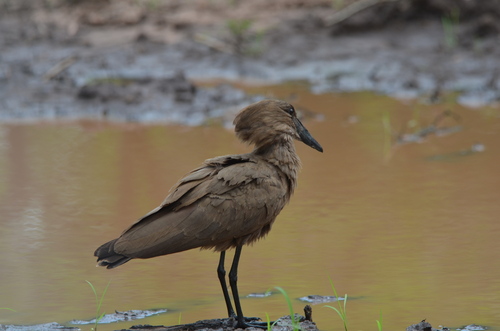
Hamerkop (Scopus umbretta) Hamerkop
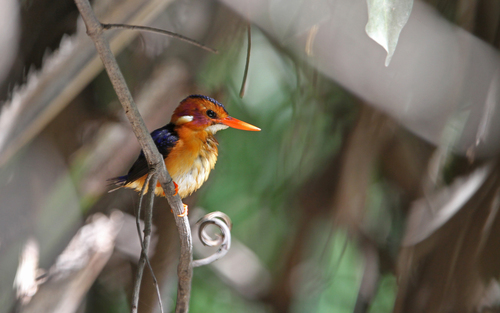
African Pygmy Kingfisher (Ispidina picta) African Pygmy Kingfisher

Media

Loading…

In short

The most reliable way to separate Hamerkop from African Pygmy Kingfisher is by overall size and structure: Hamerkop is a medium-sized, drab brown waterbird with a distinctive hammer-shaped head and long bill, while African Pygmy Kingfisher is a tiny, vividly colored woodland bird with a short, straight bill. In flight or perched, Hamerkop’s bulky build, broad wings, and jerky gait contrast sharply with the kingfisher’s compact, delicate proportions and rapid, direct flight. Juvenile plumages are not a source of confusion here, as both species resemble adults, but the kingfisher’s blue upperparts and rufous underparts are never matched by Hamerkop. Habitat is also a strong clue: Hamerkop is always near water, while African Pygmy Kingfisher prefers wooded areas away from open wetlands.

Identification tips

  1. Size is the single most decisive mark: Hamerkop is over four times the length and vastly heavier than African Pygmy Kingfisher. Even at a distance, the kingfisher will look tiny and delicate, while Hamerkop is robust and heron-like.
  2. Head and bill shape: Hamerkop has a unique hammer-shaped head with a long, thick, slightly hooked bill and a crest at the back. African Pygmy Kingfisher has a small, rounded head and a short, straight bill (orange in adults, black in juveniles).
  3. Plumage color: Hamerkop is plain brown with faint purple iridescence and a slightly barred tail. African Pygmy Kingfisher is bright blue above, rufous below, with a dark blue crown and white ear patch (sometimes with a blue spot above in southern birds).
  4. Juvenile differences: Juvenile kingfishers have a black bill and less violet on the ear coverts but still show strong blue and rufous contrast. Juvenile Hamerkops are brown like adults, with a brown bill that becomes black at fledging. There is no overlap in plumage at any age.
  5. Legs and feet: Hamerkop’s legs are long, black, and partially webbed, feathered only to the upper tibia. Kingfisher’s legs are very short and inconspicuous.
  6. Flight style: Hamerkop flies with broad, rounded wings, sometimes soaring with neck outstretched or coiled. Kingfisher’s flight is rapid, direct, and low, with quick wingbeats and no soaring.
  7. Perched posture: Hamerkop stands upright, often in water, with a jerky, bobbing gait. Kingfisher perches horizontally on branches in woodland, rarely on the ground or in water.
  8. Habitat context: Hamerkop is always near water—lakes, rivers, ponds, wetlands. African Pygmy Kingfisher is found in woodland, forest edge, or bush, often away from water.
  9. Feeding behavior: Hamerkop hunts by wading, probing mud, or shuffling feet in water. Kingfisher catches insects by sallying from a perch, never wading.
  10. Tail and wing shape: Hamerkop has a short, slightly barred tail and broad wings; kingfisher has a short tail but much narrower, pointed wings relative to its size.
  11. Vocalizations: Hamerkop’s calls are shrill, cackling, or rattling, often in social groups. Kingfisher gives a high, insect-like 'tsip-tsip' in flight.
  12. Social behavior: Hamerkop may be seen alone or in small groups, sometimes giving social calls. Kingfisher is usually solitary or in pairs.
  13. Mistaken context: If you see a small, blue-and-rufous bird in woodland, it is never a Hamerkop. If you see a medium-sized brown bird wading in water, it is never an African Pygmy Kingfisher.
  14. Sexes alike: Both species show little or no sexual dimorphism; do not rely on sex to separate them.
  15. No seasonal confusion: Both species retain their basic plumage year-round; no seasonal molt or eclipse plumage causes confusion.

Size

Hamerkop is vastly larger, standing about 56 cm tall and weighing around 470 g, compared to the African Pygmy Kingfisher’s tiny 12 cm length and 14.6 g weight [wikipedia][wikidata]. The difference is so extreme that even at a distance or in poor light, the kingfisher appears sparrow-sized, while Hamerkop is comparable to a small heron or egret. Bill size also reflects this: Hamerkop’s bill is long (80–85 mm), thick, and slightly hooked, while the kingfisher’s is short and straight. Even fledglings of Hamerkop are much larger than adult kingfishers.

Plumage

There are no confusing age-specific wing or flight patterns between these two: both juveniles and adults are easily separated by color and structure. Hamerkop is uniformly drab brown with a faint purple iridescence on the back and a slightly barred tail, lacking any bright or contrasting colors. Its legs are black and only feathered to the upper tibia. African Pygmy Kingfisher, by contrast, is strikingly colorful: adults and juveniles have rufous underparts, a blue back and tail, and a dark blue crown. Juveniles have a black bill (not orange) and less violet on the ear coverts, but still show the strong blue/rufous contrast. There is no stage where a kingfisher appears all-brown or where a Hamerkop shows blue or rufous plumage.

Behaviour

Hamerkop’s behavior is typical of a wader: it walks or wades in shallow water with a jerky, rapid gait, often probing mud or shuffling its feet to flush prey. It may also soar with broad, rounded wings and a stretched or coiled neck, and sometimes feeds in flight by snatching prey from the water surface. African Pygmy Kingfisher behaves like a typical small kingfisher: it perches quietly in woodland, then makes rapid, direct flights to catch insects. It is not seen wading or walking in water, and its flight is fast and straight, not soaring or gliding.

Habitat

Hamerkop is always associated with water: it is found in wetlands, lakesides, riverbanks, estuaries, and even fish ponds or rocky coasts [wikipedia]. It is never found in dry woodland away from water. African Pygmy Kingfisher, on the other hand, is a bird of woodland and forest edges, often far from open water. Seeing a small blue-and-rufous bird in dense woodland or bush is a strong pointer to kingfisher, while any medium-sized brown bird stalking in shallow water is almost certainly a Hamerkop.

Voice

Hamerkop is mostly silent when alone, but in groups it gives a variety of cackles, rattles, and a distinctive 'yip-purr' call. Its solo flight call is a shrill 'nyip' or 'kek.' African Pygmy Kingfisher’s call is a high-pitched, insect-like 'tsip-tsip,' usually given in flight. The kingfisher’s call is much higher and more delicate, while Hamerkop’s are coarser and more social.

Submit a better description

Use the same sections as the comparison. Your text is published immediately.

The most reliable way to separate Hamerkop from African Pygmy Kingfisher is by overall size and structure: Hamerkop is a medium-sized, drab brown waterbird with a distinctive hammer-shaped head and long bill, while African Pygmy Kingfisher is a tiny, vividly colored woodland bird with a short, straight bill. In flight or perched, Hamerkop’s bulky build, broad wings, and jerky gait contrast sharply with the kingfisher’s compact, delicate proportions and rapid, direct flight. Juvenile plumages are not a source of confusion here, as both species resemble adults, but the kingfisher’s blue upperparts and rufous underparts are never matched by Hamerkop. Habitat is also a strong clue: Hamerkop is always near water, while African Pygmy Kingfisher prefers wooded areas away from open wetlands.

  1. Size is the single most decisive mark: Hamerkop is over four times the length and vastly heavier than African Pygmy Kingfisher. Even at a distance, the kingfisher will look tiny and delicate, while Hamerkop is robust and heron-like.
  2. Head and bill shape: Hamerkop has a unique hammer-shaped head with a long, thick, slightly hooked bill and a crest at the back. African Pygmy Kingfisher has a small, rounded head and a short, straight bill (orange in adults, black in juveniles).
  3. Plumage color: Hamerkop is plain brown with faint purple iridescence and a slightly barred tail. African Pygmy Kingfisher is bright blue above, rufous below, with a dark blue crown and white ear patch (sometimes with a blue spot above in southern birds).
  4. Juvenile differences: Juvenile kingfishers have a black bill and less violet on the ear coverts but still show strong blue and rufous contrast. Juvenile Hamerkops are brown like adults, with a brown bill that becomes black at fledging. There is no overlap in plumage at any age.
  5. Legs and feet: Hamerkop’s legs are long, black, and partially webbed, feathered only to the upper tibia. Kingfisher’s legs are very short and inconspicuous.
  6. Flight style: Hamerkop flies with broad, rounded wings, sometimes soaring with neck outstretched or coiled. Kingfisher’s flight is rapid, direct, and low, with quick wingbeats and no soaring.
  7. Perched posture: Hamerkop stands upright, often in water, with a jerky, bobbing gait. Kingfisher perches horizontally on branches in woodland, rarely on the ground or in water.
  8. Habitat context: Hamerkop is always near water—lakes, rivers, ponds, wetlands. African Pygmy Kingfisher is found in woodland, forest edge, or bush, often away from water.
  9. Feeding behavior: Hamerkop hunts by wading, probing mud, or shuffling feet in water. Kingfisher catches insects by sallying from a perch, never wading.
  10. Tail and wing shape: Hamerkop has a short, slightly barred tail and broad wings; kingfisher has a short tail but much narrower, pointed wings relative to its size.
  11. Vocalizations: Hamerkop’s calls are shrill, cackling, or rattling, often in social groups. Kingfisher gives a high, insect-like 'tsip-tsip' in flight.
  12. Social behavior: Hamerkop may be seen alone or in small groups, sometimes giving social calls. Kingfisher is usually solitary or in pairs.
  13. Mistaken context: If you see a small, blue-and-rufous bird in woodland, it is never a Hamerkop. If you see a medium-sized brown bird wading in water, it is never an African Pygmy Kingfisher.
  14. Sexes alike: Both species show little or no sexual dimorphism; do not rely on sex to separate them.
  15. No seasonal confusion: Both species retain their basic plumage year-round; no seasonal molt or eclipse plumage causes confusion.

Hamerkop is vastly larger, standing about 56 cm tall and weighing around 470 g, compared to the African Pygmy Kingfisher’s tiny 12 cm length and 14.6 g weight [wikipedia][wikidata]. The difference is so extreme that even at a distance or in poor light, the kingfisher appears sparrow-sized, while Hamerkop is comparable to a small heron or egret. Bill size also reflects this: Hamerkop’s bill is long (80–85 mm), thick, and slightly hooked, while the kingfisher’s is short and straight. Even fledglings of Hamerkop are much larger than adult kingfishers.

There are no confusing age-specific wing or flight patterns between these two: both juveniles and adults are easily separated by color and structure. Hamerkop is uniformly drab brown with a faint purple iridescence on the back and a slightly barred tail, lacking any bright or contrasting colors. Its legs are black and only feathered to the upper tibia. African Pygmy Kingfisher, by contrast, is strikingly colorful: adults and juveniles have rufous underparts, a blue back and tail, and a dark blue crown. Juveniles have a black bill (not orange) and less violet on the ear coverts, but still show the strong blue/rufous contrast. There is no stage where a kingfisher appears all-brown or where a Hamerkop shows blue or rufous plumage.

Hamerkop’s behavior is typical of a wader: it walks or wades in shallow water with a jerky, rapid gait, often probing mud or shuffling its feet to flush prey. It may also soar with broad, rounded wings and a stretched or coiled neck, and sometimes feeds in flight by snatching prey from the water surface. African Pygmy Kingfisher behaves like a typical small kingfisher: it perches quietly in woodland, then makes rapid, direct flights to catch insects. It is not seen wading or walking in water, and its flight is fast and straight, not soaring or gliding.

Hamerkop is always associated with water: it is found in wetlands, lakesides, riverbanks, estuaries, and even fish ponds or rocky coasts [wikipedia]. It is never found in dry woodland away from water. African Pygmy Kingfisher, on the other hand, is a bird of woodland and forest edges, often far from open water. Seeing a small blue-and-rufous bird in dense woodland or bush is a strong pointer to kingfisher, while any medium-sized brown bird stalking in shallow water is almost certainly a Hamerkop.

Hamerkop is mostly silent when alone, but in groups it gives a variety of cackles, rattles, and a distinctive 'yip-purr' call. Its solo flight call is a shrill 'nyip' or 'kek.' African Pygmy Kingfisher’s call is a high-pitched, insect-like 'tsip-tsip,' usually given in flight. The kingfisher’s call is much higher and more delicate, while Hamerkop’s are coarser and more social.

Discard your changes?

You have unsaved edits. If you leave now, those changes will be lost.

Hamerkop · African Pygmy Kingfisher · My Tricky Birds