

Hairy-breasted Barbet vs Vieillot's Barbet
Tricholaema hirsuta versus Lybius vieilloti
Play a quiz with Hairy-breasted Barbet and Vieillot's Barbet
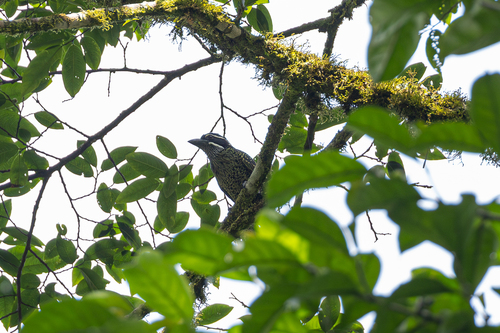 Hairy-breasted Barbet
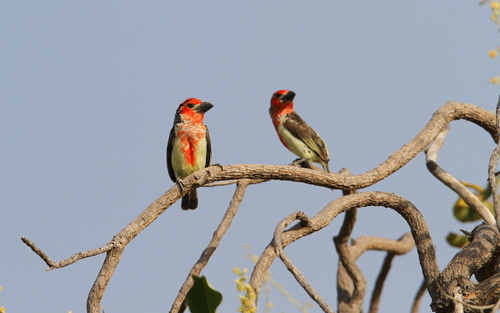 Vieillot's Barbet
In short
The most reliable field mark to separate Hairy-breasted Barbet from Vieillot's Barbet is head and breast color: Hairy-breasted shows a blue-black or black head with white facial stripes and a yellow, heavily marked breast, while Vieillot's Barbet has a bright red head and breast with white and red blending, lacking strong facial stripes. Immature Hairy-breasted Barbets show paler, sparser spots and more barred underparts, while immature Vieillot's are simply duller overall. In flight or perched, look for the yellow-spotted upperparts and black throat of Hairy-breasted versus the yellow back stripe and red head of Vieillot's. Both are chunky barbets, but Hairy-breasted is larger and heavier. Voice is also distinctive: Hairy-breasted gives repeated 'oork' or 'oop' notes, while Vieillot's performs a complex, polyphonic duet with yodeling and 'poop-poop' notes.
Identification tips
- Head color (all ages): Hairy-breasted Barbet has a blue-black or black head with white superciliary and malar stripes (except some subspecies), while Vieillot's Barbet always has a bright red head with no strong white striping.
- Breast and throat (adults): Hairy-breasted shows a black throat and yellow breast with heavy black markings; Vieillot's has a red and white neck and breast, lacking a black throat.
- Upperparts (adults): Hairy-breasted has black upperparts with yellow spots and a yellow-barred rump; Vieillot's has dark brown upperparts with a distinctive yellow stripe down the back.
- Underparts (adults): Hairy-breasted's underparts are yellow with black markings; Vieillot's are yellowish with dark flank spots, but the breast is red and white.
- Immature plumage: Young Hairy-breasted Barbets have laxer, paler-spotted upperparts and more barred vents, while immature Vieillot's are just duller, not patterned differently.
- Bill and face: Both have thick, dark bills, but only Hairy-breasted shows strong white facial stripes (superciliary and malar) in most subspecies.
- Tail and jizz: Both are chunky, short-tailed barbets, but Hairy-breasted is larger and bulkier; Vieillot's is more compact and sparrow-sized.
- Size in context: If seen with other barbets or familiar birds, Hairy-breasted will stand out as larger and heavier (17–18 cm, 43–63 g) compared to the smaller Vieillot's (15 cm, 36 g).
- Voice: Listen for simple, repeated 'oork' or 'oop' notes from Hairy-breasted, versus the complex, polyphonic duet (yodeling and 'poop-poop' notes) of Vieillot's, often with ceremonial bowing.
- Behavior: Both may join mixed flocks, but only Vieillot's is likely to be seen duetting with synchronized bowing.
- Habitat: Dense rainforest interior suggests Hairy-breasted; open woodland or edge, especially near villages, suggests Vieillot's.
- Subspecies variation (Hairy-breasted): Some subspecies (e.g., flavipunctata, angolensis, ansorgii) have reduced or altered head striping and browner tones, but none have the solid red head of Vieillot's.
- Sex differences: Female Hairy-breasted Barbets are more golden yellow below than males, but both sexes retain the black head and throat; Vieillot's sexes are similar.
- Flight views: No distinctive upperwing panel or flight mark is described for either, but Hairy-breasted's yellow-edged wing feathers may be visible at close range.
- Pitfalls: Immature Hairy-breasted may appear duller and less spotted, but will never show the red head and breast of Vieillot's. Vieillot's never shows a black throat or strong white facial stripes.
Size
Hairy-breasted Barbet is noticeably larger and heavier, measuring 17–18 cm in length and weighing 43–63 g, while Vieillot's Barbet is smaller at about 15 cm and 36 g. In the field, Hairy-breasted will appear bulkier and longer, with a more robust presence compared to the sparrow-sized, compact Vieillot's.
Plumage
- Immature birds: Hairy-breasted Barbet immatures have laxer plumage, paler and sparser yellow spotting on the upperparts, and more barred black markings on the vent. Vieillot's Barbet immatures are simply duller than adults, without specific pattern changes.
- Adults: Hairy-breasted Barbet males have a blue-black head with a white superciliary and malar stripe, black upperparts with yellow spots, yellow-barred rump, black throat, and yellow breast/flanks with black markings. Females are more golden yellow below. Vieillot's Barbet adults have a striking red head, red and white neck and breast, dark brown upperparts with a yellow stripe down the back, and yellowish underparts with dark flank spots. Both sexes are similar in Vieillot's, but only Hairy-breasted shows strong facial stripes and a black throat.
- Subspecies variation: Hairy-breasted subspecies show variable head striping and underpart brightness, but all lack the solid red head of Vieillot's.
Behaviour
Both species are often seen singly or in pairs and may join mixed-species flocks. Hairy-breasted Barbet is territorial and often forages alone or as a pair, feeding on fruit and insects, sometimes bashing insects on branches. Vieillot's Barbet is also social but is especially noted for its duetting behavior, with pairs performing elaborate greeting and song displays. Both species may be seen perched prominently, but only Vieillot's is known for its ceremonial bowing and synchronized duets.
Habitat
Hairy-breasted Barbet is found throughout the African tropical rainforest, favoring dense, humid forest habitats. Vieillot's Barbet is not described in detail here, but is typically found in more open woodland and savanna-edge habitats, often near human habitation. Thus, context can help: deep rainforest suggests Hairy-breasted, while open woodland or edge may favor Vieillot's.
Voice
Hairy-breasted Barbet gives repeated 'oork' or 'oop' notes, often while puffing its throat and rotating its head. Its song is simple and repeated. Vieillot's Barbet, in contrast, performs a complex, polyphonic duet: one bird gives a yodel (two flute-like notes), answered by the partner's 'poop-poop', with both birds bowing ceremoniously. The duet is distinctive for its overlapping, many-voiced quality and is performed year-round, not just in breeding season.