

Hairy-backed Bulbul vs Yellow-bellied Bulbul
Tricholestes criniger versus Alophoixus phaeocephalus
Play a quiz with Hairy-backed Bulbul and Yellow-bellied Bulbul
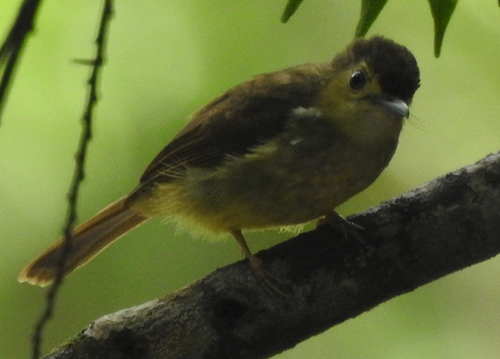 Hairy-backed Bulbul
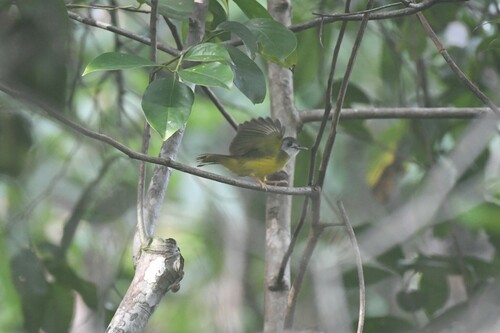 Yellow-bellied Bulbul
In short
The most reliable field mark to separate Hairy-backed Bulbul from Yellow-bellied Bulbul is the presence of conspicuous hair-like filoplumes on the back of the Hairy-backed Bulbul, which are often concealed but unique when seen. Hairy-backed Bulbul also shows a pale yellowish lore and broad eye ring, a rufous-brown tail with creamy white tips, and a creamy white throat merging into a yellow breast. In contrast, Yellow-bellied Bulbul lacks the hairy-backed appearance and has a more uniform yellow belly with a greyish or brownish cap and head. Both species overlap in range and habitat, so careful attention to structural and plumage details is essential, especially as both can appear similar at a glance.
Identification tips
- Look for hair-like filoplumes on the back: Only Hairy-backed Bulbul shows these distinctive bristle-like feathers, though they may be concealed. If seen, this is diagnostic for Hairy-backed.
- Check the lores and eye ring: Hairy-backed Bulbul has pale yellowish lores and a broad eye ring, while Yellow-bellied Bulbul lacks these features.
- Examine the cap and neck: Hairy-backed Bulbul has a dark rufescent olive-brown cap and neck, contrasting with the more uniform greyish or brownish cap of Yellow-bellied Bulbul.
- Tail color and pattern: Hairy-backed Bulbul's tail is bright rufous-brown with creamy white tips, a combination not seen in Yellow-bellied Bulbul.
- Throat and breast transition: The creamy white chin and throat of Hairy-backed Bulbul merge into a yellow breast, while Yellow-bellied Bulbul tends to have a more uniform yellow underpart without the sharp creamy white throat.
- Upperwing and uppertail-coverts: Hairy-backed Bulbul shows olive-rufous uppertail-coverts and upperwings, which can be a subtle but useful mark if seen well.
- Bill and leg color: Hairy-backed Bulbul has a light blue-grey bill and pale greenish-brown legs (adults), with juveniles showing pale fleshy pink legs. These are subtle and best used in good light at close range.
- Iris color: Adult Hairy-backed Bulbul has a dark brown iris, while juveniles have a grey-brown iris. Iris color for Yellow-bellied Bulbul is not specified, so use with caution.
- General underpart color: Both species are yellow below, but Hairy-backed Bulbul's yellow is brightest on the breast and more subdued on the belly, while Yellow-bellied Bulbul is more evenly yellow.
- Absence of crest: Both species lack a crest, so this is not a separator, but beware confusion with other crested bulbuls in the region.
- Sex differences: Both species are sexually monomorphic, so sex is not helpful for field separation.
- Juvenile marks: Only Hairy-backed Bulbul's juvenile iris and leg color are described; these are minor marks but can help if seen.
- Habitat overlap: Since both species occur in the same forests, do not rely on habitat or range for separation.
- Voice: No distinctive vocal differences are described in the sources, so do not rely on calls or song for separation.
- Subspecies variation: Hairy-backed Bulbul subspecies sericeus is larger and has duller yellow undertail-coverts, and viridis is brighter above, but these are subtle and not likely to cause confusion with Yellow-bellied Bulbul.
Size
Hairy-backed Bulbul is a small bulbul, measuring 16–17 cm in length and weighing about 17 g ([wikidata]). No direct measurement is given for Yellow-bellied Bulbul, but both are considered small bulbuls and are likely similar in size. In the field, size alone is not a reliable separator between these two species.
Plumage
- Juvenile/Immature: For Hairy-backed Bulbul, juveniles have a grey-brown iris and pale fleshy pink legs, but otherwise resemble adults. No specific juvenile or immature plumage details are available for Yellow-bellied Bulbul, so age-based separation is limited.
- Adults: Hairy-backed Bulbul is olive above and yellowish below, with a dark rufescent olive-brown cap and neck, olive-rufous uppertail-coverts and upperwings, and a bright rufous-brown tail tipped creamy white. The creamy white chin and throat blend into a yellow breast, and the pale yellowish lores and broad eye ring stand out. The key feature is the presence of hair-like filoplumes on the back (often hidden). Yellow-bellied Bulbul, by contrast, lacks the hairy-backed feature and instead shows a more uniform yellow belly, a greyish or brownish cap and head, and does not have the rufous tail or creamy white throat and tail tips seen in Hairy-backed Bulbul. Both species have yellow underparts, but the head and tail patterns are distinct.
Behaviour
Both species are relatively quiet and can be inconspicuous in the forest midstory. Hairy-backed Bulbul is noted as relatively quiet and has small, weak legs and feet, which may influence its foraging behavior, but this is not a strong field mark. There is no behavioral trait described that reliably separates the two in the field.
Habitat
Both species share similar ranges and habitats, being found in the Malay Peninsula, Sumatra, and Borneo, and occupying subtropical or tropical moist lowland forests. Habitat alone does not separate them, so field identification must rely on plumage and structure.
Hairy-backed Bulbul · Yellow-bellied Bulbul · My Tricky Birds