

Grey Peacock-Pheasant vs Red Junglefowl
Polyplectron bicalcaratum versus Gallus gallus
Play a quiz with Grey Peacock-Pheasant and Red Junglefowl
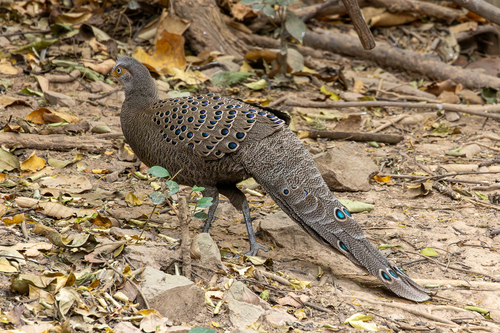 Grey Peacock-Pheasant
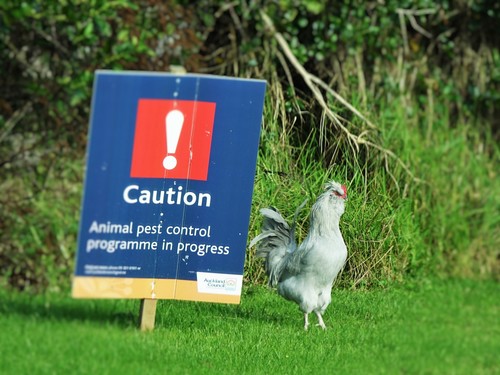 Red Junglefowl
In short
The most reliable field mark for separating Grey Peacock-Pheasant from Red Junglefowl is the presence of numerous green eyespots on the wings and tail of the peacock-pheasant, which are absent in junglefowl. In the field, Grey Peacock-Pheasant appears more uniformly grey-brown with subtle iridescent spotting, while Red Junglefowl males show bold, colorful plumage with long, arching tail feathers and a prominent red comb and wattle. Females of both species are less showy, but the peacock-pheasant retains its distinctive eyespots and bushy crest, unlike the plainer, drab junglefowl hen. In flight or when flushed, the peacock-pheasant’s rounded wings and shorter tail contrast with the junglefowl’s longer, iridescent tail and more chicken-like jizz. Habitat and behavior also differ: peacock-pheasants are more secretive and often solitary, while junglefowl are more likely to be seen in small flocks.
Identification tips
- Eyespots: Look for green eyespots on the wings and tail—present in all ages and sexes of Grey Peacock-Pheasant, absent in Red Junglefowl.
- Crest: Grey Peacock-Pheasant has an elongated, bushy crest on the head; junglefowl lacks this, instead showing a comb (red and fleshy in males, much reduced in females).
- Comb and Wattle: Red Junglefowl males have a prominent red comb and wattle; peacock-pheasant lacks both.
- Tail Shape: Peacock-pheasant’s tail is shorter, rounded, and broad with eyespots; junglefowl rooster’s tail is long, arched, and iridescent, with sickle-shaped feathers (up to 28 cm).
- Plumage Color: Male junglefowl are boldly colored (golden/red hackles, iridescent tail), while peacock-pheasant is more uniform grey-brown with subtle iridescence.
- Female/Juvenile Plumage: Junglefowl hens and juveniles are plain, cryptic brown with no iridescence or eyespots; peacock-pheasant females and young retain eyespots and a bushy crest.
- Facial Skin: Peacock-pheasant shows bare pink or yellow facial skin; junglefowl has feathered face except for the comb and wattle.
- Bill and Legs: Both species have grey bills and legs, but junglefowl males have visible spurs on the legs; peacock-pheasant does not have pronounced spurs.
- Flight Style: Junglefowl flushes with a strong, direct flight to low branches or trees; peacock-pheasant prefers to run, and if flushed, flies weakly and briefly.
- Group Size: Junglefowl often seen in small flocks; peacock-pheasant usually solitary or in pairs.
- Habitat: Peacock-pheasant is almost always in dense forest interior; junglefowl tolerates more open and disturbed habitats.
- Vocalization: Junglefowl males crow loudly and regularly; peacock-pheasant is quiet and secretive.
- Seasonal Plumage: Junglefowl males show eclipse plumage (black back, scattered red-orange plumes) in late summer–fall, but still lack eyespots or crest.
- Behavior: Junglefowl males may be seen displaying or crowing in the open; peacock-pheasant rarely displays openly and is much more elusive.
- Jizz: Junglefowl has a more upright, chicken-like stance and gait; peacock-pheasant is lower to the ground, with a more rounded, pheasant-like profile.
Size
Red Junglefowl is somewhat lighter on average (adult mass ~672 g [wikidata]), with males reaching up to 1.5 kg and females around 1 kg [wikipedia]. Grey Peacock-Pheasant is described as a large pheasant, up to 76 cm in length, but no precise mass is given. Both species are similar in overall body length (junglefowl up to 70 cm), but the peacock-pheasant appears bulkier and more robust, especially compared to the sleeker, longer-tailed junglefowl rooster. Junglefowl hens are closer in size to female peacock-pheasants, but the latter are still slightly heavier-bodied and less upright in stance.
Plumage
- Juveniles and Females: Both species’ females and young are less ornamented, but Grey Peacock-Pheasant females and immatures still show green eyespots on the wings and tail, and a bushy crest. Red Junglefowl hens and juveniles are plain, cryptic brown with no iridescent spots or crest, and have a more chicken-like appearance.
- Adult Males: Grey Peacock-Pheasant males are greyish brown with finely spotted green eyespots, elongated bushy crest, bare pink or yellow facial skin, and white throat. Red Junglefowl roosters are much brighter: golden or red hackle feathers on the neck, iridescent blue/green/purple tail with long, arching sickle feathers, and a large red comb and wattle. The peacock-pheasant lacks any red comb or wattle, and its tail is shorter and rounded, not arched.
- Seasonal Variation: Red Junglefowl males undergo an eclipse plumage (June–October) where their back turns black with scattered red-orange plumes, but still lack eyespots or a bushy crest. Female eclipse plumage is not distinguishable from their usual drab brown. Grey Peacock-Pheasant does not have a described seasonal molt affecting field marks.
Behaviour
Grey Peacock-Pheasant is typically solitary or in pairs, moving quietly through dense undergrowth and rarely seen in the open. They are shy and secretive, often detected by their movement or brief glimpses of their eyespots. Red Junglefowl are more likely to be found in small flocks (one or a few males with several females), foraging openly at forest edges or clearings. Junglefowl are more likely to flush into short, direct flight when disturbed, while peacock-pheasants prefer to run or slip away into cover. Junglefowl males are territorial and may be seen crowing from a perch or open ground, a behavior not shown by peacock-pheasants.
Habitat
Both species occur in forested habitats of Southeast Asia, but Grey Peacock-Pheasant is more strictly tied to dense, undisturbed forest interiors, especially in lowland and foothill areas. Red Junglefowl is more adaptable, found in a wider range of habitats including secondary growth, forest edges, plantations, and even near villages. Junglefowl are more likely to be seen in open or semi-open areas, while peacock-pheasants are rarely seen outside thick cover.
Voice
Red Junglefowl males are famous for their loud, far-carrying crow (“cock-a-doodle-doo”), which is used to advertise territory and attract mates. This call is diagnostic and not given by peacock-pheasants. Grey Peacock-Pheasant is generally quiet, with no described loud or distinctive vocalizations in the sources provided.