

Grey-headed Woodpecker vs Eurasian Green Woodpecker
Picus canus versus Picus viridis
Play a quiz with Grey-headed Woodpecker and Eurasian Green Woodpecker
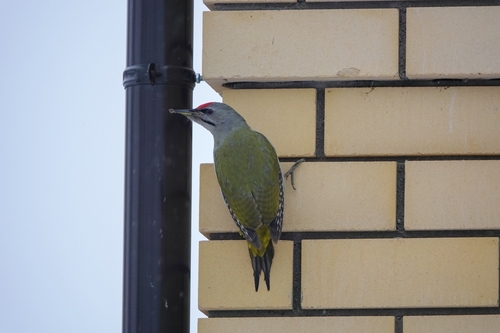 Grey-headed Woodpecker
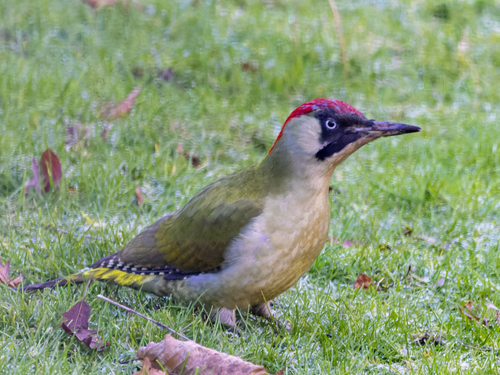 Eurasian Green Woodpecker
In short
The most reliable field mark to separate Grey-headed Woodpecker from Eurasian Green Woodpecker is the color of the head and underparts: Grey-headed shows a pale grey head and breast, while Green Woodpecker has a yellowish-green underbody and a bright red crown and nape. In all ages, Green Woodpecker is distinctly larger and bulkier, with a longer neck and heavier bill, but this is subtle in the field. Both species are green above, but Green Woodpecker has a yellow rump and a bold black 'mask' through the lores and around the eye, unlike the more subdued face of Grey-headed. Juvenile Green Woodpeckers are heavily streaked and spotted below, which can cause confusion, but their overall structure and facial pattern remain distinctive. Calls are similar, but the Grey-headed's song is more melodic and less explosive than the Green's loud, laughing 'yaffle.'
Identification tips
- Head and underparts color (all ages): Grey-headed Woodpecker has a pale grey head and breast, while Green Woodpecker has a yellowish-green underbody and a bright red crown and nape. This is the most reliable field mark in good light.
- Facial mask (all ages): Green Woodpecker has a bold black mask through the lores and around the eye, very prominent in both sexes. Grey-headed has a much less conspicuous black line across the lores and a narrower black moustache.
- Moustache stripe (adults): In Green Woodpecker, the male has a black moustache with a red centre, while the female's is solid black. In Grey-headed, the moustache is always narrow and black, with the male also showing a red forecrown.
- Crown and nape (adults): Grey-headed male has a red forecrown (not extending to the nape); female lacks red on the crown. Green Woodpecker has a bright red crown and nape in both sexes.
- Juvenile plumage: Juvenile Green Woodpecker is heavily streaked and spotted below and above, with a dark moustache (some red in young males by mid-summer). Juvenile Grey-headed is not described as streaky or spotty, so a streaked juvenile is almost always Green Woodpecker.
- Rump color (all ages): Green Woodpecker has a yellow rump, which can be visible in flight or when perched. Grey-headed's upperparts are more uniformly olive green, lacking a distinct yellow rump.
- Size and structure: Green Woodpecker is larger and bulkier, with a longer neck and heavier bill. Grey-headed is smaller, slimmer, and has a slightly rounder head. This is subtle unless both are seen together.
- Bill and neck: Green Woodpecker's bill is heavier and its neck longer, giving a more robust appearance. Grey-headed's bill is slimmer and neck shorter.
- Flight pattern: Both have undulating flight, but Green Woodpecker's larger size and yellow rump may be visible in flight.
- Voice: Green Woodpecker's call is a loud, explosive 'yaffle,' while Grey-headed's song is more melodic and less raucous. Calls can be confusing, but the overall tone and rhythm differ.
- Habitat and context: Green Woodpecker is more common in Europe and often found feeding on the ground. Both species nest in tree holes and use similar habitats, so context is not always diagnostic.
- Sex differences: In both species, males have more red on the head or moustache, but the pattern differs: Green Woodpecker male has a red-centred moustache, Grey-headed male has a red forecrown.
- Subspecies variation: Some Grey-headed subspecies (notably in Asia) have a black nape and darker green wings, but in Europe, the typical form is as described above. Green Woodpecker is more consistent across its range, except in the Iberian Peninsula (not covered here).
- Hybrid caution: Rare hybrids between these species can show intermediate features, but these are exceptional and usually resemble Grey-headed more closely.
- Pitfalls: Distant or poorly seen birds can be confused due to similar size and green upperparts. Focus on head and underparts color, facial mask, and rump color for the best chance of correct identification.
Size
Eurasian Green Woodpecker is noticeably larger and heavier than Grey-headed Woodpecker, with an average adult mass of 193 g compared to Grey-headed's much lighter build (no precise mass in the notes, but described as smaller and lighter). Green Woodpecker measures 30–36 cm in length with a 45–51 cm wingspan, while Grey-headed is 25–26 cm long with a 38–40 cm wingspan. In the field, this size difference is subtle and can be hard to judge unless both species are seen together, but Green Woodpecker often appears bulkier, with a longer neck and heavier bill.
Plumage
- Juveniles: Juvenile Green Woodpecker is heavily streaked and spotted all over, including the underparts, and the moustache is initially dark (with some red feathers in young males by mid-summer). Juvenile Grey-headed Woodpecker is not described in detail, but does not have the same level of streaking or spotting. This makes a streaky, spotty juvenile almost always a Green Woodpecker.
- Adults (male): Grey-headed Woodpecker male has a pale grey head with a red forecrown (not extending to the nape), a black line across the lores, and a narrow black moustache. Green Woodpecker male has a bright red crown and nape, a black facial mask (lores and around the white eye), and a black moustache with a red centre. Both are green above, but Green Woodpecker has a yellow rump and yellowish-green underparts, while Grey-headed is more uniform olive above and pale grey below.
- Adults (female): Grey-headed female lacks the red forecrown and has fine black streaks on the crown; Green Woodpecker female lacks the red in the moustache (solid black), but otherwise resembles the male. The facial mask is always bolder in Green Woodpecker.
- Flight: No distinctive upperwing pattern is described for either species in flight, but Green Woodpecker's yellow rump and larger size can be visible in good light.
Behaviour
Both species are shy and often detected by voice rather than by sight. Green Woodpecker spends much of its time feeding on ants on the ground and is less likely to drum on trees compared to other woodpeckers. Grey-headed Woodpecker's behavior is not described in detail, but it is generally similar in being elusive and more often heard than seen. In flight, Green Woodpecker shows an undulating pattern with several wingbeats followed by a glide, which is typical for both species.
Habitat
Both species can be found in wooded habitats across Europe and into Asia, with some overlap. Green Woodpecker is more widespread and common in Europe, while Grey-headed Woodpecker has a broader range extending into central and eastern Asia. There is no strong habitat separation in the notes, but Green Woodpecker is described as more commonly found in Europe. Both species nest in tree holes and use similar types of trees.
Voice
Calls are similar and can be confusing. Green Woodpecker is known for its loud, laughing 'yaffle' (kyü-kyü-kyück), which is explosive and far-carrying. Its song is a series of 10–18 'klü' notes, speeding up and dropping in pitch. Grey-headed Woodpecker's territorial song is more melodic and cleaner, with a series of 10–15 notes that decline in pitch and slow down, often sounding melancholic or 'dying.' Female Grey-headed's song is quieter, less melodious, and more croaky. Both species give sharp, single calls, but Green Woodpecker's are generally louder and more raucous.
Grey-headed Woodpecker · Eurasian Green Woodpecker · My Tricky Birds