

Grey Crowned-Crane vs Red-crowned Crane
Balearica regulorum versus Grus japonensis
Play a quiz with Grey Crowned-Crane and Red-crowned Crane
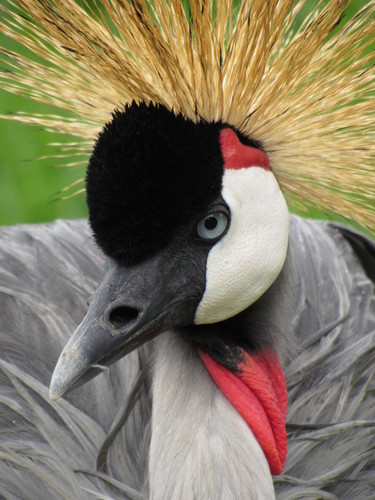 Grey Crowned-Crane
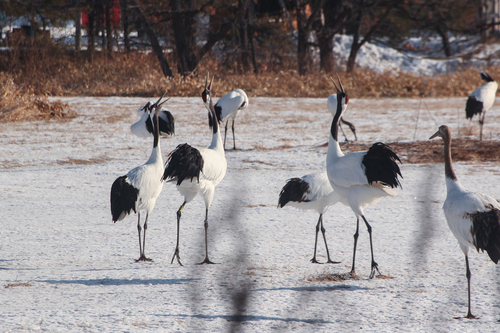 Red-crowned Crane
In short
The most reliable field mark between Grey Crowned-Crane and Red-crowned Crane is the head: Grey Crowned-Crane shows a striking golden crown of stiff feathers and a bright red throat pouch, while Red-crowned Crane has a bare red patch on the crown and a mostly white face. In flight or at rest, Grey Crowned-Crane appears mainly grey with complex wing coloring and a golden patch, whereas Red-crowned Crane is snow white with black wing secondaries that can look like a black tail. Juvenile plumages are also distinct: young Grey Crowned-Crane is overall greyer with a buff face, while juvenile Red-crowned Crane is white with tawny and gray tones and lacks the adult's red crown. Size is a strong clue—Red-crowned Crane is much larger and heavier. Habitat and behavior provide further separation: Grey Crowned-Crane is often seen in African savannahs and can roost in trees, while Red-crowned Crane is a wetland specialist of Northeast Asia.
Identification tips
- Golden feather crown vs. bare red crown: Grey Crowned-Crane always shows a golden crown of stiff feathers, while Red-crowned Crane has a bare red patch of skin on the crown (adults only). This is the single most reliable mark at any age.
- Red throat pouch: Grey Crowned-Crane has a bright red inflatable throat pouch below the bill, obvious in display and at rest; Red-crowned Crane lacks this feature.
- Cheek and face color: Grey Crowned-Crane has white cheeks and a largely dark face, while Red-crowned Crane's face is mostly white with a red crown and (in males) black on the cheeks, throat, and neck; females have these areas pearly gray.
- Juvenile head pattern: Juvenile Grey Crowned-Crane is greyer overall with a buff feathered face, lacking the golden crown; juvenile Red-crowned Crane is white with tawny and grayish tones, a grayish to coffee-brown neck collar, and no bare red skin.
- Adult body color: Grey Crowned-Crane is mainly grey-bodied with white, dark grey, dark red, and golden yellow in the wings; Red-crowned Crane is snow white with black wing secondaries and a white tail.
- Wing pattern in flight: Red-crowned Crane shows black secondaries contrasting with white primaries and body; Grey Crowned-Crane has a more complex and colorful wing with golden yellow, white, and dark tones but not the stark black-and-white contrast.
- Apparent 'black tail': When standing, Red-crowned Crane's black secondaries can look like a black tail, but the actual tail is white; Grey Crowned-Crane does not show this effect.
- Bill and leg color: Grey Crowned-Crane has a short grey bill and black legs; Red-crowned Crane has a longer olive-green to horn-colored bill and slate to grayish-black legs.
- Size: Red-crowned Crane is much larger and heavier (up to 1.5 m tall and 8–10 kg) than Grey Crowned-Crane (1 m tall, 3.5 kg). Use this only with a clear reference.
- Roosting behavior: Only Grey Crowned-Crane roosts in trees, thanks to its long hind toe; Red-crowned Crane never does.
- Habitat: Grey Crowned-Crane is found in African savannahs, marshes, and cultivated lands; Red-crowned Crane is restricted to Northeast Asian wetlands and riverine meadows.
- Display and flocking: Grey Crowned-Crane often dances energetically and forms large flocks; Red-crowned Crane is more often seen in pairs or small family groups, except during migration/winter.
- Vocalization: Grey Crowned-Crane gives a booming/honking call, quite different from the classic bugling of Red-crowned Crane.
- Juvenile wing pattern: Juvenile Red-crowned Crane shows dull black and brown secondaries and white primaries tipped with black; Grey Crowned-Crane juveniles are more uniformly grey.
- Context: If seen in Africa, it is Grey Crowned-Crane; if in Northeast Asia, it is Red-crowned Crane. These species do not overlap in the wild.
Size
Red-crowned Crane is substantially larger and heavier than Grey Crowned-Crane. Red-crowned Crane stands 150–158 cm tall (nearly 5 feet), with a wingspan of 220–250 cm (over 7–8 feet), and weighs 8–10 kg on average, making it the heaviest crane species [wikipedia][avonet]. In contrast, Grey Crowned-Crane is about 1 m tall (3 ft 3 in), with a 2 m wingspan (6 ft 7 in), and weighs around 3.5 kg [wikipedia][avonet]. This size difference is obvious in direct comparison, but less so at a distance or without a reference.
Plumage
Juvenile and immature birds are most easily separated by head and wing pattern. Juvenile Grey Crowned-Crane is overall greyer than adults, with a feathered buff face, lacking the golden crown and red throat pouch of adults. Juvenile Red-crowned Crane is mostly white with tawny, cinnamon, and grayish tones, a grayish to coffee-brown neck collar, and a crown/forehead covered in gray and tawny feathers—no bare red skin. The wing pattern in juvenile Red-crowned Crane includes dull black and brown secondaries and white primaries tipped with black, while Grey Crowned-Crane juveniles have less contrast and more uniform grey.
In adults, Grey Crowned-Crane has a golden crown of stiff feathers, white cheeks, a bright red inflatable throat pouch, mainly grey body plumage, and wings that are white, dark grey, dark red, and golden yellow. Red-crowned Crane adults are snow white overall, with black wing secondaries (appearing as a black 'tail' when standing), a bare red crown, and (in males) black on the cheeks, throat, and neck (females have these areas pearly gray). The real tail is white in Red-crowned Crane. Bill and leg color differ: Grey Crowned-Crane has a short grey bill and black legs, while Red-crowned Crane has an olive-green to horn-colored bill and slate to grayish-black legs.
Behaviour
Grey Crowned-Crane is unique among cranes for its ability to roost in trees, thanks to a long hind toe, and is often seen dancing, bowing, and jumping as part of its display. Flocks of 30–150 are not uncommon. Red-crowned Crane does not roost in trees and is more strictly associated with wetlands. Both species are known for elaborate courtship dances, but Grey Crowned-Crane's display is especially energetic and can occur year-round. Grey Crowned-Crane often associates with grazing mammals to flush insects, while Red-crowned Crane is more solitary or in pairs/family groups outside migration and wintering flocks.
Habitat
Grey Crowned-Crane is found in Sub-Saharan Africa, mainly in dry savannahs but also in marshes, cultivated lands, and grassy flatlands near water. It is adaptable and can be seen in a range of open habitats, often near rivers and lakes. Red-crowned Crane is native to Northeast Asia, breeding in wetlands, marshes, and riverine meadows, and wintering in similar wetland habitats in Korea, China, and Japan. The two species never overlap in the wild, and their habitat preferences are quite distinct: Grey Crowned-Crane is a savannah and wetland generalist, while Red-crowned Crane is a wetland specialist.
Voice
Grey Crowned-Crane gives a booming call involving inflation of the red gular sac, as well as a honking sound that is quite different from the trumpeting of other cranes. Red-crowned Crane's vocalizations are not described in detail in the notes, but are generally known to be loud, bugling trumpets typical of large cranes. In the field, Grey Crowned-Crane's call is less resonant and more honking/booming, while Red-crowned Crane's is a classic crane bugle.