

Grey-chinned Minivet vs Long-tailed Minivet
Pericrocotus solaris versus Pericrocotus ethologus
Play a quiz with Grey-chinned Minivet and Long-tailed Minivet
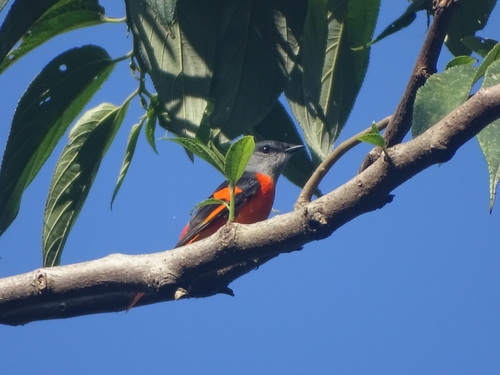 Grey-chinned Minivet
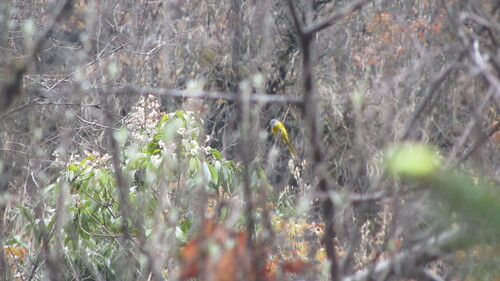 Long-tailed Minivet
In short
The most reliable field mark between Grey-chinned Minivet and Long-tailed Minivet is the combination of chin color and overall plumage tone, especially in adult males: Grey-chinned shows a pale grey chin and dark grey head, while Long-tailed lacks this contrast. Female and immature Grey-chinned Minivets are bright yellow below, but immatures have yellow-olive bars on the back—a feature not reported in Long-tailed. Both species are similar in size and shape, but habitat and altitude can help: Grey-chinned prefers higher elevation forests (1,000–2,000 m), while Long-tailed is more widespread from lowlands to montane forests. Pay close attention to chin color, back pattern in immatures, and elevation for the best separation.
Identification tips
- Chin color (all ages): Grey-chinned Minivet always shows a pale grey chin, especially striking in adult males. Long-tailed Minivet lacks this pale chin—look for this contrast when birds are facing you or in profile.
- Immature back pattern: Juvenile and immature Grey-chinned Minivets have yellow-olive bars on their back, which Long-tailed Minivets do not show. This is the best mark for separating young birds.
- Head and mantle (adult males): Grey-chinned males have a dark grey head and mantle, contrasting with the orange-yellow throat. Long-tailed males have a more uniform head and throat coloration without the pale chin.
- Greater covert tips: Grey-chinned shows orange tips to the greater coverts, visible as a wing bar in good light. This is less prominent or absent in Long-tailed.
- Underparts color (sex/age): Female and immature Grey-chinned are bright yellow below, but so are Long-tailed females—do not rely on underpart color alone.
- Lower back color: Grey-chinned has orange (male) or yellow (female) lower back; Long-tailed is similar but usually less vivid. This mark is subtle and best used in combination with others.
- Bill, legs, and eyes: Both species have black bills, legs, and eyes—these are not useful for separation.
- Tail length and shape: No diagnostic difference is reported in the sources; both are long-tailed and slim.
- Habitat and elevation: If the bird is in montane forest above 1,000 m, especially in the Himalayas or Taiwan, Grey-chinned is more likely. In lowland forests, Long-tailed is the default.
- Geographic range: Both overlap in much of Asia, but Grey-chinned extends into Taiwan, where Long-tailed is absent.
- Sexual dimorphism: Both species are sexually dimorphic, but the grey chin in Grey-chinned males is unique and diagnostic.
- Flock composition: Both species can occur in mixed flocks, so do not rely on flockmates for ID.
- Perched vs. flight views: The pale chin and back pattern in immatures are visible both perched and in flight, but are easiest to see when the bird is facing you or when the back is exposed.
- Seasonal change: No major seasonal plumage changes are reported for either species; use age and sex marks year-round.
- Pitfalls: Do not rely on overall brightness or tail length alone; focus on chin color and immature back pattern for the most reliable separation.
Size
Both species are similar in mass, with Grey-chinned Minivet averaging 14 g [wikidata]. Length for Grey-chinned is 17–19 cm [wikipedia], which is within the typical range for minivets, and Long-tailed is not reported as notably larger or smaller in the available sources. In the field, size is not a reliable separator between these two.
Plumage
- Immatures/Juveniles: Grey-chinned Minivet immatures resemble females but show yellow-olive bars on the back, a key mark not mentioned for Long-tailed. Use this back pattern for young birds.
- Adult males: Grey-chinned has a dark grey head and mantle with a distinct pale grey chin and orange-yellow throat, while Long-tailed lacks the pale chin and is generally more uniformly colored on the head and throat. Both have blackish wings, but only Grey-chinned has orange tips to the greater coverts.
- Adult females: Female Grey-chinned is bright yellow below and on the lower back, with a grey head; Long-tailed females are also yellowish but lack the grey chin and have less contrast on the head.
- Underparts: Grey-chinned males are orange below, females and immatures are yellow; Long-tailed is similar but lacks the diagnostic chin and back pattern.
Behaviour
Both species are active, arboreal insectivores that move in small flocks and sally for insects in the canopy. There are no strong behavioral differences noted in the sources that would reliably separate them in the field.
Habitat
Grey-chinned Minivet is most often found in montane forests at elevations of 1,000–2,000 m, from the Himalayas to Southeast Asia and Taiwan. Long-tailed Minivet has a broader elevational and geographic range, occurring from lowland to montane forests across southern and southeastern Asia, including areas where Grey-chinned is absent. If seen below 1,000 m, Long-tailed is much more likely; at higher elevations, both are possible, but Grey-chinned is more typical.
Grey-chinned Minivet · Long-tailed Minivet · My Tricky Birds