

Grey-bellied Spinetail vs Rufous-capped Spinetail
Synallaxis cinerascens versus Synallaxis ruficapilla
Play a quiz with Grey-bellied Spinetail and Rufous-capped Spinetail
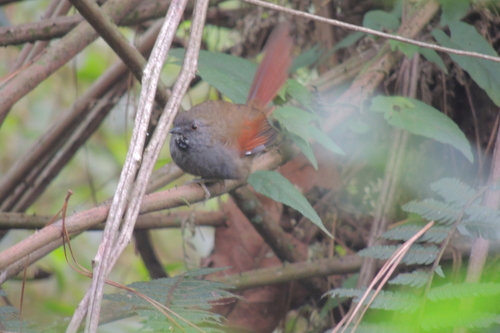 Grey-bellied Spinetail
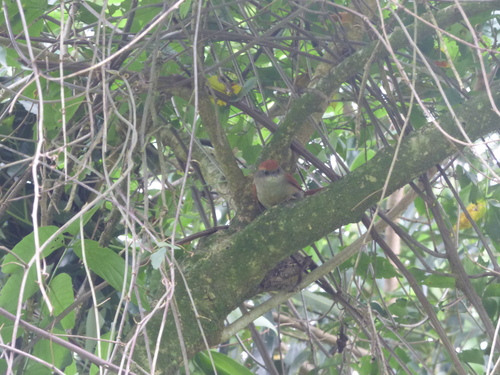 Rufous-capped Spinetail
In short
The most reliable field mark for separating Grey-bellied Spinetail from Rufous-capped Spinetail is the head pattern: Grey-bellied has a dark, grayish-brown crown blending into a gray-brown face with blackish lores and only a faint gray line behind the eye, while Rufous-capped shows a strikingly bright orange-rufous crown and nape with a bold buff supercilium. Juvenile differences are subtle but present, with Grey-bellied showing a less distinct throat patch and Rufous-capped a duller crown. Both species have chestnut tails and wings, but the underparts and throat patterns differ. Habitat preferences and foraging height can also help, as Grey-bellied prefers dense forest interiors and lower foraging, while Rufous-capped is more often at forest edges and in bamboo stands.
Identification tips
- Crown color and pattern (all ages): Rufous-capped Spinetail always shows a bright orange-rufous crown and nape, contrasting strongly with the rest of the head. Grey-bellied Spinetail has a dark grayish-brown crown and forehead, blending into the face, never bright rufous.
- Supercilium (adults and most juveniles): Rufous-capped has a broad, buff supercilium that stands out in profile. Grey-bellied lacks a strong supercilium, only showing a faint gray line behind the eye.
- Lores and face: Grey-bellied has blackish lores and a gray-brown face, while Rufous-capped's lores and ear coverts are dark brownish gray but less contrasting due to the bold supercilium.
- Throat pattern: Grey-bellied shows a whitish chin, upper throat mottled black and pale gray, and a solid black lower throat. Rufous-capped has a tiny tawny chin spot (sometimes absent in juveniles), with the rest of the chin and throat whitish and faintly streaked gray—never solidly black.
- Underparts: Grey-bellied's underparts are mostly brownish gray with a paler, grayer belly center and browner flanks/undertail. Rufous-capped is paler and buffier below, especially on the belly and lower breast.
- Tail structure: Both have chestnut tails, but Grey-bellied's is darker, with spiny tips (feather tips lack barbs), while Rufous-capped's tail is graduated and the feathers are pointed but not spiny.
- Juvenile differences: Juvenile Grey-bellied shows a less distinct throat patch and more mottling below; Rufous-capped juveniles have a duller crown, little or no chin spot, and a browner wash on the underparts. These are subtle and best used in combination with head pattern.
- Wing color: Both have chestnut or reddish chestnut wings, not a strong separator.
- Bill color: Both species have a blackish bill, with Rufous-capped sometimes showing a gray mandible with a dark tip; not a reliable field mark.
- Iris and legs: Both have reddish brown irises and greenish gray legs/feet; not useful for separation.
- Foraging height and context: Grey-bellied is more likely to be seen on or near the ground in dense forest interiors, while Rufous-capped is often higher in the understorey, at edges, or in bamboo, and more likely to join mixed flocks.
- Habitat: If seen in bamboo or at forest edge, Rufous-capped is more likely; deep interior forest with little bamboo suggests Grey-bellied.
- Voice: Listen for the very high, two-note song of Grey-bellied versus the lower, trilled or rattled song of Rufous-capped. If only calls are heard, use with caution.
- Range: Both overlap widely, but only Grey-bellied occurs in Uruguay.
- Size and structure: Both are similar in size and mass; structure is not a reliable separator in the field.
For best results, focus on the crown color and supercilium, then throat and underparts, and finally habitat and foraging context. Juvenile birds are best identified by head pattern and subtle differences in throat and underparts.
Size
Both species are very close in size and mass, with Grey-bellied Spinetail averaging 13.8 g and Rufous-capped Spinetail 14.0 g [wikidata]. Length overlaps: Grey-bellied is 13.5–15 cm, Rufous-capped 13–17 cm [wikipedia]. In the field, size is not a reliable separator.
Plumage
- Juveniles: Grey-bellied juveniles have a less distinct throat patch and paler, mottled underparts. Rufous-capped juveniles show a duller crown (less orange), little or no chin spot, and an ochraceous or brownish wash below. These differences are subtle and best seen at close range.
- Adults: Grey-bellied has a dark grayish-brown forehead and crown, blackish lores, faint gray line behind the eye, and a gray-brown face. The throat is mottled black and pale gray above, black below, and the underparts are brownish gray with a paler, grayer belly center. Rufous-capped has a bright orange-rufous crown and nape, broad buff supercilium, dark brownish gray lores and ear coverts, and a tiny tawny chin spot. Its throat is mostly whitish with faint gray streaks, and the underparts are paler buffy brownish. Both have chestnut tails and wings, but Grey-bellied's tail is darker and spiny-tipped, while Rufous-capped's is graduated and pointed.
Behaviour
Both species forage in pairs and primarily glean arthropods from low vegetation. Grey-bellied Spinetail tends to stay closer to the ground (on the ground or up to 2 m), while Rufous-capped forages in the understorey and sometimes up into the mid-storey, often joining mixed-species flocks. Rufous-capped also forages more frequently in bamboo stands and is more likely to be seen at forest edges.
Habitat
Grey-bellied Spinetail is most often found in the interior of dense lowland and montane evergreen forest and mature secondary forest, avoiding edges. Rufous-capped Spinetail is more flexible, inhabiting undergrowth and edges of various forest types, both primary and secondary, and is strongly associated with Chusquea bamboo. Both overlap in range (Argentina, Brazil, Paraguay), but Grey-bellied extends into Uruguay and is more restricted to interior forest, while Rufous-capped is more likely at edges and in bamboo patches.
Voice
Grey-bellied Spinetail gives a very high, piercing 'weeet-sweet', with the first note higher than the second. Rufous-capped Spinetail's song is more varied and lower-pitched, described as a fast nasal 'di-di-di-réét', 'tdrrrWit', or a quiet, insistent 'drrrrrt wee', with a distinctive low-pitched trill or dry rattle as a call. These differences are useful if the song is clearly heard, but both can be overlooked in mixed flocks.
Grey-bellied Spinetail · Rufous-capped Spinetail · My Tricky Birds