

Green-breasted Mango vs Veraguan Mango
Anthracothorax prevostii versus Anthracothorax veraguensis
Play a quiz with Green-breasted Mango and Veraguan Mango
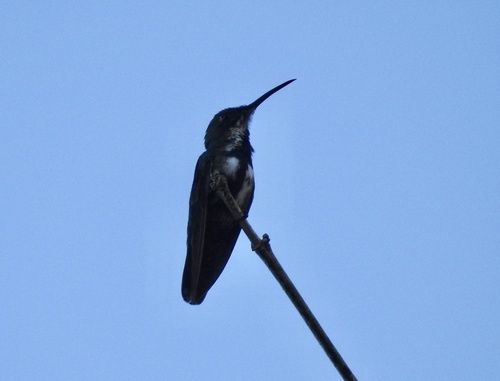 Green-breasted Mango
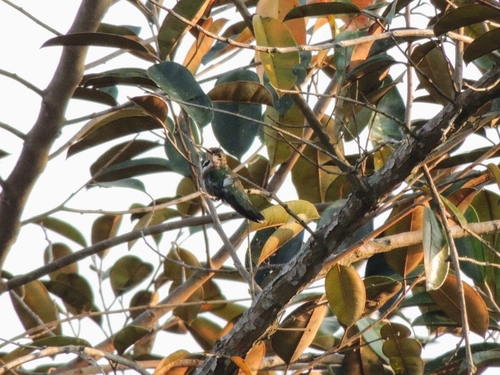 Veraguan Mango
In short
The most reliable way to separate Green-breasted Mango from Veraguan Mango is by the color and extent of the ventral (underpart) stripe: Green-breasted Mango always shows a bold, velvety black stripe down the center of the throat and chest (male and female), while Veraguan Mango lacks black on the throat and instead has a teal (female) or bluish (male) ventral stripe, with females showing a white or cream belly. Both species are metallic green hummingbirds with similar size and structure, but tail and underpart details are key. Juvenile Green-breasted Mangos can show a white throat and breast center with chestnut on the sides, which is not matched by Veraguan Mango. Range is also helpful: Veraguan Mango is restricted to Panama and Costa Rica, while Green-breasted Mango is widespread from eastern Mexico to northern South America.
Identification tips
- Ventral Stripe Color (All Ages): Green-breasted Mango always shows a bold, velvety black stripe running from chin to lower chest (both sexes). Veraguan Mango never has black on the throat; the ventral stripe is blueish (male) or dark teal (female), and in females is set on a white or cream belly.
- Throat Color (All Ages): Green-breasted Mango has black on the throat in both sexes; Veraguan Mango's throat is metallic green or blueish, never black.
- Belly Color (Females): Female Green-breasted Mango has metallic green underparts with a bordered black/blue-green stripe; female Veraguan Mango has a white or cream belly with a single dark teal stripe down the center.
- Juvenile Pattern: Juvenile Green-breasted Mango can show a white chin, throat, and breast center with chestnut on the sides—this combination is not described for Veraguan Mango and is a strong clue if seen.
- Tail Pattern (Both Sexes): Green-breasted Mango has purple or blue-black outer tail feathers with metallic gloss (males) or blue-black with purple base and whitish tips (females). Veraguan Mango has black tail feathers with a red circle central to each feather (both sexes). Look for the red circle if the tail is spread or well-lit.
- Crown and Upperparts: Green-breasted Mango males have a metallic bronze-green crown and nape; Veraguan Mango is metallic green above but lacks the bronzy tone.
- Undertail Coverts: Green-breasted Mango females have dusky undertail coverts with wide white edges; Veraguan Mango's undertail coverts are not described as distinctive.
- Bill Shape: Both species have a slightly decurved, dark bill; this is not a useful separation mark.
- Size: Both are medium-sized hummingbirds of similar length and mass; size is not a reliable field mark.
- Range: Veraguan Mango is only found in Panama and Costa Rica. Green-breasted Mango is much more widespread. If seen outside Panama/Costa Rica, it is almost certainly Green-breasted Mango.
- Sexual Dimorphism: Both species show sexual dimorphism, but the color of the ventral stripe and belly is the most reliable sex-linked difference.
- Flight and Perched Views: In flight, tail color and ventral stripe may be visible; perched, the underpart pattern is usually easier to see. Try to get a clear view of the throat and belly.
- Plumage Pitfalls: The similarity in overall green coloration and structure can cause confusion; focus on the underpart stripe and tail pattern rather than upperpart color.
- Seasonal Variation: No strong seasonal plumage differences are described for either species, but juvenile Green-breasted Mango can be distinctive.
- Voice: No diagnostic vocal differences are described in the sources; rely on visual marks.
Size
Both species are very similar in size and structure. Green-breasted Mango measures 10.3–12.1 cm in length and weighs 5.7–7.0 g. Veraguan Mango is listed at 11–12 cm in length, with no weight given, but is described as medium-sized and similar to Green-breasted Mango. Bill shape is also similar: both have a slightly decurved, dark bill. Size is not a reliable field mark between these two.
Plumage
-
Juveniles: Juvenile Green-breasted Mango resembles the adult female but with a white chin, throat, and breast center, and chestnut on the sides. No such pattern is described for Veraguan Mango juveniles, which are not detailed in the sources, but are not noted to show this combination.
-
Adult males: Green-breasted Mango males have a metallic bronze-green crown and upperparts, with a bold, velvety black stripe running from chin to chest, bordered by metallic bluish green. The tail is mostly purple with metallic gloss, with central feathers dull bronze-green. Veraguan Mango males are metallic green above, have a blueish breast and belly (not black), and black tail feathers with a red circle central to each feather.
-
Adult females: Green-breasted Mango females have less bronzy green above, a black chin and throat stripe that becomes bluish green on the breast, and a white border. The rest of the underparts are metallic green, with dusky undertail coverts edged white. Their tail has blue-black outer feathers with wide purple bases and whitish tips. Veraguan Mango females have a white-cream belly with a dark teal stripe down the breast (not black), and black tail feathers with a red circle on each feather.
-
Tail: Green-breasted Mango: outer tail feathers purple or blue-black with metallic gloss (males) or blue-black with purple base and whitish tips (females). Veraguan Mango: black tail feathers with a red circle central to each feather (both sexes).
Behaviour
Both species forage for nectar and arthropods at all levels of their habitat, from understory to canopy, and both will visit feeders. No behavioral differences are highlighted in the sources that are diagnostic in the field.
Habitat
Green-breasted Mango is widespread from eastern Mexico through most of Central America, Colombia, and Venezuela, and is a rare vagrant to the United States. Veraguan Mango is much more localized, found only in Panama and recently in Costa Rica. If you are outside Panama or Costa Rica, Veraguan Mango is extremely unlikely. Both species use a range of wooded and open habitats, including human-altered areas, so habitat type is less useful than geographic location.