

Greater Coucal vs Chestnut-winged Cuckoo
Centropus sinensis versus Clamator coromandus
Play a quiz with Greater Coucal and Chestnut-winged Cuckoo
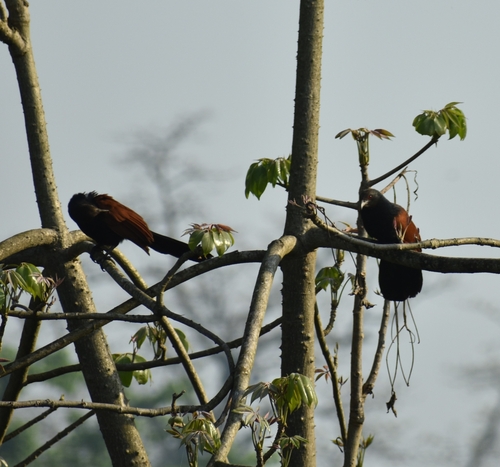 Greater Coucal
 Chestnut-winged Cuckoo
In short
The most reliable field mark to separate Greater Coucal from Chestnut-winged Cuckoo is overall structure and tail shape: Greater Coucal is much heavier-bodied with a broad, long tail and lacks a crest, while Chestnut-winged Cuckoo is slimmer, has a prominent black crest, and a long, graduated tail with subtle white tips. Juvenile Greater Coucals show barred underparts and tail, while juvenile Chestnut-winged Cuckoos are dusky with a scaly look to the wing feathers. In adults, Greater Coucal has a deep black head and underparts with bright chestnut wings, but no white collar, while Chestnut-winged Cuckoo shows a striking white nuchal half-collar and rufous throat. Both can show chestnut wings, but the context, structure, and head pattern are key. Watch for the Coucal’s heavy, crow-like jizz and the Cuckoo’s sleeker, crested profile.
Identification tips
- Overall structure: Greater Coucal is much bulkier and heavier-bodied, with a robust, crow-like build and a broad tail; Chestnut-winged Cuckoo is slender, lighter, and more agile, with a long, narrow, graduated tail.
- Crest: Chestnut-winged Cuckoo has a prominent, glossy black crest; Greater Coucal lacks any crest and has a smoothly rounded head.
- Tail shape: Coucal’s tail is broad and straight-edged, not obviously graduated; Cuckoo’s tail is long and distinctly graduated (outer feathers much shorter than central ones), often with subtle white tips (not as bold as in Jacobin Cuckoo).
- Head and collar: Chestnut-winged Cuckoo shows a narrow white nuchal half-collar separating the black head from the back, and a rufous throat; Greater Coucal has a uniformly black (sometimes purple/blue-glossed) head and throat with no white collar.
- Eye color: Greater Coucal has striking ruby red eyes, visible at close range; Chestnut-winged Cuckoo’s eye color is not diagnostic.
- Wing color: Both show chestnut wings, but Coucal’s are broader and the bird appears heavier in flight; Cuckoo’s wings are slimmer and the bird is more streamlined.
- Juvenile plumage: Juvenile Coucal (northern races) has barred underparts and tail, and spots on the crown; southern Coucal juveniles are unmarked below. Juvenile Chestnut-winged Cuckoo is dusky overall with a scaly look to the wing feathers, lacking the Coucal’s barring.
- Bill: Coucal’s bill is heavy and slightly downcurved, suited for ground foraging; Cuckoo’s bill is slimmer and more typical of arboreal cuckoos.
- Behavior: Coucal is often seen walking on the ground or moving clumsily in dense cover; Cuckoo is more arboreal, often perching in the open or joining mixed flocks.
- Habitat: Coucal is common in gardens, fields, and urban edges; Cuckoo is more tied to forest edge, secondary growth, and migratory stopover sites.
- Voice: Coucal gives deep, booming, repetitive calls; Cuckoo gives fluty, repeated twin-notes. If heard well, these are diagnostic.
- Flight style: Coucal flies with slow, heavy wingbeats and often lands clumsily; Cuckoo is more direct and agile in flight.
- Season: Chestnut-winged Cuckoo is migratory and may appear in southern India and Sri Lanka mainly in winter; Coucal is resident year-round.
- Sexes: Both species are similar in plumage between sexes; female Coucal is slightly larger, but this is not useful in the field.
- Pitfalls: Both can show chestnut wings and dark bodies, but only the Cuckoo combines a crest, white nuchal collar, rufous throat, and graduated tail. Always check for the combination of structure, head pattern, and tail shape.
Size
Greater Coucal is dramatically heavier and bulkier (body mass ~283 g) compared to the much lighter Chestnut-winged Cuckoo (~76 g) [wikidata]. Both species are similar in overall length (Coucal ~48 cm, Cuckoo ~47 cm), but the Coucal’s body is much more robust and its tail is broader and less graduated. Chestnut-winged Cuckoo is slender, with a noticeably lighter build and a long, narrow, graduated tail. In the field, Coucal often looks almost crow-like, while the Cuckoo is more svelte and agile.
Plumage
- Juveniles: Greater Coucal juveniles are duller black with spots on the crown and whitish bars on the underside and tail; northern races show barred underparts, while southern (parroti) juveniles have unmarked dull black underparts and dusky chestnut wings. Chestnut-winged Cuckoo juveniles are overall dusky with a scaly appearance to the wing feathers, lacking the Coucal’s barring or spots.
- Adults: Greater Coucal adults have a black head, upper mantle, and underparts glossed purple/blue, with rich chestnut back and wings; no white collar or crest. Chestnut-winged Cuckoo adults show a glossy black head with a prominent crest, a narrow white nuchal half-collar (breaking the black head from the back), chestnut wings, rufous throat, dusky underparts, and a long, graduated black tail with subtle white tips. The Coucal’s eyes are ruby red, while the Cuckoo’s eye color is not noted as distinctive.
- In flight: Both show chestnut wings, but the Coucal’s wings are broader and the bird appears heavier; the Cuckoo’s wings are narrower and the tail more obviously graduated.
Behaviour
Greater Coucal is often seen walking or skulking in dense vegetation, gardens, or open country, moving heavily and sometimes clumsily. It tends to be solitary or in pairs, often foraging on or near the ground. Chestnut-winged Cuckoo is more arboreal, usually seen singly and sometimes joining mixed-species foraging flocks. It is more likely to be seen in active flight or perched in the open, especially during migration when it may appear in unusual places, sometimes exhausted. The Coucal’s movement is slow and deliberate, while the Cuckoo is more agile and alert.
Habitat
Greater Coucal is a widespread resident across the Indian subcontinent and Southeast Asia, found in a broad range of habitats from dense jungle to cultivated land and urban gardens. It is a habitat generalist, often close to human habitation. Chestnut-winged Cuckoo breeds along the Himalayas and migrates south in winter to Sri Lanka, southern India, and Southeast Asia, including Indonesia, Thailand, and the Philippines. It is more closely associated with forest edges, secondary growth, and wooded areas, and is less likely to be found in urban gardens or open cultivation compared to the Coucal. During migration, the Cuckoo may turn up in atypical habitats.
Voice
Greater Coucal’s song varies by race but is generally a deep, resonant, and repetitive 'coop-coop-coop' or 'whoop' series, often delivered from cover. Chestnut-winged Cuckoo gives fluty twin-notes, repeated with short intervals, and is less likely to be heard giving the deep booming calls of the Coucal. Vocalizations are distinctive if heard well, but may not always be diagnostic in brief encounters.