

Motmot

オオバンケン 対 カンムリカッコウ

Centropus sinensis 対 Clamator coromandus

オオバンケンとカンムリカッコウのクイズ
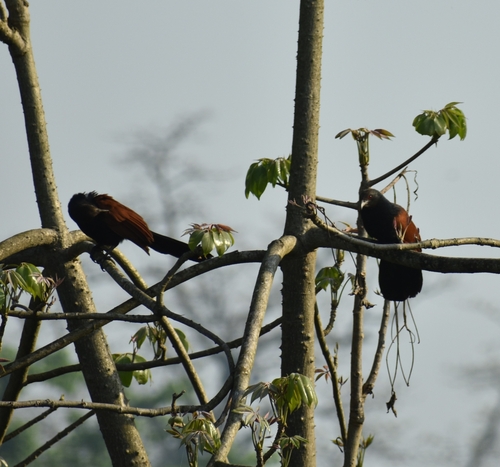
オオバンケン (Centropus sinensis) オオバンケン
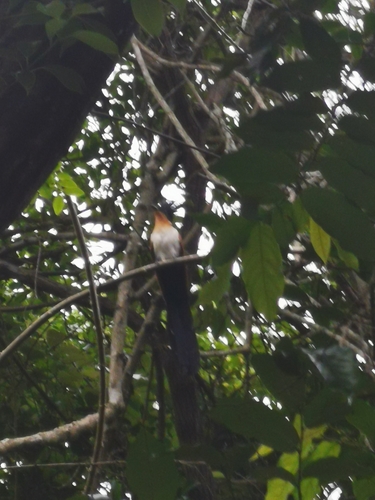
カンムリカッコウ (Clamator coromandus) カンムリカッコウ

メディア

読み込み中…

要点

オオバンケンとカンムリカッコウを区別する最も信頼できるフィールドマークは、全体の構造と尾の形状です:オオバンケンはずっと重い体を持ち、幅広く長い尾を持ち、冠羽がありません。一方、カンムリカッコウはスリムで、目立つ黒い冠羽を持ち、微妙な白い先端を持つ長く段階的な尾を持っています。幼鳥のオオバンケンは横縞のある腹部と尾を示し、幼鳥のカンムリカッコウは全体的に暗い色合いで、翼の羽毛に鱗状の外観があります。成鳥では、オオバンケンは深い黒い頭と腹部を持ち、明るい栗色の翼を持っていますが、白い襟はありません。一方、カンムリカッコウは目を引く白い後頭部の半襟と赤褐色の喉を示します。両者は栗色の翼を示すことがありますが、文脈、構造、頭のパターンが重要です。オオバンケンの重くカラスのような姿勢とカッコウのすっきりとした冠羽のプロファイルに注意してください。

識別のコツ

  1. Overall structure: オオバンケンはずっと大きくて重い体を持ち、頑丈でカラスのような体型と幅広い尾を持っています;カンムリカッコウはスリムで、軽く、より敏捷で、長く狭い段階的な尾を持っています。
  2. Crest: カンムリカッコウは目立つ光沢のある黒い冠羽を持っています;オオバンケンには冠羽がなく、滑らかに丸い頭を持っています。
  3. Tail shape: オオバンケンの尾は幅広く、直線的で、明らかに段階的ではありません;カッコウの尾は長く、明確に段階的で(外側の羽は中央の羽よりもずっと短い)、しばしば微妙な白い先端を持っています(ジャコビンカッコウほど大胆ではありません)。
  4. Head and collar: カンムリカッコウは黒い頭と背中を分ける狭い白い後頭部の半襟と赤褐色の喉を示します;オオバンケンは均一に黒い(時には紫/青の光沢がある)頭と喉を持ち、白い襟はありません。
  5. Eye color: オオバンケンは近距離で見える目を引くルビー色の目を持っています;カンムリカッコウの目の色は診断的ではありません。
  6. Wing color: 両者は栗色の翼を示しますが、オオバンケンの翼は幅広く、飛行中に重く見えます;カッコウの翼はスリムで、鳥はより流線型です。
  7. Juvenile plumage: 幼鳥のオオバンケン(北部の亜種)は横縞のある腹部と尾、頭頂に斑点があります;南部のオオバンケンの幼鳥は下側に斑点がありません。幼鳥のカンムリカッコウは全体的に暗く、翼の羽毛に鱗状の外観があり、オオバンケンの横縞はありません。
  8. Bill: オオバンケンのくちばしは重く、わずかに下向きに曲がっており、地面での採餌に適しています;カッコウのくちばしはスリムで、樹上性のカッコウに典型的です。
  9. Behavior: オオバンケンはしばしば地面を歩いたり、密な覆いの中で不器用に動いたりしているのが見られます;カッコウはより樹上性で、しばしば開けた場所に止まったり、混成群れに加わったりします。
  10. Habitat: オオバンケンは庭、田畑、都市の端で一般的です;カッコウは森林の端、二次成長、移動中の中継地により結びついています。
  11. Voice: オオバンケンは深く、轟音のような繰り返しの呼び声を出します;カッコウはフルートのような繰り返しの二重音を出します。よく聞こえれば、これらは診断的です。
  12. Flight style: オオバンケンは遅く重い羽ばたきで飛び、しばしば不器用に着陸します;カッコウはより直接的で敏捷に飛びます。
  13. Season: カンムリカッコウは渡り鳥で、主に冬に南インドやスリランカに現れることがあります;オオバンケンは年間を通じて定住しています。
  14. Sexes: 両種は性別間で羽毛が似ています;雌のオオバンケンはわずかに大きいですが、これはフィールドでは役に立ちません。
  15. Pitfalls: 両者は栗色の翼と暗い体を示すことがありますが、カッコウだけが冠羽、白い後頭部の襟、赤褐色の喉、段階的な尾を組み合わせています。常に構造、頭のパターン、尾の形状の組み合わせを確認してください。

大きさ

オオバンケンは劇的に重く、ずっしりとした体(体重約283g)で、はるかに軽いカンムリカッコウ(約76g)と比較されます [wikidata]。両種は全体の長さ(オオバンケン約48cm、カッコウ約47cm)で似ていますが、オオバンケンの体はずっと頑丈で、尾は幅広く、段階的ではありません。カンムリカッコウはスリムで、明らかに軽い体型と長く狭い段階的な尾を持っています。フィールドでは、オオバンケンはほぼカラスのように見えることが多いですが、カッコウはよりスリムで敏捷です。

羽色

行動

オオバンケンはしばしば密な植生、庭、または開けた国で歩いたり、隠れたりしているのが見られ、重く、時には不器用に動きます。孤独またはペアで見られることが多く、しばしば地面の上または近くで採餌します。カンムリカッコウはより樹上性で、通常は単独で見られ、時には混成種の採餌群れに加わります。特に移動中には、開けた場所で活発に飛んでいるのが見られることが多く、時には疲れていることもあります。オオバンケンの動きは遅くて慎重ですが、カッコウはより敏捷で警戒しています。

生息環境

オオバンケンはインド亜大陸と東南アジア全体に広く分布しており、密なジャングルから耕作地や都市の庭まで幅広い生息地で見られます。人間の居住地に近い生息地の一般主義者です。カンムリカッコウはヒマラヤ沿いで繁殖し、冬にはスリランカ、南インド、インドネシア、タイ、フィリピンを含む東南アジアに南下します。森林の端、二次成長、樹木の多い地域により密接に関連しており、オオバンケンと比較して都市の庭や開けた耕作地で見られる可能性は低いです。移動中には、カッコウが異常な生息地に現れることがあります。

声

オオバンケンの歌は亜種によって異なりますが、一般的には深く、響き渡る繰り返しの「クープ・クープ・クープ」または「フープ」シリーズで、しばしば覆いの中から発せられます。カンムリカッコウはフルートのような二重音を出し、短い間隔で繰り返され、オオバンケンの深い轟音の呼び声を出すことは少ないです。声はよく聞こえれば特異的ですが、短い遭遇では常に診断的とは限りません。

より良い説明を送る

比較と同じ項目を使ってください。文章はすぐに公開されます。

The most reliable field mark to separate Greater Coucal from Chestnut-winged Cuckoo is overall structure and tail shape: Greater Coucal is much heavier-bodied with a broad, long tail and lacks a crest, while Chestnut-winged Cuckoo is slimmer, has a prominent black crest, and a long, graduated tail with subtle white tips. Juvenile Greater Coucals show barred underparts and tail, while juvenile Chestnut-winged Cuckoos are dusky with a scaly look to the wing feathers. In adults, Greater Coucal has a deep black head and underparts with bright chestnut wings, but no white collar, while Chestnut-winged Cuckoo shows a striking white nuchal half-collar and rufous throat. Both can show chestnut wings, but the context, structure, and head pattern are key. Watch for the Coucal’s heavy, crow-like jizz and the Cuckoo’s sleeker, crested profile.

  1. Overall structure: Greater Coucal is much bulkier and heavier-bodied, with a robust, crow-like build and a broad tail; Chestnut-winged Cuckoo is slender, lighter, and more agile, with a long, narrow, graduated tail.
  2. Crest: Chestnut-winged Cuckoo has a prominent, glossy black crest; Greater Coucal lacks any crest and has a smoothly rounded head.
  3. Tail shape: Coucal’s tail is broad and straight-edged, not obviously graduated; Cuckoo’s tail is long and distinctly graduated (outer feathers much shorter than central ones), often with subtle white tips (not as bold as in Jacobin Cuckoo).
  4. Head and collar: Chestnut-winged Cuckoo shows a narrow white nuchal half-collar separating the black head from the back, and a rufous throat; Greater Coucal has a uniformly black (sometimes purple/blue-glossed) head and throat with no white collar.
  5. Eye color: Greater Coucal has striking ruby red eyes, visible at close range; Chestnut-winged Cuckoo’s eye color is not diagnostic.
  6. Wing color: Both show chestnut wings, but Coucal’s are broader and the bird appears heavier in flight; Cuckoo’s wings are slimmer and the bird is more streamlined.
  7. Juvenile plumage: Juvenile Coucal (northern races) has barred underparts and tail, and spots on the crown; southern Coucal juveniles are unmarked below. Juvenile Chestnut-winged Cuckoo is dusky overall with a scaly look to the wing feathers, lacking the Coucal’s barring.
  8. Bill: Coucal’s bill is heavy and slightly downcurved, suited for ground foraging; Cuckoo’s bill is slimmer and more typical of arboreal cuckoos.
  9. Behavior: Coucal is often seen walking on the ground or moving clumsily in dense cover; Cuckoo is more arboreal, often perching in the open or joining mixed flocks.
  10. Habitat: Coucal is common in gardens, fields, and urban edges; Cuckoo is more tied to forest edge, secondary growth, and migratory stopover sites.
  11. Voice: Coucal gives deep, booming, repetitive calls; Cuckoo gives fluty, repeated twin-notes. If heard well, these are diagnostic.
  12. Flight style: Coucal flies with slow, heavy wingbeats and often lands clumsily; Cuckoo is more direct and agile in flight.
  13. Season: Chestnut-winged Cuckoo is migratory and may appear in southern India and Sri Lanka mainly in winter; Coucal is resident year-round.
  14. Sexes: Both species are similar in plumage between sexes; female Coucal is slightly larger, but this is not useful in the field.
  15. Pitfalls: Both can show chestnut wings and dark bodies, but only the Cuckoo combines a crest, white nuchal collar, rufous throat, and graduated tail. Always check for the combination of structure, head pattern, and tail shape.

Greater Coucal is dramatically heavier and bulkier (body mass ~283 g) compared to the much lighter Chestnut-winged Cuckoo (~76 g) [wikidata]. Both species are similar in overall length (Coucal ~48 cm, Cuckoo ~47 cm), but the Coucal’s body is much more robust and its tail is broader and less graduated. Chestnut-winged Cuckoo is slender, with a noticeably lighter build and a long, narrow, graduated tail. In the field, Coucal often looks almost crow-like, while the Cuckoo is more svelte and agile.

  • Juveniles: Greater Coucal juveniles are duller black with spots on the crown and whitish bars on the underside and tail; northern races show barred underparts, while southern (parroti) juveniles have unmarked dull black underparts and dusky chestnut wings. Chestnut-winged Cuckoo juveniles are overall dusky with a scaly appearance to the wing feathers, lacking the Coucal’s barring or spots.
  • Adults: Greater Coucal adults have a black head, upper mantle, and underparts glossed purple/blue, with rich chestnut back and wings; no white collar or crest. Chestnut-winged Cuckoo adults show a glossy black head with a prominent crest, a narrow white nuchal half-collar (breaking the black head from the back), chestnut wings, rufous throat, dusky underparts, and a long, graduated black tail with subtle white tips. The Coucal’s eyes are ruby red, while the Cuckoo’s eye color is not noted as distinctive.
  • In flight: Both show chestnut wings, but the Coucal’s wings are broader and the bird appears heavier; the Cuckoo’s wings are narrower and the tail more obviously graduated.

Greater Coucal is often seen walking or skulking in dense vegetation, gardens, or open country, moving heavily and sometimes clumsily. It tends to be solitary or in pairs, often foraging on or near the ground. Chestnut-winged Cuckoo is more arboreal, usually seen singly and sometimes joining mixed-species foraging flocks. It is more likely to be seen in active flight or perched in the open, especially during migration when it may appear in unusual places, sometimes exhausted. The Coucal’s movement is slow and deliberate, while the Cuckoo is more agile and alert.

Greater Coucal is a widespread resident across the Indian subcontinent and Southeast Asia, found in a broad range of habitats from dense jungle to cultivated land and urban gardens. It is a habitat generalist, often close to human habitation. Chestnut-winged Cuckoo breeds along the Himalayas and migrates south in winter to Sri Lanka, southern India, and Southeast Asia, including Indonesia, Thailand, and the Philippines. It is more closely associated with forest edges, secondary growth, and wooded areas, and is less likely to be found in urban gardens or open cultivation compared to the Coucal. During migration, the Cuckoo may turn up in atypical habitats.

Greater Coucal’s song varies by race but is generally a deep, resonant, and repetitive 'coop-coop-coop' or 'whoop' series, often delivered from cover. Chestnut-winged Cuckoo gives fluty twin-notes, repeated with short intervals, and is less likely to be heard giving the deep booming calls of the Coucal. Vocalizations are distinctive if heard well, but may not always be diagnostic in brief encounters.

変更を破棄しますか?

保存していない編集があります。今離れると失われます。

オオバンケン · カンムリカッコウ · 苦手な鳥