

Great Knot vs Stilt Sandpiper
Calidris tenuirostris versus Calidris himantopus
Play a quiz with Great Knot and Stilt Sandpiper
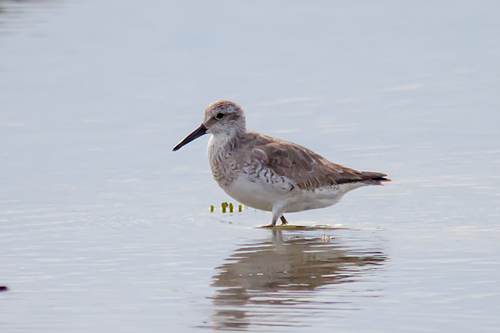 Great Knot
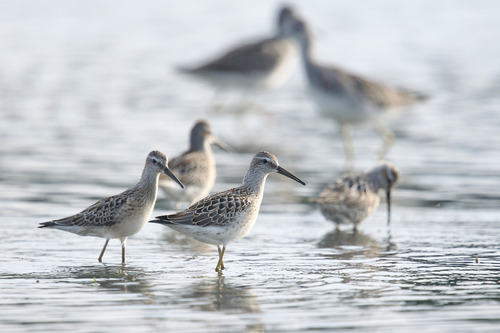 Stilt Sandpiper
In short
The most reliable field mark to separate Great Knot from Stilt Sandpiper is size: Great Knot is much larger and bulkier, with a deeper chest and heavier build, while Stilt Sandpiper is distinctly smaller and more slender. In flight, Stilt Sandpiper lacks a wingbar, whereas Great Knot shows a pale wingbar, especially in fresh plumage. Leg color is also key: Great Knot has short, dark legs; Stilt Sandpiper’s legs are longer and greenish-yellow. Bill structure differs: Great Knot’s bill is medium-length and straight, while Stilt Sandpiper’s is longer, finer, and only slightly decurved. Breeding plumage is distinctive for both, but beware non-breeding birds, which are both gray above and white below—look for size, structure, and leg color in these cases.
Identification tips
- Size is the most consistent mark: Great Knot is much larger and bulkier than Stilt Sandpiper. Use direct comparison if both are present; if alone, note the robust, deep-chested look of Great Knot versus the slim, delicate Stilt Sandpiper.
- Leg color and length: Great Knot has short, dark legs; Stilt Sandpiper has longer, greenish-yellow legs. This is visible both when standing and in flight, especially if legs trail behind.
- Bill shape: Great Knot’s bill is medium-length, straight, and fairly thick; Stilt Sandpiper’s bill is longer, finer, and only slightly decurved (not as obviously downcurved as Curlew Sandpiper, but more so than Great Knot). This is best seen in profile.
- Wing pattern in flight: Stilt Sandpiper lacks a wingbar; Great Knot shows a pale wingbar, especially in fresh plumage. This is a key mark for birds in flight or on the wing.
- Head pattern: Stilt Sandpiper has a strong white supercilium (eyebrow), especially in juveniles and non-breeding adults; Great Knot’s head is plainer, lacking a strong supercilium.
- Underpart markings (breeding): Great Knot has heavy black spotting on the face, throat, and breast, with some streaking on the belly; Stilt Sandpiper is heavily barred below (blackish on white), with reddish-orange above and below the supercilium.
- Upperpart color and pattern: Great Knot in breeding plumage shows a rufous band on the scapulars and mottled grayish upperparts; Stilt Sandpiper has a brown back with dark centers and white fringes in juveniles.
- Juvenile contrast: Stilt Sandpiper juveniles have a strong head pattern and white-fringed back feathers, but are not barred below; Great Knot juveniles are plain gray above and lack strong head patterning.
- Rump and tail: Stilt Sandpiper has a white rump, which can be seen in flight; Great Knot’s rump is not as contrasting.
- Leg length in feeding posture: Stilt Sandpiper often wades deeper due to longer legs; Great Knot usually feeds in shallower water.
- Habitat context: Great Knot is almost always coastal; Stilt Sandpiper is more likely inland or at the edge of water, but can overlap on migration.
- Behavior: Stilt Sandpiper may show a more active, sewing-machine feeding action and can be seen wading up to its belly; Great Knot moves more deliberately and is often in denser flocks.
- Non-breeding confusion: In gray winter plumage, rely on size, structure, leg color, and head pattern, as both are gray above and white below.
- Bill length relative to head: Stilt Sandpiper’s bill is noticeably longer than its head; Great Knot’s bill is only moderately longer than the head.
- Mixed flock context: If seen with other Calidris, Great Knot will stand out as the largest, while Stilt Sandpiper will be closer in size to Dunlin or Curlew Sandpiper.
Size
Great Knot is substantially larger: 26–30 cm in length, 56–66 cm wingspan, and about 165 g in mass ([wikidata]). Stilt Sandpiper is much smaller: 18–23 cm in length, 37–42 cm wingspan, and 50–70 g in mass ([wikipedia]). In the field, Great Knot appears robust and heavy-chested, while Stilt Sandpiper is slim and lightly built. This difference is obvious in mixed flocks and at a distance.
Plumage
- Juvenile/immature/fresh non-breeding: Stilt Sandpiper juveniles have a strong head pattern with a prominent pale supercilium and brownish back with white fringes, but are not barred below. Great Knot juveniles and non-breeding birds are uniformly pale gray above and lack strong head patterning, appearing plainer overall.
- Adult breeding: Great Knot shows mottled grayish upperparts with a rufous scapular band and heavy black spotting on the face, throat, and breast; some streaking extends onto the belly. Stilt Sandpiper in breeding plumage is heavily barred below (blackish on white), with reddish-orange patches above and below the supercilium, and a brown back with dark centers.
- Adult non-breeding: Both species are gray above and white below, but Great Knot is plainer and bulkier, while Stilt Sandpiper retains a white supercilium and a more contrasting head pattern.
- In flight: Stilt Sandpiper lacks a wingbar; Great Knot shows a pale wingbar, especially in fresh plumage. Stilt Sandpiper also has a white rump, which can be a supporting mark.
Behaviour
Great Knot forages by probing or picking up food by sight, mainly on mudflats and beaches, and tends to move in dense flocks. Stilt Sandpiper also forages on mudflats but often feeds in deeper water, sometimes wading up to its belly, and can show a more active, sewing-machine feeding action. Stilt Sandpiper’s longer legs allow it to feed in slightly deeper water than Great Knot.
Habitat
Great Knot is typically found on coastal mudflats and sandy beaches, especially during migration and winter. Stilt Sandpiper prefers freshwater or brackish marshes and flooded fields, but can also be found on mudflats. Overlap is possible on migration, but Great Knot is more strictly coastal, while Stilt Sandpiper is more likely inland or at the edge of water.