

Great Crested Flycatcher vs Brown-crested Flycatcher
Myiarchus crinitus versus Myiarchus tyrannulus
Play a quiz with Great Crested Flycatcher and Brown-crested Flycatcher
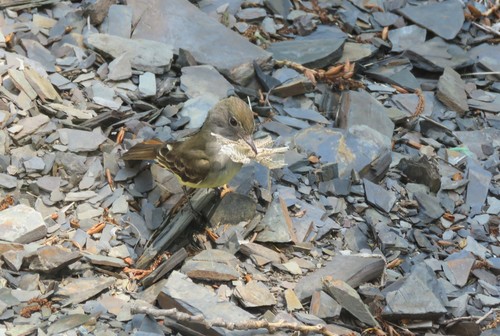 Great Crested Flycatcher
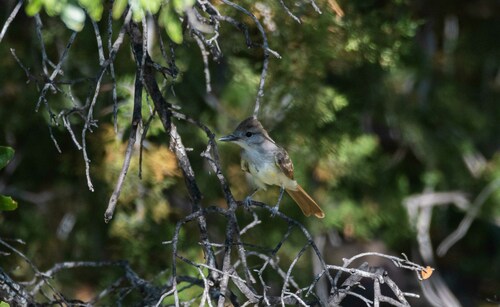 Brown-crested Flycatcher
In short
The most reliable field mark to separate Great Crested Flycatcher from Brown-crested Flycatcher is the color and pattern of the tail and wing edges: Great Crested shows a long, rich rufous tail and less rufous on the wings, while Brown-crested (especially the southwestern US subspecies) has a darker tail with rufous mostly on the inner webs and more extensive rufous edging on the wings. Both species have yellow bellies and gray breasts, but subtle differences in crown and face color, as well as wing bar contrast, help in good light. Structure and size can overlap, but Brown-crested is generally bulkier and larger-billed, especially in the southwestern US. Voice is distinctive but not always heard. Watch for regional variation in Brown-crested, which can complicate ID in overlap zones.
Identification tips
- Tail color and pattern: Great Crested Flycatcher shows a long, rich rufous tail above and below, while Brown-crested's tail is darker (grayish brown to brownish black) with rufous limited to the inner webs except the innermost pair. This is most reliable in adults and older immatures.
- Wing rufous: Brown-crested has more extensive rufous edging on the wings, especially on all but the outermost primaries. Great Crested's rufous is less pronounced and mostly limited to the tail.
- Wing bars: Brown-crested often shows two pale, more contrasting wing bars (greater and median coverts), while Great Crested's wing bars are paler but less sharply defined.
- Crown and face: Brown-crested (especially M. t. magister/cooperi) has a grayish-brown crown with darker feather shafts and a medium gray face; Great Crested's crown is brownish and less sharply marked, with a bushy crest.
- Upperparts: Great Crested is brownish above; Brown-crested is lighter brownish gray to dark olive gray, sometimes with a rufous tinge on the uppertail coverts. Some Brown-crested subspecies are darker overall.
- Throat and breast: Both have gray throats and breasts, but Brown-crested's gray may be paler and extend onto the sides; Great Crested's gray is more sharply demarcated from the yellow belly.
- Belly: Both species have bright yellow bellies, but Brown-crested may show a light gray wash on the sides.
- Bill: Brown-crested (especially in the US) has a bulkier, longer bill, sometimes with a paler base; Great Crested's bill is all dark and slightly slimmer.
- Size and structure: Brown-crested is generally larger and bulkier, especially in the southwestern US (M. t. magister), but beware overlap with smaller Brown-crested subspecies further south. Great Crested is slightly smaller and slimmer overall.
- Iris color: Brown-crested usually has a brown iris; Great Crested's iris color is less distinctive in the field.
- Legs and feet: Both species have black legs and feet; not a useful field mark.
- Vocalizations: Great Crested's loud 'whee-eep' is distinctive and not matched by Brown-crested. Use voice as a primary separator when heard.
- Habitat: In the US, Great Crested is found in eastern forests, Brown-crested in southwestern arid woodlands and riparian zones. Overlap is rare but possible in Texas/northern Mexico.
- Behavior: Both sally from high perches, but Brown-crested may seem more robust and deliberate. Not a strong separator.
- Subspecies variation: Be aware that Brown-crested subspecies further south may be smaller and darker, complicating ID. Focus on tail and wing rufous, and voice, in overlap zones.
Size
Great Crested Flycatcher averages 17–21 cm in length with a wingspan around 34 cm and weighs 27–40 g. Brown-crested Flycatcher is generally larger, especially in the southwestern US (M. t. magister), reaching 18–23 cm and 36–54 g, but other subspecies can be as small as 21 g. In the US, Brown-crested is usually bulkier and longer-billed, but size overlap is possible, especially with smaller Brown-crested subspecies further south. Both species show little to no sexual size dimorphism.
Plumage
- Juvenile/immature plumage: No detailed age-specific upperwing pattern differences are described in the sources for either species, so focus is on adult-like birds.
- Adults: Great Crested Flycatcher has brownish upperparts, a bushy crest, and a long tail that is rich rufous above and below. The wings are brown with only modest rufous edging, and the wing bars are not strongly contrasting. The throat and breast are gray, sharply separated from the bright yellow belly. Brown-crested Flycatcher (M. t. magister and M. t. cooperi) has a grayish-brown crown with darker shafts, a face that is medium gray, and upperparts that are light brownish gray to dark olive gray, often with a rufous tinge on the uppertail coverts. The tail is darker (dark grayish brown to brownish black) with rufous only on the inner webs except the innermost pair, and the wings show more extensive rufous edging and two pale, often more contrasting, wing bars. The lower breast and belly are bright yellow, but the sides may have a gray wash. Subspecies variation in Brown-crested can affect tail and upperpart color, with some (e.g., M. t. cozumelae) being darker and browner overall.
Behaviour
Both species are cavity nesters and spend most of their time in the mid to upper canopy, rarely coming to the ground. Great Crested Flycatcher is more likely to be seen sallying from high perches in eastern forests, while Brown-crested is often associated with more open or arid habitats (including cacti in the southwest). Both are active flycatchers, but Brown-crested may appear slightly more robust and deliberate in posture. Both species are socially monogamous and both sexes participate in nest site selection, though nest construction is mostly by the female.
Habitat
Great Crested Flycatcher is found in mature deciduous or mixed forests of eastern and midwestern North America, often in treetops. Brown-crested Flycatcher occupies a broader range, including arid woodlands, riparian zones, open forests, and even large cacti in the southwestern US and south through Central and South America. In the US, Brown-crested is most likely in the southwest, while Great Crested is an eastern species. Overlap is rare but possible in Texas and northern Mexico.
Voice
Great Crested Flycatcher gives a loud, rising 'whee-eep' and a three-part dawn song with two whistles and a soft churr. Other calls include a fast 'huit, huit, huit' in excitement and harsh rasps in alarm. Brown-crested Flycatcher has a different voice (not detailed in the provided notes), but is generally described in other sources as lower-pitched and less emphatic than Great Crested. In the field, Great Crested's 'whee-eep' is a strong separator if heard.
Great Crested Flycatcher · Brown-crested Flycatcher · My Tricky Birds