

Gould's Frogmouth vs Greater Necklaced Laughingthrush
Batrachostomus stellatus versus Pterorhinus pectoralis
Play a quiz with Gould's Frogmouth and Greater Necklaced Laughingthrush
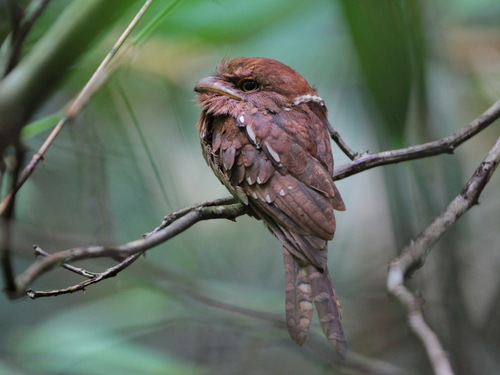 Gould's Frogmouth
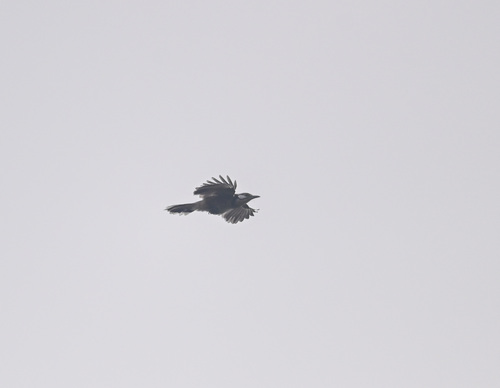 Greater Necklaced Laughingthrush
In short
The most reliable separation between Gould's Frogmouth and Greater Necklaced Laughingthrush is their overall structure and posture: the frogmouth is a squat, nocturnal bird with a broad, flat bill and cryptic brown plumage, while the laughingthrush is a more upright, active passerine with a slimmer bill and a striking black-and-white neck pattern. Gould's Frogmouth shows two color morphs (light and dark), both with a white collar and scattered white spots on the wing coverts, and sexes are similar except for subtle iris and leg color differences. In contrast, the Greater Necklaced Laughingthrush is boldly patterned with a black necklace and white throat, and is much more social and conspicuous by day. Juvenile-specific wing or flight patterns are not described for either species, so focus on overall structure, posture, and plumage details when separating these two.
Identification tips
- Posture and Structure: Gould's Frogmouth perches horizontally, appearing squat and flat-headed with a broad, wide bill; the Greater Necklaced Laughingthrush is upright, long-bodied, and has a typical songbird bill. This is a key structural difference visible even at a distance.
- Plumage Pattern: Frogmouths are cryptic brown with a white collar and scattered white spots on the wing coverts; laughingthrushes are boldly patterned with a black necklace, white throat, and strong facial markings. The necklace is never present in the frogmouth.
- Color Morphs: Gould's Frogmouth comes in light and dark morphs, but both are overall brown and lack the strong contrast of the laughingthrush.
- Sex Differences: In frogmouths, males and females are similar, but females are darker reddish-brown with brown irises and yellowish legs; males have yellow irises and pinkish legs. These subtle differences are not present in the laughingthrush, which is not described as sexually dimorphic in the notes.
- Bill Shape: The frogmouth's bill is broad, flat, and wide—adapted for catching insects at night. The laughingthrush has a slender, pointed bill typical of a songbird.
- Behavior: Frogmouths are nocturnal and sit motionless during the day, often resembling a broken branch. Laughingthrushes are diurnal, active, and often move in noisy flocks.
- Habitat Use: Frogmouths are rarely seen except at night or when flushed from dense cover; laughingthrushes are commonly seen in daylight in forest edges and thickets.
- Leg and Iris Color (Frogmouth only): If seen well, female frogmouths have yellowish legs and brown irises; males have pinkish legs and yellow irises. This is not a feature of the laughingthrush.
- Underpart Markings: Frogmouths have oval, whitish spots on the underparts; laughingthrushes have a clean white throat and a black necklace, with no such spotting.
- Sociality: Frogmouths are solitary or in pairs; laughingthrushes are highly social and often in groups.
- Flight: No distinctive age-specific wing or flight patterns are described for either species, so rely on structure and plumage.
- Voice: Not described in the notes, but in practice, laughingthrushes are very vocal and frogmouths are generally silent or give low, guttural calls at night.
- Size Impression: Laughingthrushes appear larger and more robust in the field than the compact frogmouth.
- Context: If seen at night, especially sitting motionless, suspect frogmouth; if seen in daylight, active and noisy, suspect laughingthrush.
- Potential Pitfall: In poor light or with a brief view, the frogmouth's white collar could be mistaken for the laughingthrush's necklace, but the rest of the plumage and structure will differ markedly.
Size
Gould's Frogmouth is a medium-sized bird, measuring 21–25 cm in length and weighing 47–48.5 g [wikipedia]. The Greater Necklaced Laughingthrush is generally larger and bulkier, though exact measurements are not provided in the notes. In the field, the laughingthrush will appear longer-bodied and more robust, especially when seen in groups or moving through foliage. The frogmouth, by contrast, has a compact, squat appearance when perched.
Plumage
No age-specific wing or flight patterns are described for either species, so separation relies on overall plumage and structural differences. Gould's Frogmouth appears in two morphs (light and dark), both predominantly brown with a white collar and scattered white spots on the wing coverts. The underparts show whitish, oval-shaped spots. Males and females are similar, but females are darker reddish-brown with brown irises and yellowish legs, while males have yellow irises and pinkish legs. The Greater Necklaced Laughingthrush is much more boldly marked, with a distinctive black-and-white necklace across the throat, a white throat patch, and a generally more contrasting and patterned appearance. The laughingthrush lacks the cryptic, spotty brown plumage of the frogmouth and instead shows strong facial and neck markings.
Behaviour
Gould's Frogmouth is strictly nocturnal and typically sits motionless on branches, relying on camouflage. It is rarely seen in active daylight behavior. The Greater Necklaced Laughingthrush is diurnal, highly social, and often moves in noisy groups, foraging actively in the lower and middle levels of forests. Its behavior is conspicuous and energetic, in stark contrast to the frogmouth's secretive, sedentary habits.
Habitat
Gould's Frogmouth is not described in detail for habitat in the provided notes, but as a frogmouth, it is typically associated with dense, humid forests where it can roost and hunt insects at night. The Greater Necklaced Laughingthrush inhabits subtropical or tropical moist lowland and montane forests across a broad range in South and Southeast Asia, and has been introduced to Hawaii. In the field, the laughingthrush is much more likely to be encountered in daylight within forest edges, thickets, or secondary growth, while the frogmouth is almost never seen except at night or when flushed from a day roost.
Gould's Frogmouth · Greater Necklaced Laughingthrush · My Tricky Birds