

Gouldian Finch vs Parrot-billed Seedeater
Chloebia gouldiae versus Sporophila peruviana
Play a quiz with Gouldian Finch and Parrot-billed Seedeater
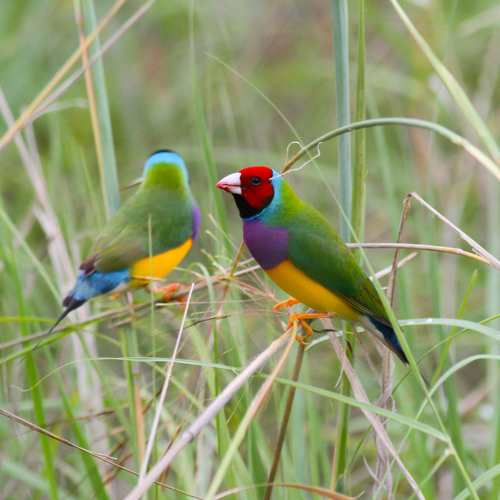 Gouldian Finch
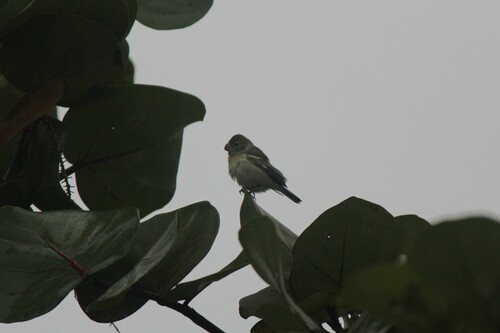 Parrot-billed Seedeater
In short
The most reliable field mark to separate Gouldian Finch from Parrot-billed Seedeater is overall coloration: adult Gouldian Finches are strikingly multicolored, while Parrot-billed Seedeaters are much more subdued, with gray-brown and white tones. If you see a bird with a thick, parrot-like bill and two pale wingbars, especially in arid open country in western South America, it is almost certainly a Parrot-billed Seedeater. Gouldian Finches, in contrast, are native only to Australia, and even immatures show a much plainer, less patterned wing. Bill shape, wing pattern, and habitat context are all strong clues, especially for non-adult birds. Both species can form large flocks outside the breeding season, but their ranges do not overlap.
Identification tips
- Range is absolute: Gouldian Finch is only found in Australia; Parrot-billed Seedeater is only in Ecuador and Peru. If you are outside these areas, reconsider your ID.
- Bill shape: Parrot-billed Seedeater has a massively thick, parrot-like bill with a rounded culmen and slightly hooked tip, very distinctive in profile. Gouldian Finch has a more typical finch bill, not as deep or parrot-like.
- Wing pattern (all ages): Parrot-billed Seedeater shows two pale wingbars and a pale patch at the base of the primaries on the closed wing, visible in both perched and flying birds. Gouldian Finch lacks wingbars and does not show a pale wing patch at any age.
- Adult male coloration: Gouldian Finch males are extremely colorful (red, yellow, green, blue, black, purple), while Parrot-billed Seedeater males are mostly grayish with a white cheek, blackish throat, and white underparts.
- Adult female/immature coloration: Parrot-billed Seedeater females and immatures are dusty brown with faint wingbars and a pale patch; Gouldian Finch females and immatures are much plainer and lack any wingbars or pale wing patch.
- Throat and face pattern (male seedeater): Parrot-billed Seedeater males have a blackish throat sharply separated from a white band and a white cheek, a pattern not found in Gouldian Finch.
- Tail pattern: Parrot-billed Seedeater has a gray-brown tail with blackish central feathers; Gouldian Finch tail is not described as distinctive in the sources.
- Leg and iris color: Both species have dark legs and eyes; not useful for separation.
- Bill color (sex/age): Male Parrot-billed Seedeater has an apricot-yellow bill, female a pale horn bill with duskier maxilla. Gouldian Finch bill color is not specified in the sources but is not described as thick or parrot-like.
- Flocking behavior: Both can form large flocks outside breeding, but Gouldian Finch is more likely to be seen in mixed finch flocks in Australia.
- Foraging behavior: Parrot-billed Seedeater is mostly ground-foraging, especially outside breeding; Gouldian Finch forages both on the ground and in vegetation.
- Habitat context: If you are in arid, open, shrubby or agricultural land in coastal Ecuador/Peru, expect Parrot-billed Seedeater. If in Australian savanna or scree slopes, expect Gouldian Finch.
- Aviculture context: Gouldian Finch is common in captivity and aviaries worldwide; Parrot-billed Seedeater is not noted as an aviary bird. If seen in a cage outside Australia, check for Gouldian Finch.
- Sexual dimorphism: Both species are sexually dimorphic, but only Parrot-billed Seedeater females/immatures show the wingbars and pale patch.
- Quiz pitfall: Immature Parrot-billed Seedeaters with faint wingbars and pale patch are easily confused with other plain finches, but never show the vibrant colors of any Gouldian Finch age or sex.
Size
Parrot-billed Seedeater measures 10.5–12.5 cm in length and averages 12.6 g in weight [wikipedia]. Gouldian Finch's measurements are not provided in the sources, but both are small finches. In the field, size is not a reliable separator between these two, as both appear similarly small and finch-like.
Plumage
- Juvenile/immature birds: Parrot-billed Seedeater immatures (especially females) are overall dusty brown with two faint wingbars and a small whitish wing patch. Gouldian Finch immatures are much plainer, lacking wingbars or a pale wing patch, and do not show any strong pattern on the closed wing.
- Adult males: Gouldian Finch males are unmistakably colorful (combinations of red, yellow, green, blue, black, and purple), while Parrot-billed Seedeater males are grayish above with a white cheek, blackish throat, white band, and two pale wingbars.
- Adult females: Parrot-billed Seedeater females are dusty brown with faint wingbars and a pale wing patch, while female Gouldian Finches are also colorful, though less so than males, and still lack the seedeater's wing pattern.
- Wing pattern in flight: Parrot-billed Seedeater of all ages shows two pale wingbars and a pale patch at the base of the primaries on the closed wing; Gouldian Finch does not show these features at any age.
Behaviour
Both species can form large flocks outside the breeding season, sometimes numbering in the thousands (Gouldian Finch) or very large groups (Parrot-billed Seedeater). During breeding, both tend to be found in smaller groups or pairs. Gouldian Finches are noted for joining mixed flocks with other grass finches, while Parrot-billed Seedeaters forage mostly on the ground, singly or in small groups during breeding. Both species are seed-eaters, but the seedeater is more strictly ground-foraging.
Habitat
Gouldian Finch is native to Australia, typically found in savanna woodlands, rough scree slopes, and sometimes in mixed flocks with other finches. Parrot-billed Seedeater is found only in the coastal lowlands of Ecuador and Peru, inhabiting arid grasslands, shrublands, agricultural areas, and overgrown fields from sea level up to 800 m. If you are in South America, you are not seeing a Gouldian Finch in the wild. Habitat and range are thus highly diagnostic.