

Fork-tailed Palm Swift vs Green-backed Trogon
Tachornis squamata versus Trogon viridis
Play a quiz with Fork-tailed Palm Swift and Green-backed Trogon
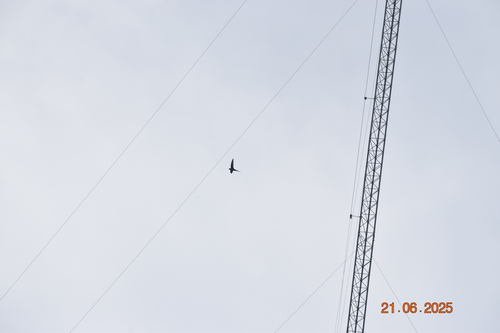 Fork-tailed Palm Swift
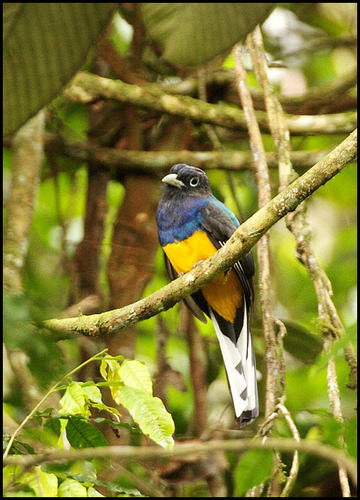 Green-backed Trogon
In short
The most reliable field mark is structural: Fork-tailed Palm Swift is a tiny, slender, fast-flying bird with long, narrow wings and a deeply forked tail, while Green-backed Trogon is a much larger, thickset bird with a short, squared tail and broad wings. In flight, the swift is highly aerial and never perches in the open, while trogons are typically seen perched upright and motionless. Plumage is also very different: the swift is mostly dark with pale mottled underparts and a pale throat, while the trogon is boldly colored (males) or gray (females), with a distinctive black-and-white patterned undertail. If you see a bird perched in the open, especially on a branch, it is almost certainly a trogon; swifts are rarely seen perched and are always in rapid flight.
Identification tips
- Size: Green-backed Trogon is much larger and bulkier than Fork-tailed Palm Swift. If the bird looks sparrow-sized or smaller, it is not a trogon.
- Structure in flight: Swifts have long, narrow, sickle-shaped wings and a deeply forked tail; trogons have broad, rounded wings and a short, squared or slightly rounded tail.
- Tail shape: The swift’s tail is deeply forked and always obvious in flight; the trogon’s tail is squared off and never forked.
- Perching behavior: Swifts are almost never seen perched in the open; trogons are almost always seen perched upright on branches, often motionless for long periods.
- Flight style: Swifts are fast, agile, and constantly in motion; trogons fly in short, direct bursts and are reluctant to fly far.
- Plumage – upperparts: Swifts are blackish brown with a greenish gloss and pale feather edges; trogon males are green-backed with a dark blue (almost black) head, females are gray above.
- Plumage – underparts: Swifts have pale, lightly mottled underparts with a pale throat; trogon males have a bright orange-yellow belly, females are gray below.
- Undertail pattern: The swift’s undertail is dark with pale edges; trogon males have a bold black-and-white undertail (broad black base, broad white tip and edge to each feather), females have black-and-white barring mainly on the outer webs of each tail feather.
- Juvenile marks: Young swifts have a buff tinge to the head and buffy feather edges, but otherwise resemble adults; juvenile trogons are not described, but no age or sex resembles a swift.
- Bill shape: Swifts have tiny, short, wide bills adapted for aerial feeding; trogons have broad, hooked bills suited for fruit and insects.
- Eye-ring: Trogons have a conspicuous pale bluish eye-ring; swifts do not.
- Sexual dimorphism: Trogons are sexually dimorphic (males green and blue, females gray); swifts show no sexual dimorphism.
- Habitat: Swifts are tied to open areas with palms, including urban areas; trogons are forest birds.
- Vocalization: Trogons give a series of accelerating 'cow' notes; swifts give high, thin flight calls (not described for this species but typical of swifts).
- Context: If you see a bird foraging high and fast over palms, it is a swift; if you see a bird sitting still on a branch in forest, it is a trogon.
Size
Fork-tailed Palm Swift is much smaller: about 13 cm (5.1 in) long and weighing 9–13.6 g [wikipedia]. Green-backed Trogon is more than twice as long at 28–30 cm (11–12 in), and is much bulkier [wikipedia]. The difference in size and mass is dramatic and obvious even at a distance.
Plumage
Juvenile and adult Fork-tailed Palm Swifts are similar, with the main difference being a buff tinge to the head and buffy feather edges in juveniles. Both ages are overall blackish brown above with a greenish gloss, a pale brownish-white throat with dusky mottling, and pale, lightly mottled underparts. The tail is deeply forked and dark. By contrast, Green-backed Trogon is strongly sexually dimorphic: adult males have a green back, dark blue (almost black) head and upper breast, bright orange-yellow belly, and a striking black-and-white undertail (broad black base, broad white tip and edge to each feather). Females are gray above and below with black-and-white barring mainly on the outer webs of the tail feathers. No age or sex of trogon resembles the swift in overall color or pattern. The swift’s plumage is much plainer, with no bright colors or bold barring. The trogon’s undertail pattern is diagnostic when seen well, especially in males.
Behaviour
Fork-tailed Palm Swift is almost always seen in rapid, agile flight, often high above or around palms, rarely if ever perching in the open. It forages aerially for insects, sometimes in small flocks. Green-backed Trogon is typically seen perched upright and motionless on a branch, often in the midstory or canopy of humid forest. Its flight is fast but it is reluctant to fly far, and it rarely joins mixed-species flocks. The two species’ behaviors are so different that confusion is unlikely if you see the bird’s behavior for more than a few seconds.
Habitat
Fork-tailed Palm Swift is found in open areas with palms, including savannas, palm swamps, riparian forest, urban areas, and especially around Mauritia palms. It is a lowland species. Green-backed Trogon is a resident of humid tropical forests, especially in the Amazon and Guiana Shield, and is typically the commonest trogon in its range. While both can occur in the same broad region, the swift prefers open areas with palms and the trogon is tied to forested habitats.
Voice
Green-backed Trogon has a distinctive song of about 20 'cow' notes, starting slow and accelerating, higher pitched than Black-tailed Trogon and slower than White-tailed Trogon [wikipedia]. Fork-tailed Palm Swift’s voice is not described in the sources, but swifts generally give high, thin calls in flight, very different from the trogon’s song. If you hear a series of accelerating 'cow' notes, you are hearing the trogon.
Fork-tailed Palm Swift · Green-backed Trogon · My Tricky Birds