

Fieldfare vs Spotted Flycatcher
Turdus pilaris versus Muscicapa striata
Play a quiz with Fieldfare and Spotted Flycatcher
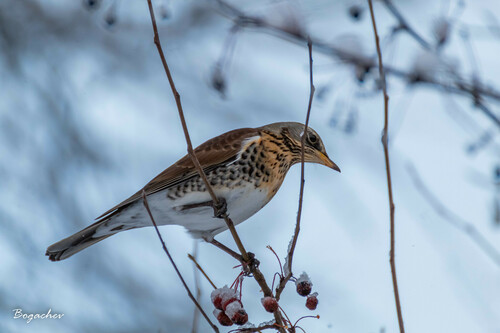 Fieldfare
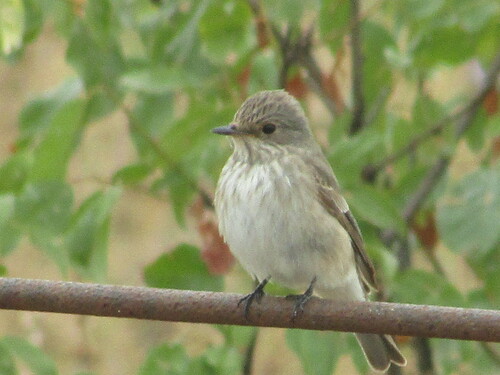 Spotted Flycatcher
In short
The most reliable way to separate Fieldfare from Spotted Flycatcher is by overall size and structure: Fieldfare is a large, chunky thrush with a bold, speckled breast and a striking grey head, while Spotted Flycatcher is a much smaller, slimmer bird with a plain grey-brown back and fine streaks on the crown and breast. In flight, Fieldfare shows conspicuous white underwing coverts and a dark tail, whereas Spotted Flycatcher’s flight is less striking, with uniform wings and a slim silhouette. Juvenile plumage can cause confusion, but Fieldfare juveniles are still bulkier and show paler streaks above, while Spotted Flycatcher juveniles are browner and have spots on the upperparts. Voice is also helpful: Fieldfare’s harsh 'tsak tsak' contrasts with the flycatcher’s thin, high 'tssssseeeeeppppp'.
Identification tips
- Size and shape: Fieldfare is much larger and bulkier than Spotted Flycatcher. If the bird looks thrush-sized or larger than a blackbird, it is not a Spotted Flycatcher. This is reliable at all ages and seasons.
- Flight pattern: Fieldfare in flight shows striking white underwing coverts and axillaries, contrasting with the dark tail. Spotted Flycatcher’s underwings are plain and do not show this contrast. This is especially useful for adults and older juveniles.
- Plumage—head and breast: Fieldfare has a slate-grey head and nape, bold blackish lores, and a creamy-buff breast with heavy brownish-black speckling. Spotted Flycatcher has a plain grey-brown head with fine brown streaks on the crown and breast, never bold spots or speckles.
- Juvenile confusion: Juvenile Fieldfare is duller but still shows thrush-like streaks and bulk. Juvenile Spotted Flycatcher is browner with ochre-buff spots above and scaly spots below, and is much slimmer. If you see a spotted or streaked small bird, check the size and structure first.
- Tail shape and color: Fieldfare has a rounded, dark brownish-black tail with subtle grey fringes and sometimes a narrow white border on the outer feathers. Spotted Flycatcher’s tail is long and slim, with pale edges but no bold pattern.
- Bill: Fieldfare’s bill is strong, slightly curved, and orange-yellow (especially in winter), with a brownish-black tip. Spotted Flycatcher’s bill is slim, black, and pointed, typical of aerial insectivores.
- Legs and feet: Fieldfare has brown legs and feet; Spotted Flycatcher’s are short and black. This can help at close range.
- Behavior: Fieldfare is often seen in flocks, especially in winter, and forages on the ground or in trees. Spotted Flycatcher is solitary or in pairs, perching upright and sallying for insects.
- Perching posture: Spotted Flycatcher perches very upright and alert, often returning to the same spot after flycatching. Fieldfare’s posture is more horizontal and less upright.
- Voice: Fieldfare’s loud, harsh 'tsak tsak' is very different from the flycatcher’s thin, high 'tssssseeeeeppppp'. Listen for these calls if the bird is vocal.
- Habitat context: In winter, Fieldfare is likely in open fields or large flocks, while Spotted Flycatcher is rarely seen in winter and prefers woodland edges or gardens in the breeding season.
- Sex differences: Fieldfare females are browner and less boldly marked than males, but still much larger and more patterned than any Spotted Flycatcher. Spotted Flycatcher sexes are alike.
- Seasonal context: Spotted Flycatcher is a summer breeder and migrates out of Europe in winter; Fieldfare is present in winter in many areas, especially in flocks.
- Confusion risk: The main risk is with juvenile birds or brief flight views. Always check size, structure, and underwing pattern first before relying on breast streaking or general color.
- When in doubt: If the bird is small, slim, upright, and flycatching from a perch, it is almost certainly a Spotted Flycatcher. If it is large, chunky, and shows a bold, speckled breast and white underwings in flight, it is a Fieldfare.
Size
Fieldfare is dramatically larger and heavier than Spotted Flycatcher. Fieldfare averages 105 g in body mass and is about 25 cm long with a 39–42 cm wingspan [wikidata, wikipedia]. In contrast, Spotted Flycatcher is a small, slim bird, only about 14.5 cm long and weighing 14–20 g [wikipedia]. Even at a distance, Fieldfare’s bulk and long, rounded tail are obvious, while Spotted Flycatcher appears slight, with a proportionally longer tail and wings for its size.
Plumage
- Juvenile/immature birds: Fieldfare juveniles are duller than adults but still show pale streaks on the feathers that are dark-streaked in adults. They retain the chunky thrush shape and a hint of the adult’s bold, speckled breast. Spotted Flycatcher juveniles are browner overall, with ochre-buff spots above and scaly brown spots below, lacking the bold thrush patterning.
- Adults: Fieldfare adults are distinctive: slate-grey head, nape, and rump; dark brown back; blackish tail; and a boldly speckled creamy-buff breast. In flight, the white underwing coverts and axillaries stand out. Spotted Flycatcher adults are plain grey-brown above, off-white below, with fine brown streaks on the crown, throat, and breast, and pale-edged wings and tail. Both sexes are similar in Spotted Flycatcher, while Fieldfare females are slightly browner and less boldly marked than males.
- Flight views: Fieldfare’s white underwing coverts are diagnostic in flight. Spotted Flycatcher shows no such contrast, appearing uniformly pale below with no bold wing or tail pattern.
Behaviour
Fieldfare often moves in flocks, especially outside the breeding season, and is usually seen foraging on the ground or flying between trees with a strong, direct flight. Spotted Flycatcher is typically solitary or in pairs, perching upright on exposed branches and making short sallies to catch insects, often returning to the same perch. Its upright, alert posture and repeated flycatching flights are characteristic.
Habitat
Both species breed in woodland and scrub across Europe and the Palearctic, but Fieldfare is more associated with open woodland, fields, and sometimes urban parks, especially in winter when it forms flocks. Spotted Flycatcher prefers woodland edges, gardens, parks, and clearings, often choosing sites with prominent perches for hunting insects. Fieldfare is more likely in open country or large flocks in winter, while Spotted Flycatcher is usually alone or in pairs in more sheltered, edge habitats.
Voice
Fieldfare’s call is a harsh, repeated 'tsak tsak', especially in flight or when alarmed, and is quite loud and distinctive. Its song is weak and rarely heard, a mixture of blackbird-like phrases and whistles. Spotted Flycatcher’s call is a thin, high, drawn-out 'tssssseeeeeppppp', slightly descending, much softer and less harsh than Fieldfare’s. The difference in call quality—Fieldfare’s harsh and chattering versus the flycatcher’s thin, high-pitched note—is a useful clue.