

Eastern Crested Guineafowl vs Western Crested Guineafowl
Guttera pucherani versus Guttera verreauxi
Play a quiz with Eastern Crested Guineafowl and Western Crested Guineafowl
 Eastern Crested Guineafowl
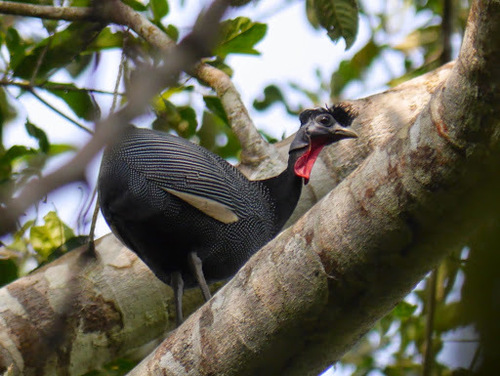 Western Crested Guineafowl
In short
Eastern and Western Crested Guineafowl are extremely similar in the field, with both showing blackish plumage densely spotted white and a prominent black crest. The most reliable way to separate them is by range: Eastern Crested Guineafowl is found from Somalia to Tanzania and nearby islands, while Western Crested Guineafowl occurs from West Africa through Central Africa, extending into western Kenya, Zambia, and Angola. In the field, their crests differ subtly in shape and texture, but this is often hard to judge at a distance or in poor light. Juvenile and adult plumages are not reliably separable by wing or body pattern alone. Habitat preferences overlap, so context is only useful when combined with range.
Identification tips
- Range is the most reliable separator: If you are in East Africa (Somalia to Tanzania, Zanzibar, Tumbatu), you are almost certainly seeing Eastern Crested Guineafowl. If you are in West or Central Africa (Guinea-Bissau to Cameroon, western Kenya, Zambia, Angola), you are likely seeing Western Crested Guineafowl. Overlap is possible in western Kenya.
- Crest shape and texture: Both species have a black crest, but the exact form (curly vs. downy) may differ subtly. However, this is not well described in the notes and is unreliable at a distance or in poor light.
- Plumage pattern is not diagnostic: Both show dense white spots on blackish plumage at all ages. Do not rely on spot size, density, or arrangement to separate them.
- No age-specific wing or flight marks: There are no described differences in juvenile, immature, or adult upperwing pattern, either in flight or perched.
- Size and structure are identical: Both species are the same length and mass, and share similar proportions. Bill, tail, and wing shape do not help.
- Habitat overlap: Both species use open forest, woodland, and forest-savanna mosaics. Do not use habitat alone to separate them.
- Behavior is not helpful: Both are ground-dwelling, social, and behave similarly when flushed or foraging.
- Vocalizations not described: No differences in calls or song are noted in the available sources.
- Sexes and ages look alike: No sexual dimorphism or age-based differences are reported that would help in the field.
- Beware the 'plumed' confusion: The names 'crested' and 'plumed' are often misapplied. Only the Plumed Guineafowl (not covered here) is truly separable by crest type.
- Quiz pitfalls: Most quiz mix-ups stem from ignoring range or over-interpreting subtle crest differences. If you are unsure, default to range unless you have expert-level photographs of the crest.
- When in doubt: If you are in a potential overlap zone (e.g., western Kenya), consider both possibilities and consult local checklists or experts for recent records.
Size
Both species are virtually identical in size, with a total length around 50 cm (20 in) and weight ranging from 721–1,543 g (1.59–3.40 lb) [wikipedia]. There are no structural or proportional differences noted between them, so size is not a useful field mark for separation.
Plumage
Plumage is extremely similar in both species at all ages: both show overall blackish feathers densely covered with small white spots, and both have a distinctive black crest on the crown. The form of the crest—ranging from small curly feathers to more downy tufts—varies between species, but the notes do not specify exactly how these differ between Eastern and Western Crested Guineafowl. There are no described differences in juvenile, immature, or adult wing or body pattern, and no mention of age-specific flight marks that would allow separation. The only consistent difference may be subtle variation in crest shape or texture, but this is not detailed in the available sources and is likely unreliable for most observers.
Behaviour
Both species share similar behaviors, frequenting open forests, woodlands, and forest-savanna mosaics. They are ground-dwelling, often seen in small groups, and their movements and foraging habits are not described as differing between the two. Flight and perched jizz are not reported to differ in any diagnostic way.
Habitat
Habitat preferences are nearly identical: both species inhabit open forest, woodland, and forest-savanna mosaics. The only meaningful difference is geographic: Eastern Crested Guineafowl is restricted to East Africa (Somalia to Tanzania, Zanzibar, and Tumbatu Island), while Western Crested Guineafowl ranges from Guinea-Bissau to Cameroon, Kenya, Zambia, and Angola. Overlap may occur in western Kenya, so local knowledge of range boundaries is critical.
Eastern Crested Guineafowl · Western Crested Guineafowl · My Tricky Birds