

Crowned Woodnymph vs White-tailed Emerald
Thalurania colombica versus Microchera chionura
Play a quiz with Crowned Woodnymph and White-tailed Emerald
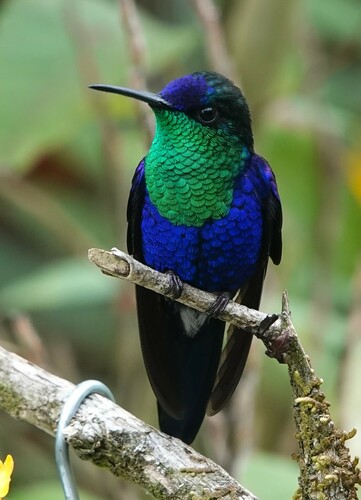 Crowned Woodnymph
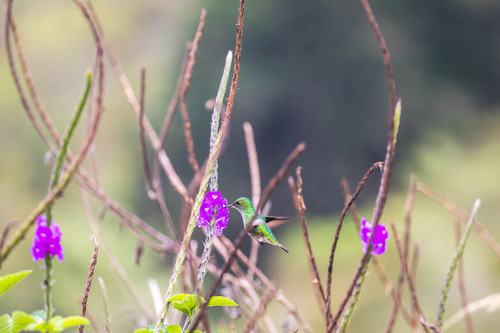 White-tailed Emerald
In short
The most reliable field mark to separate Crowned Woodnymph and White-tailed Emerald is the tail pattern: White-tailed Emerald of all ages and sexes shows obvious white outer tail feathers with black tips, while Crowned Woodnymph has a blue-black tail (males) or blue-black with only small white tips on outer feathers (females). Immature birds are best separated by tail and underpart color: White-tailed Emerald immatures have white or dull white bellies, while Crowned Woodnymph immatures are grayish below (females) or dusky with limited iridescence (males). Adult male Crowned Woodnymphs are larger, with a distinctly violet or glittering green crown and a much more deeply forked tail. Structure and bill shape are similar, but the Emerald is noticeably smaller and shorter-tailed. Habitat and elevation can help: White-tailed Emerald is a highland specialist, while Crowned Woodnymph is more widespread and found at lower elevations.
Identification tips
- Tail pattern is the single most reliable field mark: White-tailed Emerald (all ages, both sexes) shows three outer pairs of tail feathers that are white with black tips or bands, very obvious in flight or when fanned. Crowned Woodnymph males have a uniformly blue-black tail; females have blue-black tails with only small white tips on the outer three pairs.
- Underpart color in immatures: Immature White-tailed Emeralds have white or dull white bellies (with grayish buff fringes in males, grayer in females), while immature Crowned Woodnymphs are grayish (females) or dusky (males) below, never truly white.
- Adult male crown and upperparts: Crowned Woodnymph males have a violet or glittering green crown and upper back (depending on subspecies), a feature never shown by White-tailed Emerald, which is bronzy green above.
- Adult male underparts: Crowned Woodnymph males have a violet belly and glittering green throat/chest; White-tailed Emerald males have a white belly and vent contrasting with a green throat/chest.
- Adult female underparts: Crowned Woodnymph females are pale to darker gray below, never white; White-tailed Emerald females are dull white below with bronzy green flanks.
- Tail shape: Crowned Woodnymph males have a deeply forked tail; White-tailed Emerald's tail is less deeply forked and appears shorter and more compact.
- Size: Crowned Woodnymph is noticeably larger and heavier than White-tailed Emerald, but this is most apparent with experience or side-by-side comparison.
- Bill: Both have straight black bills, but the Emerald's mandible base is pinkish (may be hard to see in the field).
- Habitat and elevation: White-tailed Emerald is restricted to highland forest (750–2,000 m, mostly 1,000–1,700 m in Costa Rica); Crowned Woodnymph is found at lower elevations and over a much broader range.
- Voice: If heard, White-tailed Emerald's scratchy twittering and buzzing song is distinctive; absence of this song does not confirm Woodnymph.
- Subspecies variation: Some Crowned Woodnymph subspecies have a green (not violet) crown, but all lack the Emerald's white tail pattern.
- Female tail pattern: Both show some white in the outer tail feathers, but in the Emerald the white is broad and obvious, with a black band or tip; in Woodnymph females, the white is limited to small tips.
- Behavior: Both species are active and feed at various heights, but Emerald males may be seen at leks or in the canopy more often.
- Distribution: Outside the Talamancan highlands, White-tailed Emerald does not occur; any similar hummingbird elsewhere is likely a Crowned Woodnymph.
- Immature confusion: When in doubt with a dull, small hummingbird with white outer tail feathers, default to White-tailed Emerald; if the tail is dark with only tiny white tips (females), consider Woodnymph, especially if underparts are grayish.
Size
Crowned Woodnymph is distinctly larger: adult males are 9.5–11.5 cm long and weigh 4–5.5 g, females 8.5–9.2 cm and 3.5–4.2 g [wikipedia]. White-tailed Emerald is smaller and lighter: both sexes are only 7.5–8 cm long, with males about 3.3 g and females 3.1 g [wikipedia]. This size difference is noticeable in direct comparison or with experience, but can be subtle in the field unless both species are together. The Woodnymph also has a longer, more deeply forked tail, especially in males.
Plumage
- Immatures:
- Crowned Woodnymph immature males are dusky on crown, throat, and underparts, with very limited iridescent purple; immature females are dull green above and entirely pale gray below. Their tails lack obvious white except for small tips on females.
- White-tailed Emerald immature males resemble adults but have duller underparts with grayish buff feather fringes; immature females have grayer underparts than adults. All immatures show the distinctive white outer tail feathers with black tips or bands, a key separation from Woodnymph at any age.
- Adult males:
- Crowned Woodnymph males (nominate) have a violet forehead, crown, upper back, and belly, with a glittering green throat and chest, dark bronzy green nape, and a deeply forked blue-black tail. Subspecies vary in crown color (some green, some violet), but all lack white in the tail.
- White-tailed Emerald males are bronzy green above, with a glittering green throat and chest, but a white belly, vent, and undertail coverts. Their tail is copper-bronze centrally, with three outer pairs white with black tips—a striking field mark.
- Adult females:
- Crowned Woodnymph females are bright green above, pale gray throat and chest, darker gray belly, and a blue-black tail with white tips on the outer three pairs of feathers. The underparts are always grayish, never pure white.
- White-tailed Emerald females are bronzy green above, dull white below with bronzy green flanks, and the tail is bronzy centrally with three outer pairs white with a black band near the tip. The white in the tail is much more extensive and obvious than in Woodnymph females.
- Tail pattern is diagnostic at all ages: White-tailed Emerald always shows prominent white in the outer tail feathers, while Crowned Woodnymph never shows more than small white tips (females only).
Behaviour
Both species are active, fast-moving hummingbirds. White-tailed Emerald males often display at leks in small groups and may be seen in the canopy, while females tend to remain in the understory. Crowned Woodnymph is also agile and feeds at various heights. In flight, the Emerald may appear even smaller and more compact than the Woodnymph, but both have similar feeding and perching behaviors. No major behavioral differences are diagnostic in the field.
Habitat
Habitat and elevation are helpful context clues. White-tailed Emerald is a highland species, found mostly between 750–2,000 m (especially 1,000–1,700 m in Costa Rica), in moist to humid montane forest, forest edges, and gardens [wikipedia]. Crowned Woodnymph is more widespread, found from Belize and Guatemala to northern Peru, and occurs at lower elevations as well as foothills. If seen in lowland forest or outside the Talamancan highlands, it is almost certainly not White-tailed Emerald. In the highlands, both may overlap, so plumage and tail pattern remain essential.
Voice
White-tailed Emerald has a distinctive song: a prolonged, thin scratchy twittering, mixed with buzzing or gurgling notes, and gives soft scratchy chipping notes when foraging and high-pitched buzzy notes when chasing [wikipedia]. No vocal information is provided for Crowned Woodnymph in the sources, so voice is not a reliable separation unless the Emerald's unique twittering is heard.