

Common Nighthawk vs Red-necked Nightjar
Chordeiles minor versus Caprimulgus ruficollis
Play a quiz with Common Nighthawk and Red-necked Nightjar
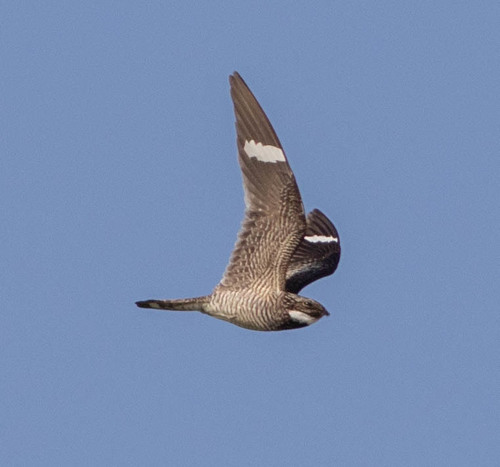 Common Nighthawk
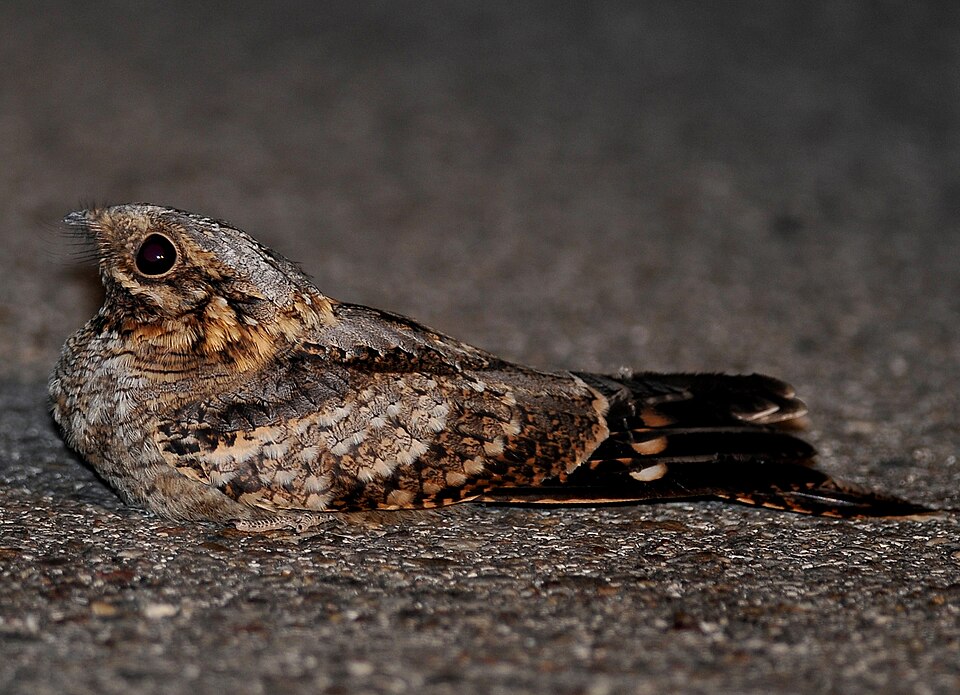 Red-necked Nightjar
In short
The most reliable field mark for separating Common Nighthawk from Red-necked Nightjar is the presence of a bold white wing patch in both species, but the nighthawk’s patch is smaller in juveniles and more sharply defined in adults, while the nightjar’s is larger and both sexes have white tail corners and a distinctive rufous neck-collar. Juvenile nighthawks show a smaller white wing patch than adults, which can be a pitfall. Structurally, Red-necked Nightjar is bulkier, longer-tailed, and has a noticeably rufous collar, while Common Nighthawk is slimmer with a more erratic, buoyant flight. Both are cryptic at rest, but the nighthawk often perches horizontally on branches or roofs, whereas the nightjar is more strictly ground-roosting. Vocalizations are completely different and diagnostic if heard.
Identification tips
- White wing patch size and placement: Both species show a white wing patch, but in juvenile Common Nighthawk it is smaller and less bold than in adults; Red-necked Nightjar’s is larger and both sexes also show white tail corners and throat. Use this in flight, especially for immatures.
- Rufous neck-collar: Only Red-necked Nightjar has a prominent rufous collar, visible in good light and at rest. If you see this, it is diagnostic for nightjar.
- Tail shape and length: Red-necked Nightjar is longer-tailed and bulkier; Common Nighthawk has a notched tail and slimmer, more angular profile.
- Flight style: Nighthawk flight is buoyant, erratic, and acrobatic, with sharp twists and turns; Red-necked Nightjar flies with strong, deliberate wingbeats and glides, appearing more moth-like and steady.
- Perching behavior: Common Nighthawk often perches horizontally on branches, posts, roofs, or the ground; Red-necked Nightjar is more strictly ground-roosting and rarely perches above ground.
- Plumage pattern: Nighthawk is dark gray, black, and brown with intricate cryptic patterns and barring on sides and abdomen; Red-necked Nightjar is lichen-grey, heavily barred, and streaked with buff, chestnut, and black, with a rufous collar.
- Underpart barring: Both species are barred below, but Red-necked Nightjar is more heavily and coarsely barred.
- Facial features: Nighthawk lacks rictal bristles and has a large, flattened head with large eyes; nightjar’s face is less distinctive but the rufous collar stands out if visible.
- Size in hand or at close range: Red-necked Nightjar is larger and heavier (32 cm, 84 g) than Common Nighthawk (22–25 cm, 79 g), but size can be hard to judge in the field.
- Geographic context: In Europe or North Africa, a large nightjar with a rufous collar is Red-necked; in the Americas, it is Common Nighthawk.
- Vocalizations: If heard, the nighthawk’s call is very different from the nightjar’s repetitive 'kyok-kyok-kyok...' or wing-clap. Use voice whenever possible.
- Seasonal molt: Juvenile nighthawks are paler and have a smaller white wing patch than adults, which can lead to confusion with nightjar, especially in autumn.
- Sex differences: Both sexes of Red-necked Nightjar show white in the tail and throat, while nighthawk’s white markings are less extensive and not on the tail corners.
- Habitat: Nightjar prefers open sandy heaths with scattered trees or bushes; nighthawk is more generalist and often seen over cities and open areas.
- Pitfalls: Immature nighthawks with reduced white wing patches can be mistaken for nightjars; always check for the rufous collar and white tail corners to confirm Red-necked Nightjar.
Size
Red-necked Nightjar is the larger of the two, with a length of 32 cm and a wingspan of 64 cm, compared to the Common Nighthawk’s 22–25 cm length and 51–61 cm wingspan [wikipedia]. Mass is similar but slightly higher in the nightjar (84.0 g vs 79.3 g) [wikidata]. In the field, the nightjar appears bulkier and longer-tailed, while the nighthawk is slimmer and more angular, especially in flight.
Plumage
Juvenile Common Nighthawks are paler overall and have a smaller white wing patch than adults, which can make them appear less contrasting in flight. Adults of both species have white wing spots, but the Red-necked Nightjar’s is larger and both sexes also show white on the tail corners and throat. The nightjar is lichen-grey with heavy barring and a prominent rufous neck-collar, while the nighthawk is dark gray, black, and brown with intricate cryptic patterns and noticeable barring on the sides and abdomen. The nighthawk lacks a rufous collar entirely. The Red-necked Nightjar’s underparts are heavily barred, and the North African subspecies is paler with more orange and black banding on the primaries. Both species are extremely cryptic at rest, but the nightjar’s rufous collar is a strong field mark if visible.
Behaviour
Common Nighthawk is most conspicuous in buoyant, erratic flight, often foraging high and showing sharp twists and turns. It perches horizontally on branches, posts, roofs, or the ground, rarely moving on foot. Red-necked Nightjar is more strictly ground-roosting during the day, lying flat and motionless, resembling a piece of bark or lichen. Its flight is described as easy, silent, and moth-like, with strong, deliberate wingbeats alternating with glides. Both are crepuscular or nocturnal, but nighthawk flight is more erratic and acrobatic, while the nightjar is steadier and more moth-like.
Habitat
Common Nighthawk is found throughout the Americas and is highly migratory, often seen over open areas, cities, and rooftops. Red-necked Nightjar is restricted to Iberia and North Africa for breeding, wintering in tropical West Africa, and prefers open sandy heaths with scattered trees or bushes. In Europe, the nightjar is the largest nightjar and is rarely seen outside its breeding range. Habitat context can be helpful: a nightjar in Iberia or North Africa is likely Red-necked, while a nightjar in the Americas is almost certainly a nighthawk.
Voice
The Common Nighthawk’s identity is often best revealed by its vocalization, which is not described in detail here but is distinct from the Red-necked Nightjar. The Red-necked Nightjar gives a repetitive mechanical 'kyok-kyok-kyok...' call that rises and falls as the bird turns its head, and also produces a sharp wing-clap during courtship. The nighthawk’s call is not similar and, if heard, is diagnostic for separation.