
Common Nighthawk vs Eurasian Nightjar
Chordeiles minor versus Caprimulgus europaeus
Play a quiz with Common Nighthawk and Eurasian Nightjar
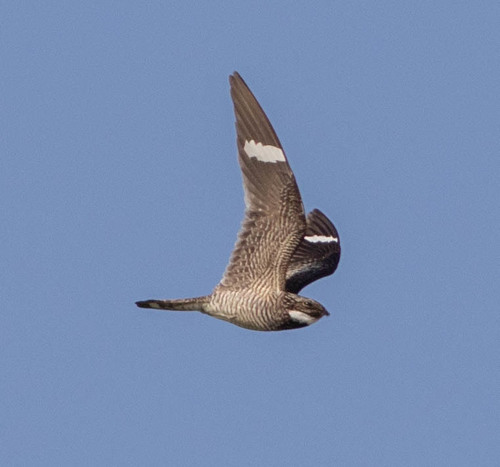 Common Nighthawk
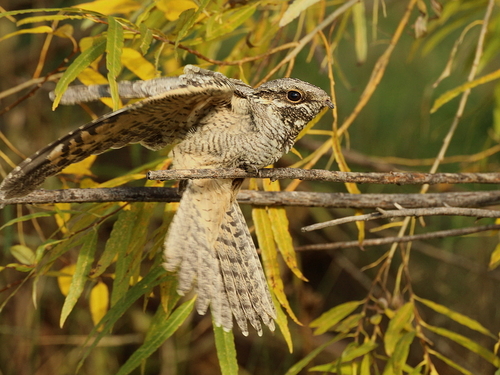 Eurasian Nightjar
In short
The most reliable field mark between Common Nighthawk and Eurasian Nightjar is the presence and pattern of white patches on the wings and tail, especially in flight and for adult males. Common Nighthawk of all ages shows a bold white wing patch (smaller in juveniles), while adult male Eurasian Nightjar has a white wing patch and white tail corners, but females and juveniles lack these white areas. Structure also helps: Common Nighthawk is slimmer, with longer, more pointed wings and a notched tail, and often appears more erratic in flight. Both species are cryptic when perched, but Eurasian Nightjar is bulkier and lacks the nighthawk’s distinctive white wing flash (except in adult males). Vocalizations are quite different, with the nighthawk giving a sharp peent and the nightjar a long churring trill.
Identification tips
- White wing patch in flight: Common Nighthawk of all ages and sexes shows a bold white patch across the primaries, visible as a large flash in flight. Eurasian Nightjar males have a smaller white patch (across three primaries), but females and juveniles lack any white in the wings. If you see a large, obvious white wing flash, especially on a slim, erratic-flying bird, it's a nighthawk.
- Tail pattern: Male Eurasian Nightjar has white tips to the two outer tail feathers, visible in flight; females and juveniles lack this. Common Nighthawk has a notched tail but no white tail corners.
- Juvenile confusion: Juvenile nighthawks are paler and have a smaller white wing patch, but still show some white. Juvenile Eurasian Nightjar lacks white in wings/tail and resembles adult female nightjar—uniformly cryptic, brownish-grey.
- Structure in flight: Common Nighthawk is slimmer, with long, pointed wings and a notched tail, giving a more angular, falcon-like silhouette. Eurasian Nightjar is bulkier, with broader wings and a rounder body.
- Flight style: Nighthawk flight is buoyant, erratic, and often high overhead. Eurasian Nightjar's flight is softer, more buoyant, and silent, often lower to the ground.
- Perched posture: Both perch horizontally, but nighthawk's wings extend beyond the tail and it often chooses open, exposed perches (e.g., roofs, posts). Eurasian Nightjar is more likely to be found on the ground or low branches in dense cover.
- Facial features: Eurasian Nightjar has a pale buff hindneck collar and a white moustachial line, but these are subtle and not always visible. Nighthawk has a large, flattened head with large eyes and lacks rictal bristles.
- Plumage details: Both are intricately patterned, but only the nighthawk has a consistent white wing patch. Nightjar is more uniformly grey-brown with buff and brown barring below.
- Vocalization: Listen for the nighthawk's sharp 'peent' call, especially at dusk. Eurasian Nightjar's male song is a long, mechanical churring trill, often from a perch.
- Sex differences: Only male Eurasian Nightjar shows white in wings and tail; females and juveniles lack these marks. Both sexes of nighthawk have the white wing patch.
- Seasonal molt: Both species complete their main molt on wintering grounds, but this is not a field mark.
- Habitat context: If in the Americas, only Common Nighthawk is possible; in Europe/Palearctic, Eurasian Nightjar is the default. However, always check field marks in case of vagrancy.
- Behavior at rest: Nighthawk is more likely to be seen roosting in the open, nightjar is more secretive and camouflaged.
- Size impression: Both are similar in size, but nighthawk appears slimmer and more angular, nightjar bulkier and rounder.
- Pitfalls: Female and juvenile Eurasian Nightjar can be mistaken for nighthawk if white wing patch is not checked; juvenile nighthawks have a reduced but still visible white patch.
Size
Both species are similar in mass, with Common Nighthawk averaging about 79 g [wikidata], and Eurasian Nightjar males ranging from 51–101 g and females 67–95 g [wikipedia]. Eurasian Nightjar is slightly longer (24.5–28 cm) than Common Nighthawk (22–25 cm), but their wingspans overlap (nighthawk: 51–61 cm, nightjar: 52–59 cm). In the field, the nighthawk may appear more slender and angular due to its long, pointed wings and notched tail, while the nightjar is bulkier and rounder.
Plumage
- Juvenile/immature birds: Juvenile Common Nighthawk is paler overall and shows a smaller white wing patch than adults, but still has some white visible in flight. Juvenile Eurasian Nightjar resembles adult females, lacking any white in the wings or tail, making them more uniformly cryptic and brownish-grey above with buff and brown barring below.
- Adult males: Both species' adult males show white in the wings, but the pattern differs. Common Nighthawk (all ages/sexes) has a bold white patch across the primaries, visible as a large flash in flight. Male Eurasian Nightjar has a smaller white patch (across three primaries) and white tips to the outer tail feathers, but the wing patch is less extensive and the tail white is diagnostic for males only.
- Adult females: Female Eurasian Nightjar lacks any white in the wings or tail, while female Common Nighthawk still shows the white wing patch. Both species are intricately patterned with cryptic barring and mottling, but only the nighthawk has a consistent white wing flash across all ages and sexes.
- Perched birds: Both are very cryptic, but the nighthawk's wings extend beyond its notched tail, and it often perches horizontally on open surfaces. Eurasian Nightjar is bulkier and shows a pale buff hindneck collar and a white moustachial line, but these are subtle in the field.
Behaviour
Common Nighthawk is most conspicuous in buoyant, erratic flight, often high overhead, and is less frequently seen on the ground. It perches horizontally on branches, posts, or flat surfaces, sometimes on roofs. Eurasian Nightjar is also crepuscular/nocturnal but tends to fly lower, with a softer, more buoyant and silent flight. Nightjars are harder to flush and observe, relying heavily on camouflage when perched. Both are difficult to spot during the day, but nighthawk is more likely to be seen flying at dusk or dawn.
Habitat
Common Nighthawk is found throughout the Americas, often in open habitats, cities, and rooftops. Eurasian Nightjar breeds across Europe and the Palearctic, favoring open woodlands, heath, and scrub. While both prefer open or semi-open habitats for foraging, their ranges do not overlap, and Eurasian Nightjar is never found in the Americas. Habitat alone is not diagnostic if the observer is in a region where only one species occurs.
Voice
Common Nighthawk gives a distinctive, sharp 'peent' call, often heard at dusk or during display dives. Eurasian Nightjar male produces a long, continuous churring trill from a perch, sometimes for up to 10 minutes, with occasional bubbling trills and wing-clapping. The nightjar's song is ventriloquial and can be confused with mole crickets, while the nighthawk's call is short and easily distinguished. Both species have alarm and threat calls, but these are less likely to be diagnostic in the field.