

Common Guillemot vs Rusty Blackbird
Uria aalge versus Euphagus carolinus
Play a quiz with Common Guillemot and Rusty Blackbird
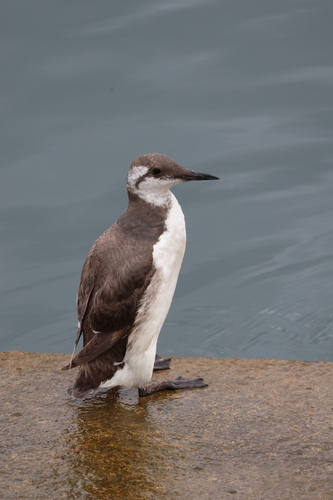 Common Guillemot
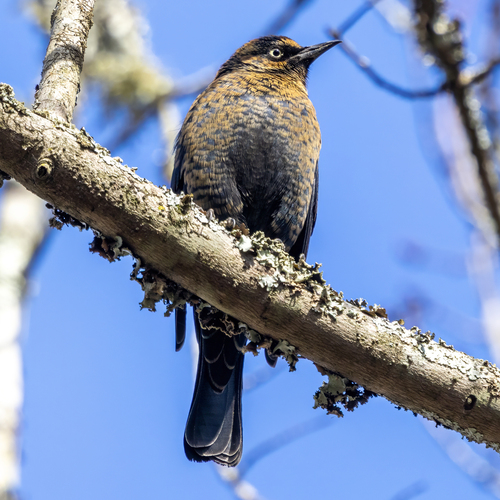 Rusty Blackbird
In short
The most reliable way to separate Common Guillemot from Rusty Blackbird is by overall structure and habitat: Guillemot is a heavy-bodied seabird with a sharp, dagger-like bill and short tail, usually seen on cliffs or at sea, while Rusty Blackbird is a slender, land-based songbird with a pointed but thinner bill and a pale yellow eye, often found in wet woodlands or near water inland. In flight, Guillemot shows narrow, pointed wings and a white belly, while Rusty Blackbird has broader wings and a more uniform dark appearance with a paler eye. Seasonal plumage changes can be confusing for both species, but the Guillemot never shows the rusty tones or pale eye of the blackbird. If you see a bird with a white underbody and dark upperparts on the water or cliffs, it's a Guillemot; if it's foraging in a wet woodland or flocking with other blackbirds, it's a Rusty Blackbird.
Identification tips
- Habitat is often decisive: Guillemot is marine/coastal, Rusty Blackbird is inland in wet woods or fields. If you see a bird away from the sea, it's almost certainly not a Guillemot.
- Body size and shape: Guillemot is much larger and heavier, with a thickset body and short tail; Rusty Blackbird is slim and much smaller.
- Bill structure: Guillemot has a long, thin, dagger-like bill; Rusty Blackbird's bill is pointed but shorter, thinner, and more typical of a songbird.
- Leg color: Guillemot's legs are dark grey to black; Rusty Blackbird's leg color is not diagnostic, but never as heavy or set far back as Guillemot's.
- Eye color: Rusty Blackbird always has a pale yellow eye (adult), which stands out at a distance; Guillemot's eye is dark, never pale.
- Plumage contrast: Guillemot shows sharp black (or brown) upperparts and white underparts, especially in breeding season; Rusty Blackbird is all dark or rusty-edged, never sharply bicolored.
- Winter plumage: Guillemot's face turns white with a dark spur, but the body remains black above and white below; Rusty Blackbird develops extensive rusty feather edges and always keeps the pale eye.
- Bridled Guillemot confusion: Some Guillemots show a white eye-ring and line, but the iris is still dark, and the bird is always much bulkier than any blackbird.
- Flight style: Guillemot flies with rapid, whirring wingbeats and looks heavy, often low over the water; Rusty Blackbird has a more typical blackbird flight, with bursts of flapping and gliding, and is lighter on the wing.
- Perched posture: Guillemot stands upright, penguin-like, especially on cliffs; Rusty Blackbird perches horizontally on branches or wires.
- Flocking: Guillemot is colonial only at breeding sites, otherwise solitary or in small groups at sea; Rusty Blackbird often flocks with other blackbirds and starlings, especially in winter.
- Vocalizations: Guillemot's call is a deep growl, Rusty Blackbird gives high squeaks and gurgles; if you hear a musical or squeaky song, it's not a Guillemot.
- Juvenile confusion: Young Guillemots resemble adults in winter, with white faces and dark spurs, but never show the rusty tones or pale eye of young or adult Rusty Blackbird.
- Feeding behavior: Guillemot dives underwater for fish, often seen surfacing at sea; Rusty Blackbird probes mud or shallow water for invertebrates, never dives.
- Context clues: If you're scanning a sea cliff or ocean, expect Guillemot; if you're in a swamp, wet woodland, or field with blackbirds, expect Rusty Blackbird.
Size
Common Guillemot is much larger and heavier than Rusty Blackbird. Guillemot measures 38–46 cm in length and weighs 775–1,250 g ([wikipedia]), making it a bulky seabird. Rusty Blackbird is a medium-sized songbird, weighing only about 60 g ([wikidata]), and is much slimmer and lighter. Even at a distance, Guillemot's size and chunky build are apparent compared to the much smaller, more delicate Rusty Blackbird.
Plumage
-
Juvenile/First-winter/Immature: No distinctive upperwing pattern is described for either species at these ages; both have similar upperwing color to adults, but Guillemot juveniles and first-winter birds resemble adult winter plumage, with white faces and dark spurs behind the eye. Rusty Blackbird juveniles are not described in detail, but adults in winter show strong rusty edges to the feathers, especially on the back and flanks, and always have a pale yellow eye.
-
Adult Breeding: Guillemot is black (or dark brown in southern populations) above and white below, with a sharp contrast between the two; the face is entirely dark. Rusty Blackbird males are glossy black with green and purple sheen, females are greyer, and both have a pale yellow eye. The blackbird never shows the sharp black-and-white contrast or the white underparts of the Guillemot.
-
Adult Non-breeding/Winter: Guillemot's face turns white with a dark spur behind the eye, but the rest of the upperparts remain dark and the underparts white. Some Guillemots show a white eye-ring and line ('bridled' morph), but never a pale iris. Rusty Blackbird in winter is dark with extensive rusty feather edges and always a pale yellow eye. The rusty tones and pale eye are never seen in Guillemot.
Behaviour
Common Guillemot spends almost all of its life at sea, coming to land only to breed on rocky cliffs or islands, where it nests in dense colonies. It dives for fish and is rarely seen inland or away from water. Rusty Blackbird is a terrestrial forager, often seen walking on wet ground or in shallow water, feeding on insects and seeds, and is usually found in small flocks, sometimes with other blackbirds. Guillemot's behavior is more penguin-like, with upright posture and awkward walking on land, while Rusty Blackbird moves more like a typical blackbird, perching in trees and foraging on the ground.
Habitat
Guillemot is strictly marine, breeding on sea cliffs and spending the rest of the year far out at sea. It is never found inland away from large bodies of water. Rusty Blackbird breeds in boreal forests and muskeg, winters in wet woodlands, swamps, and flooded fields, and is found far from the ocean. If you see a bird in a forest, marsh, or field, it's a Rusty Blackbird; if it's on a sea cliff or bobbing on the ocean, it's a Guillemot.
Voice
Guillemot's main call is a deep, growling "murrrr," especially loud at colonies, and chicks give a high-pitched whistle. Rusty Blackbird is quieter in winter but sings a mix of gurgling and high-pitched squeaks in spring. The two sound nothing alike: Guillemot is low and harsh, Rusty Blackbird is higher-pitched and more musical.