
Common Chaffinch vs Hawfinch
Fringilla coelebs versus Coccothraustes coccothraustes
Play a quiz with Common Chaffinch and Hawfinch
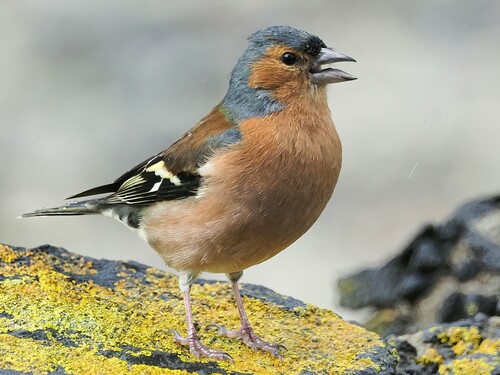 Common Chaffinch
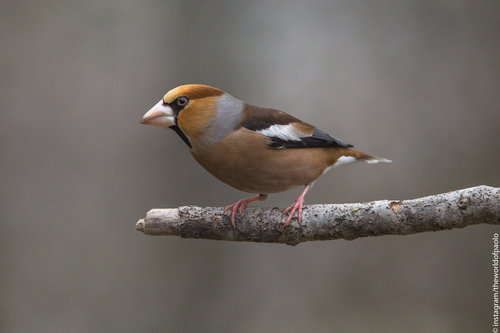 Hawfinch
In short
The most reliable field mark between Common Chaffinch and Hawfinch is the bill: Hawfinch has a massive, bull-headed, conical bill, while Chaffinch’s bill is much slimmer and more typical of small finches. In flight, Hawfinch appears very short-tailed and bulky, with striking white wing bars and tail tip, whereas Chaffinch shows two crisp white wing bars and white tail sides but is more slender and longer-tailed. Adult male Chaffinches are brightly colored with a blue-grey cap and rusty underparts, but females and juveniles are much duller and can be confused with Hawfinch at a distance. Both species have white in the wings, but the pattern and structure are quite different. Careful attention to bill size, head shape, and flight silhouette will resolve most confusion, especially in dull-plumaged or immature birds.
Identification tips
- Bill size and shape: Hawfinch has a massive, bull-headed, conical bill, much larger and thicker than Chaffinch’s slender finch bill. This is the single most reliable structural difference at any distance or angle.
- Head and neck structure: Hawfinch appears bull-necked and big-headed, with a steep forehead and thick neck; Chaffinch is more streamlined and small-headed.
- Tail shape and length: In flight, Hawfinch looks very short-tailed and compact, while Chaffinch has a longer, more tapered tail with obvious white sides.
- Wing pattern in flight: Chaffinch (all ages) shows two crisp white wing bars and white tail sides; Hawfinch has a single broad white wing patch and a white tail tip, with less obvious tail sides.
- Adult male plumage: Chaffinch males are unmistakable with blue-grey cap, black forehead, and rich rust-red underparts; Hawfinch is more uniform brown with orange head and black bib/eye-stripe.
- Female and juvenile confusion: Both can be dull brown, but Chaffinch still shows two neat white wing bars and a slimmer bill; Hawfinch’s bill is always thick, and the wing patch is blockier.
- Flight silhouette: Hawfinch is heavy, short-tailed, and bull-headed in flight; Chaffinch is slimmer, longer-tailed, and more agile.
- Leg color: Hawfinch has short, pinkish legs; Chaffinch’s legs are grey-brown, but this is rarely diagnostic in the field.
- Bill color by season: Hawfinch’s bill is black in summer, paler in winter; Chaffinch’s bill is pale grey in winter, bluish-grey in spring, but bill size is a much better separator.
- Habitat context: In gardens, farmland, or open country, expect Chaffinch; Hawfinch is almost always in mature woodland or large parks with big trees.
- Behavior: Chaffinch is more active and often on the ground; Hawfinch is more secretive, often high in trees or perched quietly.
- Vocalizations: Chaffinch gives a sharp 'pink' call and cheerful song; Hawfinch’s call is a hard 'chick', and its song is quiet and rarely heard.
- Relative abundance: Chaffinch is common and widespread; Hawfinch is scarce and local in most areas, so default to Chaffinch unless you have strong evidence for Hawfinch.
- Mixed flocks: If you see a group, especially on the ground, they are almost certainly Chaffinches; Hawfinches rarely form large flocks and are more solitary.
- When in doubt: Focus on bill size and head shape first, then check wing and tail patterns in flight. If the bird looks bull-headed and massive-billed, it’s a Hawfinch; if it’s slim-billed and shows two white wing bars, it’s a Chaffinch.
Size
Hawfinch is substantially larger and heavier than Common Chaffinch. Chaffinch averages 22 g in mass and is about 14.5 cm long with a wingspan of 24.5–28.5 cm. Hawfinch is much more robust, weighing 46–70 g, with a length of 16.5–18 cm and a wingspan of 29–33 cm. In the field, Hawfinch looks noticeably bulkier, with a thick neck and large head, while Chaffinch is more delicate and slender. The size difference is especially obvious if both species are seen together, but can be underestimated at a distance or without direct comparison.
Plumage
- Juveniles and females: Both species have duller, brownish plumage, but Chaffinch juveniles and females show two clear white wing bars and white tail sides, while Hawfinch has a single strong white wing patch and white tail tip. Chaffinch’s wing bars are more linear and crisp, whereas Hawfinch’s wing patch is broader and more blocky.
- Adult males: Chaffinch males are brightly colored with a blue-grey cap, black forehead, and rich rust-red underparts, while Hawfinch of both sexes is overall light brown with an orange-brown head, black bib and eye-stripe, and a gray nape. Hawfinch’s wings are deep black above with white, brown, and blue stripes, but the overall effect is more muted than the Chaffinch’s bright contrasts.
- Flight views: Chaffinch shows a slimmer, longer-tailed profile with two white wing bars and white tail sides; Hawfinch appears short-tailed and bull-headed, with a broad white wing patch and white tail tip. Both have white in the wings, but the shape and placement are different.
- Seasonal changes: Chaffinch males become brighter in spring as feather tips wear off, while Hawfinch’s bill color changes from pale in winter to black in summer, but overall body plumage is similar year-round.
Behaviour
Chaffinch is an active, agile bird, often seen feeding on the ground or flitting through trees and bushes, sometimes in mixed flocks. Hawfinch is more secretive and usually seen singly or in small groups, often high in the canopy or perched quietly. In flight, Chaffinch is bouncy and direct, while Hawfinch looks heavy, with slow, powerful wingbeats and a noticeably short tail. Hawfinch’s movements are more deliberate and less restless than Chaffinch.
Habitat
Both species can occur in woodland and parkland, but Chaffinch is much more widespread and adaptable, found in a wide range of habitats including gardens, hedgerows, and open countryside. Hawfinch is more specialized, favoring mature deciduous or mixed woodland with large trees, especially hornbeam, and is less likely to be seen in open or urban areas. If you’re in a garden or farmland, Chaffinch is far more likely; Hawfinch is usually restricted to well-wooded areas.
Voice
Chaffinch has a familiar, cheerful song and a sharp, metallic 'pink' call. Hawfinch’s call is a hard, explosive 'chick', and its song is quiet and mumbled, often going unnoticed. In mixed flocks or when birds are hidden, the difference in call notes can be useful: Chaffinch’s call is higher-pitched and more ringing, while Hawfinch’s is lower, harder, and more abrupt.