

Cinnamon-breasted Bunting vs Striolated Bunting
Emberiza tahapisi versus Emberiza striolata
Play a quiz with Cinnamon-breasted Bunting and Striolated Bunting
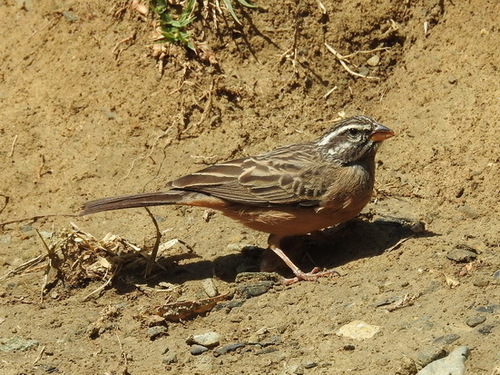 Cinnamon-breasted Bunting
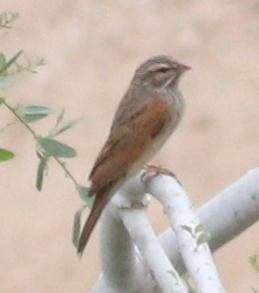 Striolated Bunting
In short
The most reliable field mark between Cinnamon-breasted Bunting and Striolated Bunting is the color and pattern of the underparts and head: Cinnamon-breasted Bunting shows rich cinnamon underparts and a boldly striped head (especially in males), while Striolated Bunting has a paler belly and a greyer, more streaked head with a clear white supercilium and moustachial stripe. Juveniles and females of both species are duller, but Cinnamon-breasted Bunting juveniles retain a buffier, paler throat and less crisp head stripes. Both are similar in size and structure, so careful attention to head and underpart coloration is key. Voice and behavior offer secondary clues but are less distinctive in the field.
Identification tips
- Underpart Color: Cinnamon-breasted Bunting always shows rich cinnamon brown underparts, while Striolated Bunting has a paler belly. This is the most reliable field mark in all plumages.
- Head Pattern (Males): Cinnamon-breasted Bunting males have bold black and white head stripes and a solid black throat patch. Striolated Bunting males have a grey head with dark streaks, a white supercilium and moustachial stripe, and no solid black throat.
- Head Pattern (Females/Juveniles): Cinnamon-breasted Bunting females and juveniles have browner, less crisp head stripes and a paler, blotched or buffy throat. Striolated Bunting females and juveniles have a greyer head with brownish tones, more diffused streaking, and a white supercilium/moustachial stripe.
- Throat Patch: Only Cinnamon-breasted Bunting males show a solid black throat patch. Females and juveniles have a smaller, blotched, or pale throat. Striolated Bunting never shows a solid black throat patch.
- Facial Stripes: Striolated Bunting has a cleaner, whiter supercilium and moustachial stripe, set against a greyer head, while Cinnamon-breasted Bunting's stripes are more brownish in females and juveniles.
- Belly Contrast: In Striolated Bunting, the belly is noticeably paler than the chestnut flanks and breast; in Cinnamon-breasted Bunting, the cinnamon color is more uniform across the underparts.
- Song: Cinnamon-breasted Bunting gives rapid, high-pitched trills ending in a whistle; Striolated Bunting's song is weaker, more chaffinch-like, and less trilled. Use with caution unless familiar with both.
- Behavior: Both species flick the tail, but this is not diagnostic. Both sing from perches and forage on the ground.
- Size and Structure: Both are similar in size and shape; do not rely on size for separation.
- Flight Views: No distinctive upperwing or flight pattern differences are described for either species; focus on head and underpart color if seen in flight.
- Sex Differences: Male Cinnamon-breasted Buntings are more strikingly marked than females; Striolated Bunting shows less sexual dimorphism but males are still more crisply marked.
- Juvenile Pitfalls: Juvenile Cinnamon-breasted Buntings can appear dull and may be confused with Striolated Bunting, but look for the buffier head stripes and paler, browner throat.
- Habitat: Overlap is possible; do not use habitat alone for identification.
- Group Size: Both species may flock, but Cinnamon-breasted Bunting is more often seen in small groups or pairs; this is not diagnostic.
- Local Abundance: Check local eBird reports for abundance, but do not use as a primary field mark.
Size
Both species are nearly identical in size, with Cinnamon-breasted Bunting averaging about 14.8g and 13–15 cm in length, and Striolated Bunting at 14 cm. There is no practical size difference in the field; structure and jizz are also similar, with neither species showing a distinctly longer tail or bill.
Plumage
- Juveniles and Females: Cinnamon-breasted Bunting juveniles and females have buffier, paler head stripes and a paler, browner throat compared to adults. The head stripes are less crisp and more brownish than in males. In contrast, Striolated Bunting females and juveniles have a greyer head with brownish tones and more diffused streaking, plus a white supercilium and moustachial stripe that remains visible but less bold than in males.
- Adult Males: Cinnamon-breasted Bunting males show black and white striped heads and a uniform black throat patch, with rich cinnamon brown underparts. Striolated Bunting males have a grey head with dark streaks, a prominent white supercilium and moustachial stripe, and a chestnut body but a paler belly than Cinnamon-breasted Bunting.
- Underparts: Cinnamon-breasted Bunting is always more richly cinnamon below, while Striolated Bunting is paler on the belly, even in breeding males.
- Head Pattern: Cinnamon-breasted Bunting's head stripes are bolder and more contrasting in males, while Striolated Bunting's facial stripes (supercilium and moustachial) are cleaner and whiter, set against a greyer background.
- Throat: Cinnamon-breasted Bunting males have a solid black throat patch; females and juveniles have a smaller, blotched, or paler throat. Striolated Bunting lacks a solid black throat patch, instead showing streaking or mottling.
Behaviour
Both species are ground-foraging buntings that may be seen singly, in pairs, or small groups. Cinnamon-breasted Bunting is noted for tail-flicking while hopping, which is typical for Emberiza buntings. Courtship and aggression behaviors are not reliably separable in the field. Both often sing from elevated perches such as rocks or bushes.
Habitat
Both species occupy dry, rocky, or semi-arid habitats, often with scattered bushes or trees. Cinnamon-breasted Bunting is widespread in sub-Saharan Africa, while Striolated Bunting's range is more to the north and east (not detailed in the provided notes). Habitat overlap is possible in some regions, so habitat alone is not diagnostic.
Voice
Cinnamon-breasted Bunting gives short, high-pitched, rapid trills, with songs ending in a characteristic final whistle. Striolated Bunting's song is similar to but weaker than that of the common chaffinch, and is delivered from a perch. In practice, both species' songs are variable and not always easy to separate by ear, but Cinnamon-breasted Bunting's song is generally faster and more trilled.
Cinnamon-breasted Bunting · Striolated Bunting · My Tricky Birds